
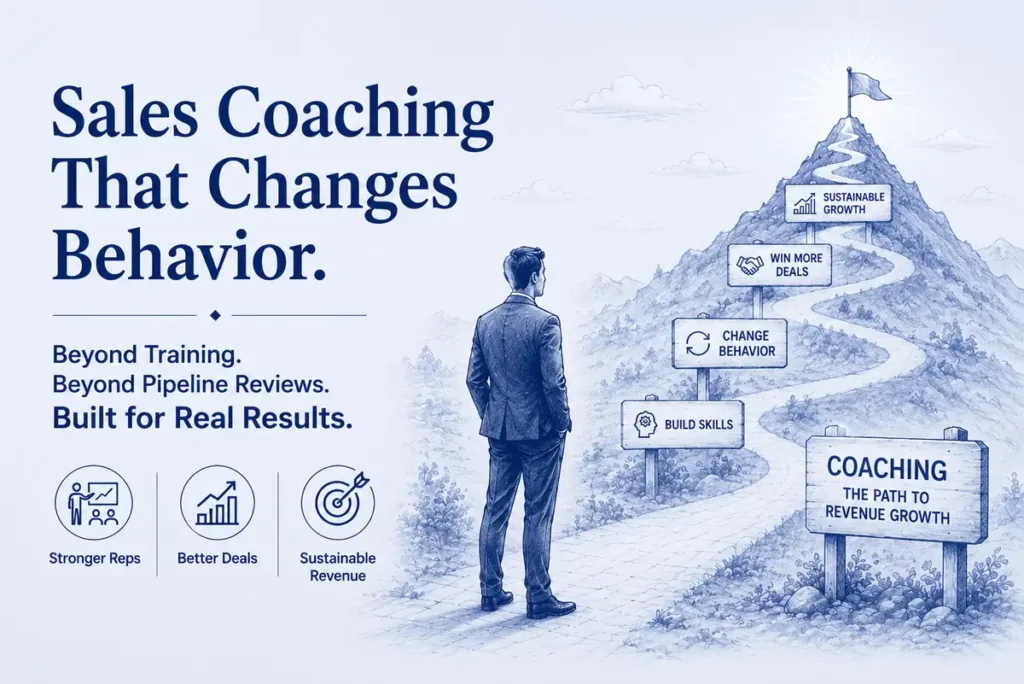
Marcus ran a sales team of eighteen reps at a 1,400 employee software company, and every Friday for two years he did what he called coaching: a thirty minute call with each rep walking through their top three deals. What stage is this at? When do you think it closes? What do you need from me? He asked good questions. His reps answered them accurately. Win rates had not moved in eighteen months.
Marcus was not coaching. He was inspecting. From the outside, the two look almost identical: a manager, a rep, a deal, a conversation. What was missing was the part that actually changes behavior.
Marcus blamed the reps for not applying what they had learned in last year’s training. HR blamed the training vendor for weak content. The reps blamed a tougher market. Nobody blamed the fact that reviewing a deal and coaching a rep are two different activities, and the company had only ever done the first one.
This is not a story about effort. Marcus worked harder on those Friday calls than almost anything else in his week. It is what happens when pipeline inspection gets mistaken for a sales coaching program, one of the most common and least visible failure points in B2B tech sales.
If your one-on-ones sound like status updates rather than skill development, you are running pipeline reviews with a coaching label on the calendar invite.
Pipeline reviews and real sales coaching look similar from a distance the way a chart review and an actual physical exam look similar. One tells you the patient’s current numbers. The other tells you what to actually do differently. Companies that only ever do the first one are always surprised when nothing changes.
Training and coaching both sit inside what is known internally as the Revenue Execution System, but they occupy different layers. Training belongs to the Build layer, teaching a team what good looks like. Coaching belongs to the Execute layer, converting that knowledge into behavior under the pressure of a live deal. Skipping from training straight to pipeline review skips the layer that actually determines whether anything changes.
Your Team Doesn’t Need More Training. It Needs Coaching That Sticks
Sales Mastery Program builds stage-specific selling capability, and pairs it with the coaching infrastructure that makes it stick. Free. 20 minutes. Get an instant report on where your team’s gaps actually are.
What Sales Coaching Really Means in IT/Software Sales
Sales coaching, in practical terms, is a manager working with an individual rep to identify a specific gap in how they sell and change it through repeated, guided practice on real opportunities. That definition sounds close to training and close to pipeline review, which is exactly why the three get confused constantly. Effective sales coaching for software companies in particular has to account for a sales coaching process that looks nothing like the generic version taught in most B2B sales coaching content online.
Training builds knowledge and skill at scale, usually for the whole team at once, usually before the skill is needed on a live deal. A pipeline review inspects the current state of opportunities: stage, close date, next step, forecast confidence. Coaching sits between them, taking a skill the rep already has some exposure to and building it into consistent behavior through observation, feedback, and practice tied to the rep’s own deals.
IT and software sales specifically need continuous coaching because the skill demands are unusually layered. A rep has to run technical discovery with an engineering buyer, translate that into a business case for an economic buyer, manage a multi-month evaluation cycle, and hold a room of stakeholders with different, sometimes conflicting priorities. Nobody learns that from a single workshop. It gets built rep by rep, deal by deal, through coaching focused on improving behavior, deal execution, and sales performance rather than one-time exposure to a framework.
Training Teaches. Pipeline Reviews Inspect. Coaching Changes Behavior
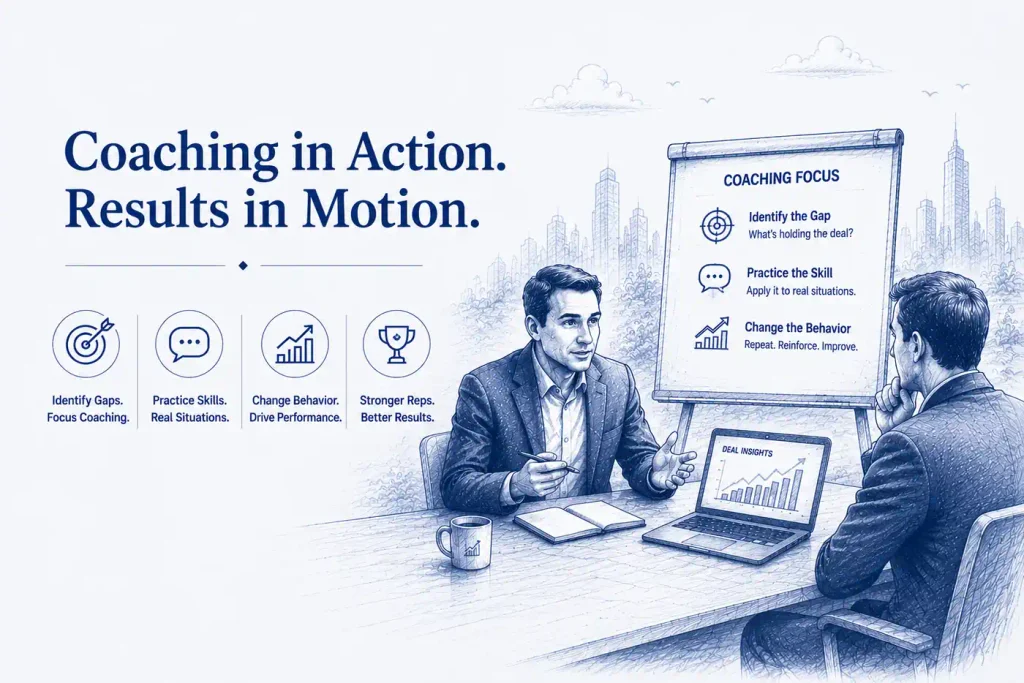
Each of these three activities has a distinct purpose, and treating them interchangeably is where most coaching programs quietly fail before they start.
Training builds knowledge and skills. It is where a rep first encounters a qualification framework, a discovery methodology, or an objection-handling structure. Pipeline reviews inspect opportunities and forecast. They answer questions about where deals stand, not questions about whether the rep running them has the skill to move them forward. Coaching identifies performance gaps and changes rep behavior. It is the only one of the three that actually intervenes in how a specific person sells.
Pipeline inspection alone does not develop selling skills for a simple reason: asking someone what stage a deal is in does not teach them how to advance it. A manager can run a flawless pipeline review, correctly forecasting every deal in the funnel, and still never once address why a rep’s discovery calls consistently miss the economic buyer. Effective sales coaching lives in that gap, and most sales organizations have never actually operated there.
The Building Blocks of a Real Sales Coaching Program
A sales coaching program is not one activity. It is four connected disciplines, and removing any one of them collapses the whole structure.
Individual Performance Diagnosis
Coaching has to start by identifying each rep’s specific skill and performance gaps, not by applying identical coaching to everyone on the team. One rep might struggle with multi-stakeholder alignment while another closes fine but consistently underprices the deal in negotiation. A coaching program built around a single generic curriculum treats both reps the same way and improves neither.
Real Deal and Call Coaching
Coaching that happens on active opportunities and actual recorded sales conversations, not hypothetical scenarios, is what actually transfers. The coach examines what happened on a specific call, why it happened, and what the rep should do differently next time, using the rep’s own words and the buyer’s own objections as the material.
Role-Play and Deliberate Practice
Discovery, objection handling, demos, negotiation, and closing all benefit from deliberate practice using realistic IT and software sales situations before the rep faces the equivalent moment live. This is the step most coaching programs skip entirely, jumping from feedback straight back into the next live call with no rehearsal in between.
Continuous Feedback and Reinforcement
A single coaching conversation changes nothing on its own. Repeated feedback, reinforced across multiple deals until the new behavior becomes the rep’s default rather than something they have to consciously remember, is what separates coaching from a one-time correction.
What Happens Inside an Effective Sales Coaching Session?
A real coaching session follows a specific sequence, and skipping steps is usually where managers unintentionally slide back into pipeline inspection.
It starts by reviewing the specific performance issue rather than the deal generally, then examining the relevant call or opportunity where that issue actually showed up. The manager asks the rep to self-diagnose first, since a rep who can identify their own mistake retains the correction far better than one who is simply told. From there, the session identifies the precise behavior that needs to change, provides targeted coaching on that behavior specifically, and has the rep practice the improved approach before the conversation ends. The rep then applies it to a live opportunity, and the manager follows up on the actual result.
Compare that sequence to Marcus’s Friday calls. His conversations covered exactly none of those eight steps. They covered stage, close date, and next step, which is a complete pipeline review and an entirely absent coaching session, delivered in the same thirty minutes his team had been told was coaching for two straight years.
How Sales Coaching Goes Beyond Pipeline Reviews
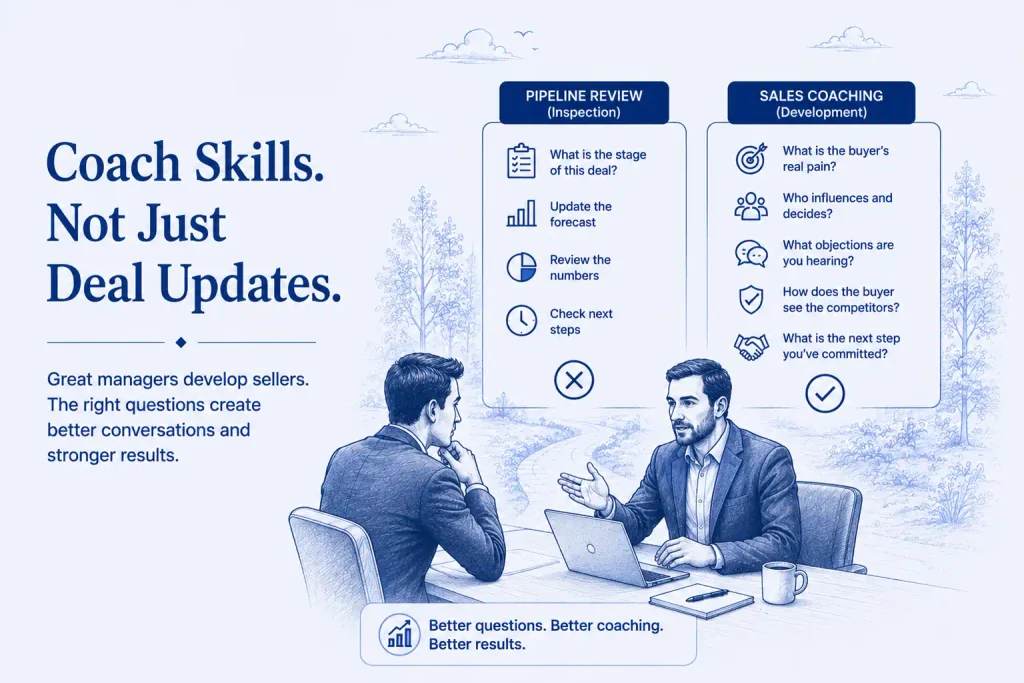
“What is the stage of this deal?” is not a coaching question. It is an inspection question, and answering it accurately requires no skill development on the rep’s part at all.
Real coaching questions probe discovery quality, the buyer’s actual pain and how well the rep understands it, the decision process and who genuinely controls it, stakeholder alignment across a multi-threaded buying committee, the objections the rep is actually hearing versus the ones they are prepared for, competitive pressure in the specific account, and whether the rep secured a real next-step commitment or just a polite acknowledgment. Each of those questions forces the rep to demonstrate understanding, not just recite a data point.
This is the shift from deal inspection to rep development, and it is the single clearest signal of whether a manager is running a sales coaching program or a status meeting wearing a coaching label.
What Should IT/Software Sales Reps Actually Be Coached On?
The specific skill areas that matter most in technology sales are discovery and problem diagnosis, selling business outcomes rather than product features, multi-stakeholder selling across technical and economic buyers, aligning a technical champion with a business decision maker, qualification discipline, objection handling under real pressure, demo effectiveness tied to what the buyer actually cares about, enterprise deal strategy for longer and more complex cycles, negotiation, and closing with genuine next-step control rather than a vague follow-up.
Coaching every rep on all ten areas at once produces the same dilution as generic training. Coaching each rep on the two or three areas where their specific gap actually sits, identified through diagnosis rather than assumption, is what makes a B2B tech sales process improve measurably instead of just feeling more active. This is what separates sales performance coaching from a generic skills refresher: it targets the specific sales skills each rep is missing, not the ones a curriculum happens to include.
Who Should Own the Sales Coaching Program?
Frontline sales managers own the day-to-day coaching relationship, because they are the ones in the room for calls and deal reviews on a weekly basis. Sales leadership owns the consistency of the program across managers, making sure one manager’s team is not getting rigorous coaching while another’s gets none at all. External sales coaches can add real value when they bring pattern recognition across many teams and technology categories that an internal manager, coaching for the first time, simply has not built yet.
Coaching should not depend only on occasional external training days, because a two-day workshop delivered once a year cannot produce the repetition that changes behavior. Tech sales training that never gets reinforced through ongoing coaching decays within weeks, regardless of how well the workshop itself was designed. Consistency between managers, reps, and leadership, all operating from the same definition of what coaching actually is, matters more than which specific person delivers it.
How to Build a Sales Coaching Cadence That Actually Works
A coaching cadence that works includes weekly individual coaching sessions, regular deal coaching tied to specific active opportunities, call reviews using real recorded conversations, dedicated role-play sessions for upcoming high-stakes calls, monthly skill-gap and performance reviews to check whether the coaching focus needs to shift, and ongoing reinforcement rather than a one-time intervention when a rep first shows a gap. These sales coaching strategies only work when they run on a fixed schedule rather than whenever a manager happens to find time.
Consistency matters more than occasional intensive training for the same reason physical conditioning matters more than one hard workout. A single excellent coaching session, delivered once and never repeated, produces a brief improvement that fades within weeks. A modest coaching cadence, repeated every week for a quarter, produces durable behavior change because the rep’s brain treats the new approach as normal rather than as an exception to remember.
How to Measure Whether Sales Coaching Is Working
Behavioral indicators show up before revenue numbers do, and they are worth tracking on their own. Better discovery, improved qualification discipline, stronger deal control, and more confident objection handling are all observable within a handful of coached calls, well before they show up in a quarterly report.
Sales performance indicators confirm whether those behavioral changes are actually converting into results: win rate, conversion rates by stage, sales cycle length, average deal value, pipeline progression, and quota attainment. Coaching hours logged or session attendance are not meaningful success metrics on their own, since a rep can sit through every scheduled coaching session and still show zero behavioral change if the sessions themselves were pipeline reviews in disguise. The metric that matters is whether the coached behavior actually shows up in the next live deal.
What a Real Sales Coaching Program Should NOT Look Like
Generic training delivered once or twice a year is not a coaching program. Calling pipeline inspection coaching, as Marcus did for two years, is not a coaching program. Giving every rep identical coaching regardless of their specific gap is not a coaching program, and neither is giving advice without ever having the rep practice it before their next live call.
Coaching only when performance drops turns coaching into damage control instead of ongoing development, which means the best reps, the ones who could improve fastest with real attention, get almost none of it. Focusing on activity metrics like call volume instead of behavior and outcomes measures effort without ever confirming it changed anything. And stopping coaching the moment short-term improvement appears is how a temporary uptick quietly reverts to baseline within a quarter, because the reinforcement that made the improvement durable never continued.
How TALSMART Builds Sales Coaching Around Revenue Performance
Sales coaching, done well, starts by identifying the specific sales and revenue execution gaps a team actually has, not by delivering a standard curriculum and hoping it applies broadly enough to matter.
That means connecting coaching directly to rep behavior, deal execution, and revenue performance rather than treating it as a soft skill exercise disconnected from the number. Diagnosis, coaching, practice, and measurement work together as one continuous cycle rather than four separate initiatives run by different teams on different schedules. Coaching built this way is based on the team’s actual performance gaps rather than a generic training calendar, and it connects directly to the broader Revenue Execution System, sitting specifically at the Execute layer where knowledge either becomes behavior or quietly evaporates.
Find the Sales Gaps Holding Your Team Back
The Revenue-Gap Diagnostic identifies exactly which stage and which reps need coaching, before you spend another quarter guessing. Free. 20 minutes. Get an instant report.
What a Real Sales Coaching Program Looks Like: A Practical Framework
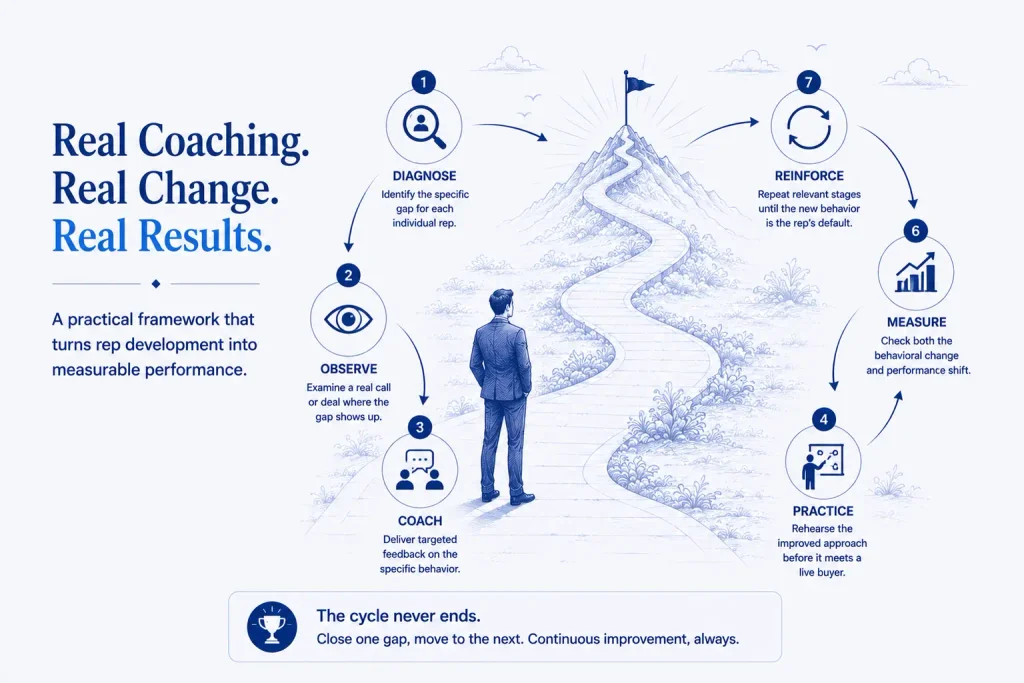
Diagnose, Observe, Coach, Practice, Apply, Measure, Reinforce. Seven stages, running as a continuous cycle rather than a one-time sequence.
Diagnose identifies the specific gap for each individual rep. Observe examines a real call or deal where that gap actually shows up. The coach delivers targeted feedback on the specific behavior, not general encouragement. Practice rehearses the improved approach before it meets a live buyer. Apply puts the rehearsed behavior into an actual opportunity. Measure checks both the behavioral change and the resulting performance shift. Reinforce repeats the relevant stages until the new behavior is the rep’s default, not an exception they have to consciously remember.
This cycle creates continuous improvement instead of one-time learning because it never actually ends. A rep who has closed their discovery gap moves to the next identified gap, and the cycle runs again. Each stage connects to measurable sales performance rather than a completion certificate, which is the structural difference between a sales coaching program and a training event with a coaching label attached.
Training vs. Pipeline Review vs. Coaching
| Dimension | Training | Pipeline Review | Coaching |
|---|---|---|---|
| Primary purpose | Builds knowledge and skill | Inspects deal status and forecast | Changes rep behavior |
| Frequency | Occasional, often annual | Weekly or biweekly | Continuous, tied to live deals |
| Focus | The whole team, generic content | The deal | The individual rep’s specific gap |
| Output | Awareness of a framework | Forecast accuracy | Durable behavior change |
| Failure mode when treated as coaching | Knowledge decays without reinforcement | Confused with development, changes nothing | N/A, this is the missing layer |
Every row in this table describes an activity most sales organizations already run. The failure is treating any one of the first two as a substitute for the third.
If recognizing your own Friday calls in that first row of the table feels uncomfortable, that is a useful signal, not a failure. It is usually the moment sales leaders stop scheduling more pipeline reviews and start building an actual sales coaching program instead.
Turn Sales Coaching Into a Revenue System
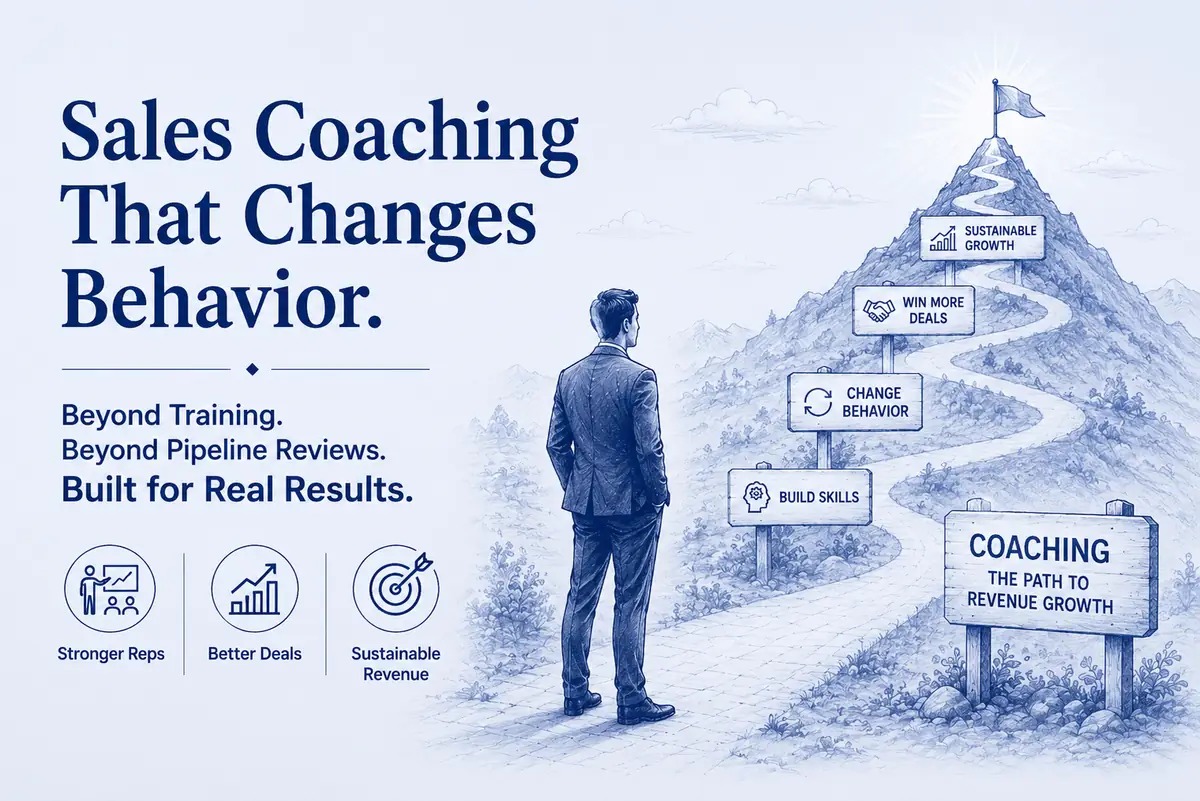
Training creates knowledge. Pipeline reviews create visibility. Coaching develops the behaviors that actually improve sales execution. Confusing any two of these for the third is how a company can run a full calendar of sales activity and still see the same win rate a year later.
Before choosing a coaching program, a training vendor, or a new curriculum, identify the team’s actual performance gaps first. Effective coaching connects directly to stronger execution and, eventually, to the revenue growth a generic training refresh never reliably produces on its own.
Identify the Sales Gaps Holding Your Team Back
Find out exactly where coaching will move the number, before you invest in another training program. Free. 20 minutes. Get an instant report.
TALSMART is a global revenue execution partner for B2B technology companies, operating across 100 + countries and 23 languages.
Frequently Asked Questions
What is a sales coaching program?
A sales coaching program is a structured, ongoing process where managers identify each rep’s specific skill and performance gaps, then work with them individually through observation, feedback, and practice on real deals until the improved behavior becomes consistent. It is distinct from training, which builds knowledge at scale, and from pipeline reviews, which inspect deal status.
What is the difference between sales training and sales coaching?
Sales training and coaching serve different functions. Training teaches a skill or framework, typically to the whole team at once. Coaching takes that skill and builds it into consistent behavior for an individual rep through repeated practice on their own deals. Training without coaching produces reps who can describe the right approach but do not reliably use it under pressure.
How often should sales reps receive coaching?
Effective sales coaching is weekly at minimum, tied to active opportunities rather than delivered as an occasional event. Consistency matters more than intensity. A modest weekly cadence sustained over a quarter produces more durable behavior change than an intensive session delivered once and not repeated.
What should sales managers coach their teams on?
Managers should coach on the specific gap each rep actually has, identified through diagnosis rather than assumption. Common focus areas in B2B tech sales include discovery quality, multi-stakeholder alignment, objection handling, demo effectiveness, and negotiation, but the right focus for any individual rep depends on where their specific performance is breaking down.
How do you measure sales coaching effectiveness?
Track both behavioral indicators, such as improved discovery and stronger deal control, and sales performance indicators, such as win rate, conversion by stage, and quota attainment. Coaching hours or session attendance are not meaningful metrics on their own, since attendance does not confirm that behavior actually changed on the next live deal.
Is sales coaching effective for IT and software sales teams?
Yes, and arguably more necessary in IT and software sales than in most other industries, because the skill demands are unusually layered: technical discovery, multi-stakeholder buying committees, and long evaluation cycles all require behavior that a single training event cannot reliably produce on its own.