

You ran the offsite. You brought in the trainer. You watched your team nod through every slide. And three months later, your pipeline still looks exactly the same.
That is not a motivation problem. It is a structural one. And the sales leaders who have genuinely cracked this are not doing anything exotic. They are doing a handful of specific things with real discipline, and the results compound because of it.
Forbes recently gathered insight from the people building and leading high-performing sales organisations. What came back was not a new framework or a trending methodology. It was a set of practices grounded in how people actually learn, apply, and retain what they are taught.
This article breaks down what those leaders said, why it works, and what it means for the way you build your sales organisation right now.
The Single Biggest Mistake in Sales Training: Going It Alone
The first thing Forbes leaders said, almost universally, was this: stop asking new reps to learn in isolation.
Pairing new hires with experienced sellers is not a new idea. But the way most organisations do it, if they do it at all, is too passive. A brief introduction. A few joint calls. Then the new rep is left to navigate the rest themselves.
The leaders in this research were describing something different. Structured shadowing. Deliberate pairing. Intentional time where a new rep watches, asks, debriefs, and begins to absorb not just what top performers do, but how they think.
The insight here is not about mentorship as a concept. It is about transfer. The knowledge, instinct, and judgement sitting inside your top performers does not move to the rest of your team through a training deck. It moves through proximity, observation, and repeated exposure to how elite sellers operate in real situations.
This is one of the core structural gaps in most B2B tech sales organisations. Top performer behaviour lives in their heads, not in the system. When that rep moves on, the revenue moves with them. A revenue organisation dependent on a few heroic individuals is not a sales team. It is a liability.
The fastest way to transfer winning behaviour is not a training programme. It is proximity to someone doing it well, structured and repeated until it becomes instinct.
Real Scenarios Over Slides: Why Case Studies Change Everything
The second consistent theme from Forbes leaders was the power of real-life case studies in training environments.
Abstract sales principles are easy to understand and difficult to apply. When a rep learns a technique in theory, they can recall it in a quiz. When they learn it through a real situation, a lost deal, a tough negotiation, a buyer who changed their mind at the last moment, they recognise that pattern when it shows up in their own pipeline.
The most effective training rooms were not teaching what to do. They were teaching how to read situations. How to know which stage you are actually at, what the buyer is really weighing up, and what the right next move is when the deal is not going to plan.
This matters especially in B2B tech sales. Multi-stakeholder deals, long cycles, procurement complexity. No two situations unfold the same way. Reps who can only apply a script will keep hitting walls. Reps who understand the underlying dynamics will find a way through.
Worth asking honestly: when your team reviews a lost deal, are they diagnosing what actually went wrong at each stage? Or are they moving on without extracting the learning?
Not Sure Where Your Team Is Losing Deals?The Revenue Gap Diagnostic maps exactly where your team loses across all five deal stages and benchmarks them against the top 4% of B2B tech sales professionals. Start the Free Diagnostic →
Hearing Your Own Calls: The Uncomfortable Training Tool That Actually Works
Several Forbes leaders specifically mentioned call review as one of the most underused tools in sales training. Not just any calls. Your own calls, played back in a structured review with a coach or a peer.
There is something different about hearing yourself navigate a discovery call or a negotiation. You notice the moment you moved too fast. You catch the question you should have asked. You hear the point where the energy shifted, and you realise you missed it in real time.
This kind of review is uncomfortable. It is also exactly why it works. The learning sticks because it is tied to a real situation you experienced, not a hypothetical you observed. And when done consistently, it builds a self-awareness in your reps that no classroom session can replicate.
The leaders who got the most from this approach were not using it as a performance review tool. They were using it as a development tool. That distinction matters enormously for how your reps receive the feedback and whether the behaviour actually changes.
This is the difference between training as an event and coaching as an embedded system. One is forgotten within 90 days. The other compounds.
Skill development without feedback loops is just exposure. The loop is what makes learning compound.
Modelling Success Is Not Optional. It Is the Method.
Forbes leaders were consistent on this: past successes are not just motivational content. They are training material.
When a rep who closed a complex deal walks the team through exactly how it unfolded, the objections they faced, the internal champion they built, the moment the deal nearly fell apart and how they recovered, something transfers that a generic training scenario simply cannot produce. The team sees that it is possible. They see a real path. They see someone who looks like them doing it.
“Success breeds success” is a phrase used loosely. What Forbes leaders were describing is something more specific. When you systematically extract the decisions, moves, and mindset behind your best outcomes and make them teachable, you begin to install that pattern across more of your team.
This is the structural difference between a sales organisation that consistently produces results and one that relies on a handful of people carrying the number quarter after quarter. The Unified Revenue Execution System is built precisely to close this gap. It turns top performer behaviour from something that lives in one person’s head into something that runs as a system across your entire team.
The system that got you here is the exact thing preventing you from getting to the next stage. Winning behaviour has to be extracted, codified, and made teachable.
Customised Training Is Not a Luxury. It Is the Only Training That Compounds.
Multiple Forbes leaders raised this clearly: training that treats every rep the same produces average results across every rep.
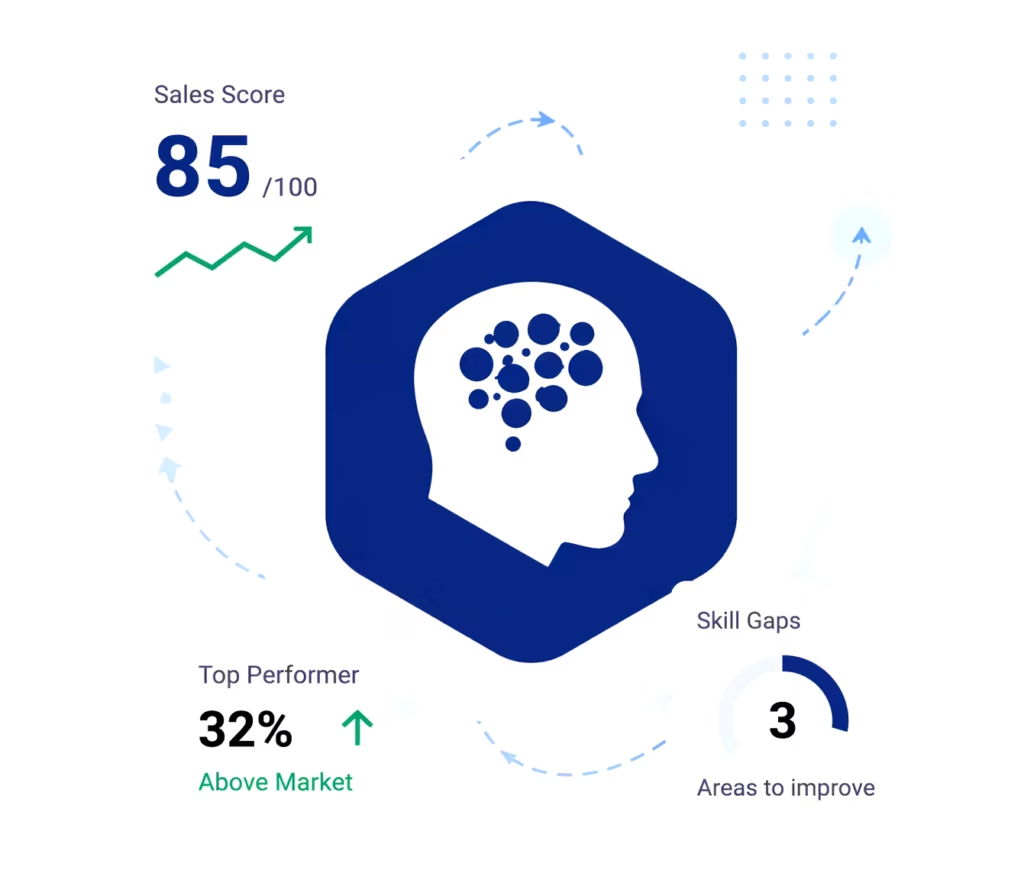
One leader mentioned having people take a personal assessment before any training programme begins. Not to rank them. To understand where each individual sits, what they are naturally strong at, and where their development needs to be concentrated.
This is the difference between training as an event and training as a system. When you know that one rep needs work on discovery and another needs work on negotiation, you can direct development precisely. You stop spending your most limited resource, your team’s time and attention, on things that will not move the needle for each individual.
Most B2B tech organisations run annual or quarterly training events and expect durable behaviour change. They rarely get it. 70% of reps revert to pre-training behaviour within 90 days without ongoing reinforcement. Not because the training was wrong. Because the system around it was not built to sustain it.
Customised training is also more likely to be taken seriously. Reps who receive development that clearly connects to where they are struggling today engage differently than reps sitting through a programme designed for someone else’s gap.
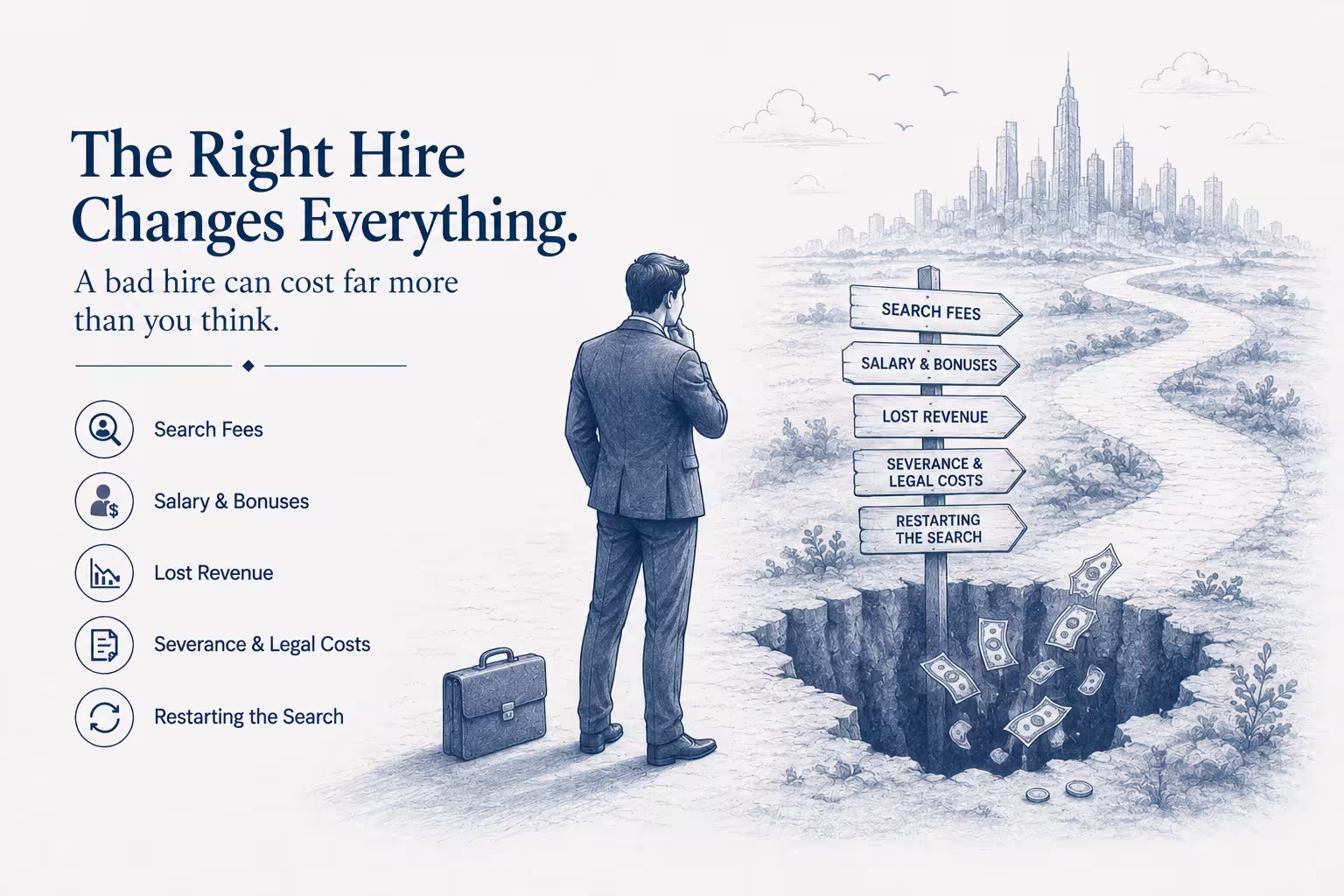
The most expensive training is the training that does not land. When development is built around diagnostic data rather than assumption, quota attainment is 2.1x higher.
Find Your Team’s Exact Gap
Free Revenue Gap Diagnostic. 20 minutes. Instant report. Benchmarks every rep against the top 4% of B2B tech sales professionals across all five stages of the deal cycle.
Short, Frequent, Applied: The Training Cadence That Actually Sticks
Forbes leaders also converged on format. Long, infrequent training events do not produce durable change. Short, repeated, applied learning sessions do.
The science behind this is not new. Information revisited at intervals sticks. Information delivered once in a long block fades. 87% of training content is forgotten within 30 days without reinforcement.
But frequency alone is not enough. The leaders who got lasting results were pairing short training sessions with immediate application. Not just ‘here is the technique’, but here is where you use it this week, and here is what you will report back on.
This is where most sales training programmes collapse. The session ends. The rep returns to their pipeline. There is no structure connecting what they learned to what they do next. And within 90 days, the numbers look the same as before.
The leaders who closed this gap were not running longer programmes. They were building reinforcement into the rhythm of how their teams worked. Coaching on live deals. Reviewing calls against what was covered in training. Making the skill visible in the moment it was needed, not just in a scheduled classroom block.
This is the third layer of the Unified Revenue Execution System. Embedded coaching is not a weekly 1:1 where managers review the CRM. It is a structured process where a coach works inside live deal reviews, call debriefs, and pipeline conversations to help reps apply what they have learned to real opportunities, in real time.
Training tells reps what good looks like. Coaching makes them do it under pressure, on live deals, until it becomes instinct.
Reserve a Spot in the 2026 Coaching Cohort
Embedded coaches inside your live deals. Two spots remaining. Skills compound when they are coached in the field, not just taught in a classroom.
Always-On Access: Making Knowledge Available When It Is Actually Needed
The final point from Forbes leaders was about availability. The best training programmes are not locked inside a two-day event or a quarterly review. They are accessible when a rep is preparing for a call, navigating a tough negotiation, or trying to recall how to handle a specific objection.
This does not require complex infrastructure. It requires intentional design. Training content that is searchable. Reference material that is short and specific. A coaching relationship where a rep can ask a question in the context of a real situation, not just in a scheduled session.
The reps who improve fastest are the ones who are hungry to get better. They do not want to wait for the next training cycle. They want the answer now, applied to what is in front of them. Building learning into the live selling environment is how you feed that hunger and convert it into compounding performance.
What This Means for Your Sales Organisation
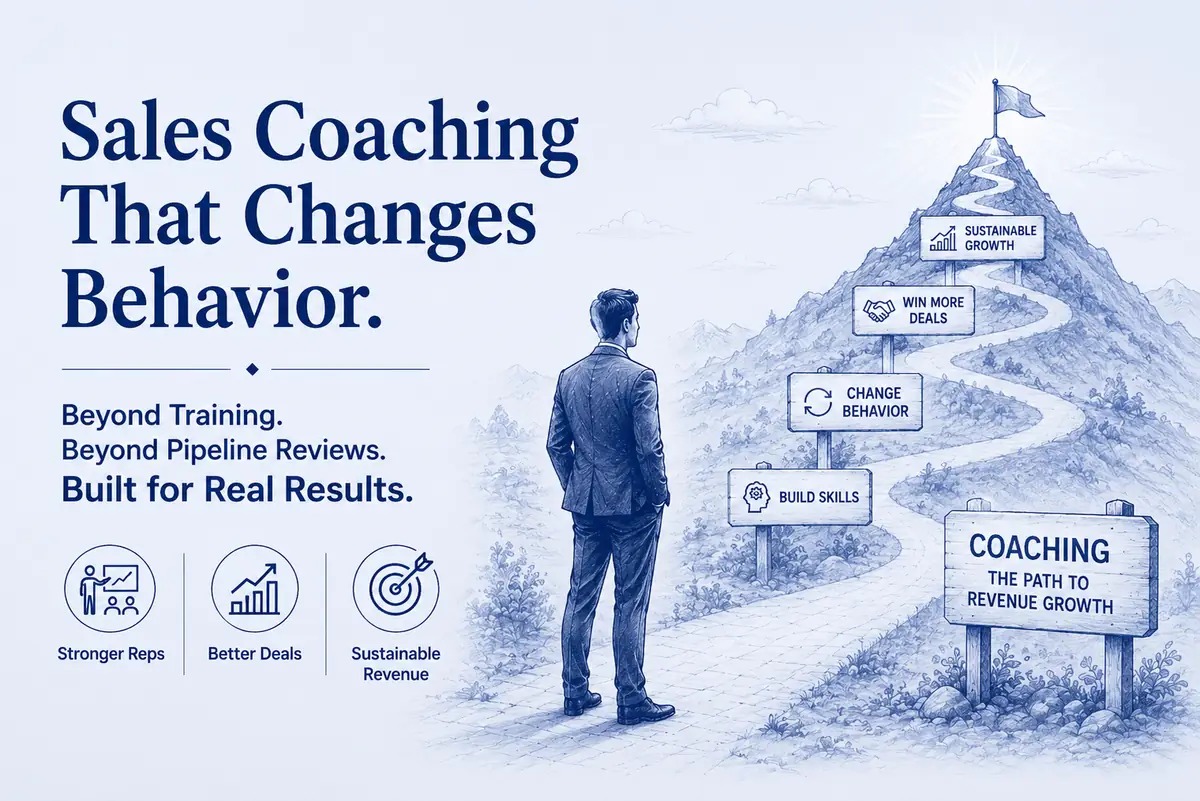
Looking across everything Forbes leaders shared, a clear picture emerges. The organisations producing consistent, scalable sales results are not running better training events. They are building better training systems.
The difference comes down to a few things:
- Transfer, not delivery. Top performer behaviour moves through proximity and structured shadowing, not through slides.
- Real situations, not theory. Case studies and call reviews build pattern recognition that abstract training cannot.
- Precision, not volume. Understanding where each rep has a gap and targeting development there produces 2.1x higher quota attainment.
- Reinforcement, not events. Short, frequent, applied training with coaching on live deals is the only cadence that produces durable change.
- Availability, not scheduling. The reps who improve fastest need access to learning in the moment, not just in a calendar block.
The gap between where your team is today and what is structurally possible is rarely about effort or talent. It is about whether the system you have built around your team is designed to produce and sustain the results you need, without depending on a handful of heroic reps to carry the number every quarter.
The Unified Revenue Execution System was built for exactly this. It connects four compounding layers: Diagnose, Build, Execute, Lead. Each layer makes the next more effective. Skip one and the system stalls.
Where to Go From Here
If you are leading a B2B tech sales organisation and any of these patterns feel familiar, the most useful next step is not another training programme. It is understanding exactly where in your deal cycle each rep is losing ground, and what it is costing you every quarter.
The Revenue Gap Diagnostic benchmarks your team against the top 4% of B2B tech sales professionals across all five stages of the deal cycle. It takes 20 minutes. The report lands in your hands instantly. It is the starting point for building a training and coaching system that actually compounds.
There is no CEO or head of sales who regrets building structure early. There are many who regret waiting.
Start the Revenue Gap Diagnostic
Free. 20 minutes. Instant report. Know exactly where your team stands before you decide what to build next. No pitch call attached.
TALSMART is a global revenue execution partner for B2B tech companies, operating across 100 countries and 23 languages. The Revenue Execution System is built exclusively for the complexity of enterprise technology sales.