
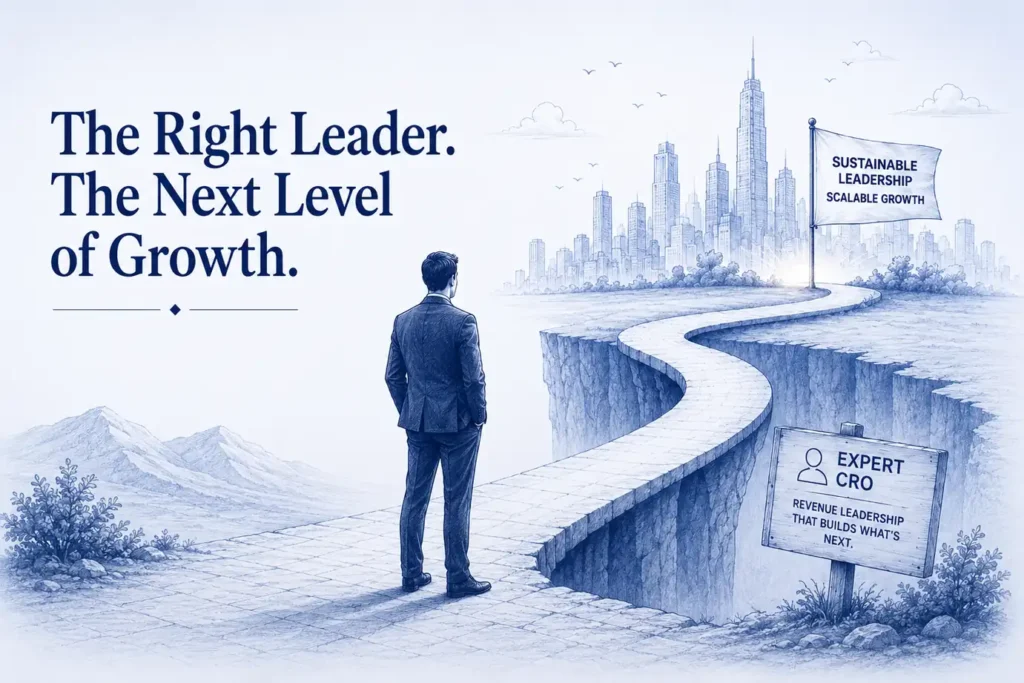
Priya’s tech company had just closed its Series B. The product was strong. The market opportunity was real. She had a VP Sales who had been with her since the early days and who had helped build the team from three reps to twenty-two. Revenue was growing. It just wasn’t growing predictably. Forecast accuracy was running at 61%. Marketing was generating leads that sales weren’t working. Customer success was losing accounts that sales had closed six months earlier.
At the board meeting, the question was not whether the company could grow. It was whether the structure underneath the company could sustain the growth that was coming.
Priya did not need a better VP Sales. She needed a different kind of leader entirely.
If you have watched your company grow in headcount but not in predictability, in pipeline activity but not in pipeline quality, in markets entered but not in margins sustained, the problem is probably not your VP Sales. It is the structural gap between managing sales and leading an entire revenue engine.
A VP Sales is like the captain of a ship. They navigate the vessel, manage the crew, and get to the destination. A CRO is like the architect of the fleet. They decide which ships get built, how they connect, where they go, and how they grow faster than the ones they are racing against. One role is about execution. The other is about architecture.
The Revenue Execution System (Diagnose, Build, Execute, Lead) is built for this distinction. The Lead layer exists specifically because execution alone cannot sustain growth beyond a certain scale. When the revenue engine becomes more complex than any single function can manage, the architecture needs a different kind of leader.
Not Sure Which Revenue Gap Is Holding Your Growth Back?
The Revenue Gap Diagnostic maps exactly where your sales system is breaking down before you hire anyone to fix it. Free. 20 minutes. Get An Instant Report.
Growth Problems Change as Companies Scale
The revenue challenges that matter at $2 million ARR are not the same ones that matter at $20 million, and they are nothing like the ones that define success at $50 million. At the earliest stage, the problem is usually the pipeline. Can the team generate enough qualified opportunities to sustain growth? At the next stage, the problem shifts to process. Is the sales motion repeatable enough to scale without depending on the same two or three people carrying the number?
By the time a tech company reaches mid-market scale, the problems have compounded. Sales, marketing, and customer success are running on separate metrics. The go-to-market strategy that worked at product-market fit is straining against a more complex customer base. The VP Sales who built the team through the early stages is now managing operations rather than building capability, because nobody has the bandwidth to do both.
A B2B tech sales strategy built entirely around sales execution works until the revenue engine becomes too complex for one function to manage. That point arrives sooner than most founders expect, and it usually announces itself through the exact symptoms described in this article.
What Makes an Expert CRO Different From a Traditional Sales Leader?
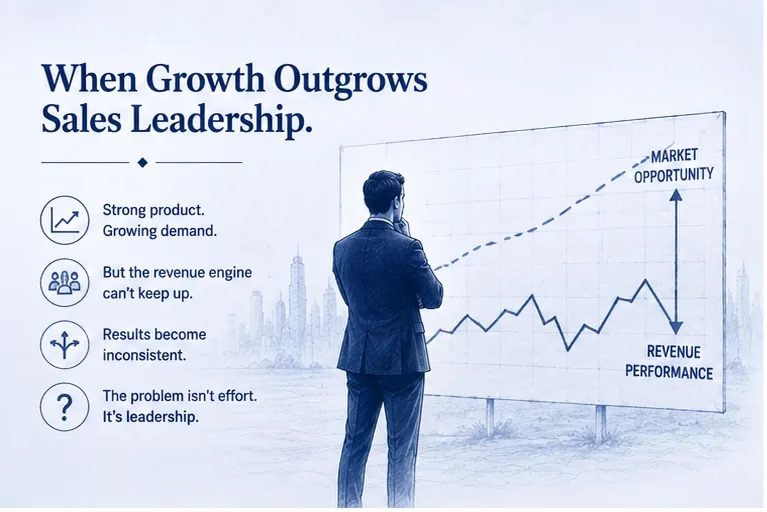
A traditional sales leader owns the pipeline and the quota. An expert CRO owns the entire revenue model. That distinction sounds subtle. In practice, it determines whether a company can build predictable growth or whether it remains dependent on the performance of its best individual contributors.
| Dimension | Traditional VP Sales | Expert CRO |
|---|---|---|
| Primary focus | Closing deals and managing the sales team | Connecting sales, marketing, customer success, and revenue operations |
| Revenue scope | Sales pipeline and quota attainment | Full revenue lifecycle from pipeline to retention to expansion |
| GTM ownership | Sales execution within existing strategy | Go-to-market design, alignment, and continuous adaptation |
| Team building | Hiring and managing sales reps | Building cross-functional revenue leadership across all functions |
| Forecasting | Pipeline-based sales forecast | Predictable revenue model with leading and lagging indicators |
| Complexity handled | Single sales motion | Multi-product, multi-market, multi-channel revenue complexity |
A VP Sales manages the sales function. A CRO manages the system that produces revenue across every function.
9 Signs Your Tech Company Needs an Expert CRO
None of these signs are about failure. They are about scale. They appear in companies that are growing. The question is whether the architecture underneath that growth is built to sustain it.
Sign 1: Your Revenue Growth Has Become Unpredictable
Quarterly revenue that varies by 30% or more from forecast is not a market problem. It is a visibility problem. When the CRO executive recruitment conversation becomes about forecast accuracy rather than target size, the company has outgrown its current revenue architecture.
If you cannot predict next quarter’s revenue within 15%, your system lacks the leading indicators that make revenue visible before it closes.
Sign 2: Sales, Marketing, and Customer Success Are Working in Silos
Marketing generates leads that sales does not trust. Sales closes accounts that customer success cannot retain. Customer success surfaces expansion opportunities that marketing never hears about. Each function is performing. The revenue engine is not. This is one of the clearest signals that the company needs cross-functional revenue leadership rather than better individual function management.
Sign 3: Your Revenue Engine Has Become Too Complex to Manage Through Sales Alone
Multiple products. Multiple markets. Multiple customer segments. Multiple sales channels. A VP Sales can manage one motion well. An expert CRO builds the architecture that runs several simultaneously without each one cannibalizing the others.
Sign 4: Your Sales Team Has Scaled, But Sales Performance Has Not
Headcount has grown from eight to twenty-two. Revenue has grown from $4 million to $6 million. The math does not work. More reps have not produced more revenue because the underlying capability gaps were never addressed. Adding people to a broken process produces more of the same result, not a better one.
Tech sales training and capability development are typically where the CRO’s intervention creates the earliest measurable change. Not by running training events, but by diagnosing which stages each rep is underperforming at, then building targeted capability at exactly those points.
Sign 5: Your Go-to-Market Strategy Is No Longer Producing Consistent Growth
The product-market fit era of the business was characterised by pull. Customers found you. Referrals worked. The early GTM strategy was more discovery than design. At scale, pull gives way to push, and push requires a deliberately designed go-to-market strategy that can be adapted as markets shift and competition increases. If the GTM motion that worked at $5 million is still the default at $25 million, the company is operating on borrowed time.
Sign 6: Your Company Is Entering the Next Growth Phase
A new funding round. A new product line. A new geographic market. Each of these inflection points changes the revenue requirements without automatically changing the revenue leadership structure. The leader who built $10 million in ARR through founder-led growth and a scrappy sales team is not always the right leader to architect the path to $50 million through structured, scalable commercial execution.
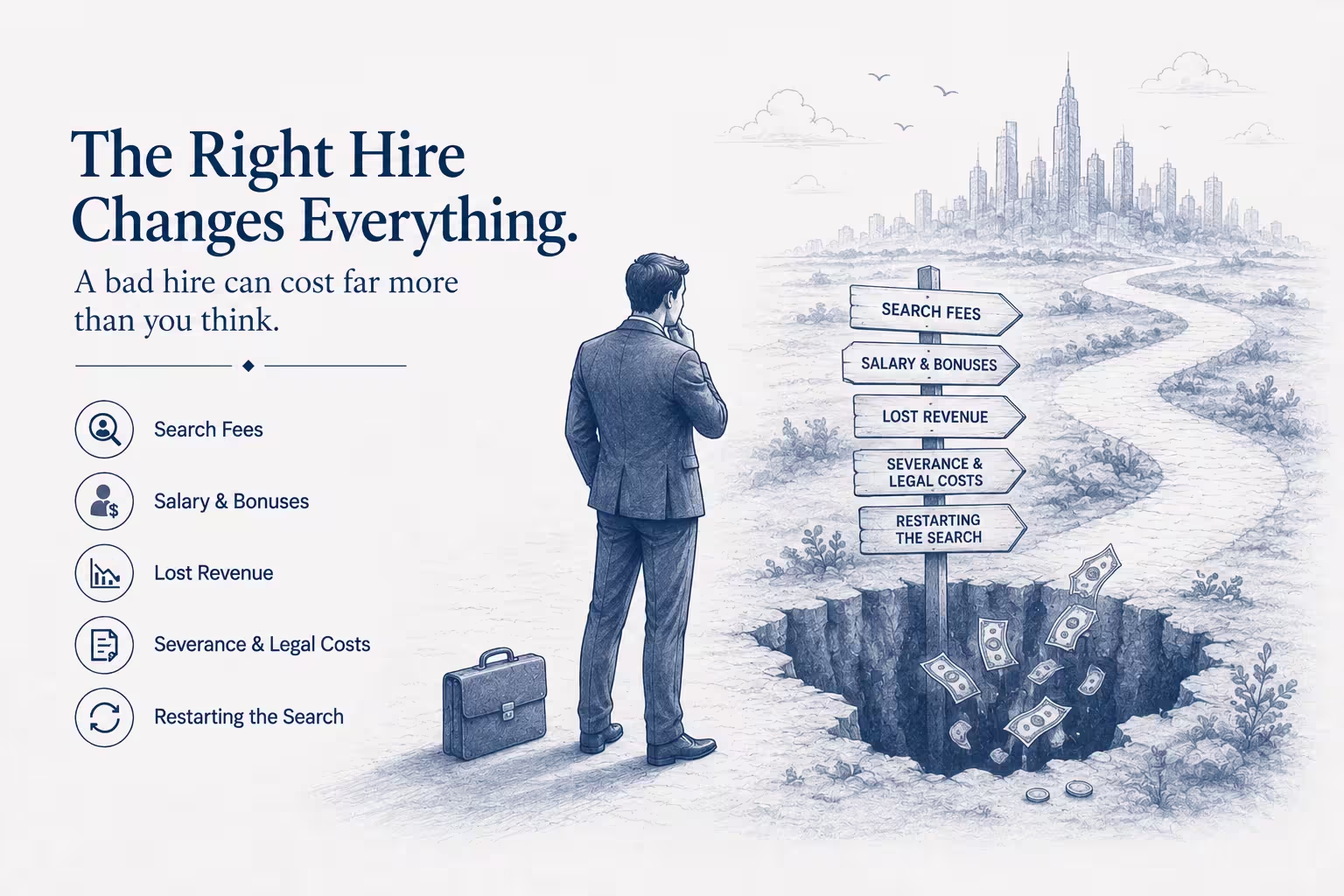
Sales leadership hiring decisions at this inflection point are among the highest-leverage decisions a tech company makes. Getting the CRO profile wrong at the moment of scaling costs far more than the search fee. It costs the quarters of compounding revenue loss that follow.
Sign 7: Your Sales Leaders Are Managing Teams Instead of Building a Scalable Revenue Engine
The best VP Sales in a growing tech company is inevitably consumed by operational demands. Forecast reviews. Pipeline calls. Rep performance management. Deal escalations. The strategic work of building a scalable revenue engine, designing the qualification process, aligning compensation to growth stage, building the coaching infrastructure, gets deferred indefinitely. Not because the leader is wrong, but because the role has outgrown the capacity of one person to manage it.
Sign 8: You Are Struggling to Build the Right Revenue Leadership Team
If every revenue leadership search takes longer than expected, if A-player candidates are declining offers, if the team being built skews toward those who were available rather than those who were right, the company has a talent architecture problem. A CRO who has built high-performing revenue teams before brings both the network and the judgment to attract the leaders that a company at this stage cannot find on its own.
Revenue leadership search at the CRO level requires specialist access to passive candidates who are currently succeeding in comparable roles. The best CRO candidates are not browsing job boards. They are building revenue at the company that was smart enough to find them first.
Sign 9: Your Company Needs a Revenue Transformation, Not Just Sales Management
This is the most important signal. Not a sales performance problem. Not a pipeline volume problem. A structural misalignment between where the company is going and how the revenue system is built to get there. Revenue transformation requires someone who has rebuilt broken revenue architectures before, who has the cross-functional authority and credibility to do it again, and who can lead the organisation through the transition without losing the team that built the early success.
Case Study: Sales Opportunity Qualification for IT Sales in Uncertain Times
Bob Apollo, Founder and Chief Outcomes Officer at Inflexion-Point Strategy Partners, breaks down the opportunity qualification framework that IT sales teams need in volatile, uncertain business environments. Most tech companies lose deals not because they lost the pitch, but because they qualified the wrong opportunities in the first place. A CRO who builds the qualification discipline into the revenue architecture prevents this waste at scale. The practical guide to sales opportunity qualification for IT sales teams is the starting point for any CRO building a structured revenue process.
Watch the video: https://youtu.be/0he1BItmK3M?si=XTyKeLNcxMrLWHAw
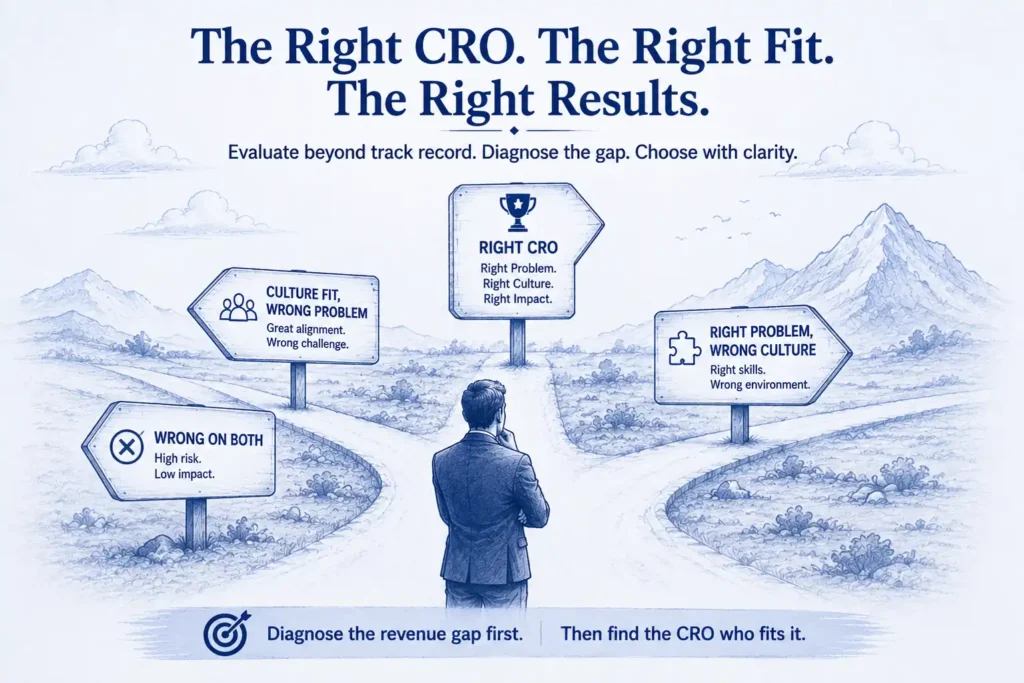
How to Evaluate Whether a CRO Candidate Is Right for Your Tech Company
The instinct to hire based on revenue track record alone is understandable. It is also how companies end up with a CRO who hit $50 million in ARR in a completely different context, with a different product, a different market, and a different team, and who cannot replicate the result in yours.
Start With the Revenue Gap
Before approaching a single candidate, run a revenue gap diagnostic across the current commercial operation. Which stage of the sales process is producing the highest revenue loss? Where is the qualification breaking down? What is the forecast accuracy and why? The answers define the specific capability the incoming CRO must possess. A CRO hired without this diagnosis is hired for the title, not the problem.
Evaluate Their Ability to Build Sales Capability
A CRO who cannot develop the people already in the revenue team will replace them. Replacement at scale is expensive. Assessment of coaching track record, capability-building methodology, and specific examples of teams they developed (rather than teams they managed) is the difference between a CRO who compounds the company’s investment and one who consumes it.
Sales coaching capability at the management layer is one of the CRO’s most important structural contributions. The best CRO candidates build a coaching infrastructure that outlasts their tenure rather than creating personal dependency.
Sales training and coaching systems designed by an expert CRO run without the CRO having to be present. That is the test. If the training and coaching require the CRO to deliver them personally, the revenue system has not been built. It has been performed.
Evaluate Their Ability to Hire A-Players
The CRO’s network is part of the asset being hired. A CRO with deep relationships in the passive talent market can build the revenue leadership team that the company cannot attract on its own. Evaluate their hiring track record with the same rigor as their sales track record.
Executive sales recruiters who specialize in B2B technology understand the difference between a CRO who has hired well and one who has been lucky with the talent market. The assessment looks at who they hired, how long those people stayed, and what the revenue impact was during and after their tenure.
Assess Culture and Leadership Fit
A CRO who has built predictable revenue in a 500-person enterprise may be exactly the wrong fit for a 45-person company that needs someone to build the process from scratch while still closing deals personally. Culture fit is not about personality. It is about whether the candidate’s working style, risk tolerance, and leadership approach match the specific stage the company is actually in.
Define the Revenue Gap Before the CRO Search Begins
The Revenue Gap Diagnostic produces the precise capability profile your next CRO must match. Free. 20 minutes. Get An Instant Report. No sales call required.
How TALSMART Helps Tech Companies Find the Right CRO
CRO executive recruitment for B2B technology companies requires specialist access, specialist assessment, and a search process built around the revenue problem rather than the job description.
Exclusively technology companies. Every evaluator, every assessment, and every candidate relationship is built around B2B tech revenue leadership. This is not a generalist practice that handles tech. It is a specialist practice that handles nothing else.
Elite CRO candidates in under two weeks. Because passive talent outreach runs continuously, the candidate pipeline exists before the vacancy is declared. The best CRO candidates are not in active search. They are already performing.
No retainer. Own skin in the game. Own money and own time are committed before a fee is earned. Payment is tied to the commercial performance of the placed leader.
Revenue-gap diagnostics before every search. The diagnostic output defines the leadership profile. The CRO’s experience is matched to the specific gap identified, not to the generic job description.
Expert assessment and culture fit. Candidates are evaluated by coaches with experience at organizations like Google and Oracle. Assessment covers both commercial capability and cultural alignment with the company’s growth stage.
Build the Revenue Leadership Your Next Growth Phase Requires
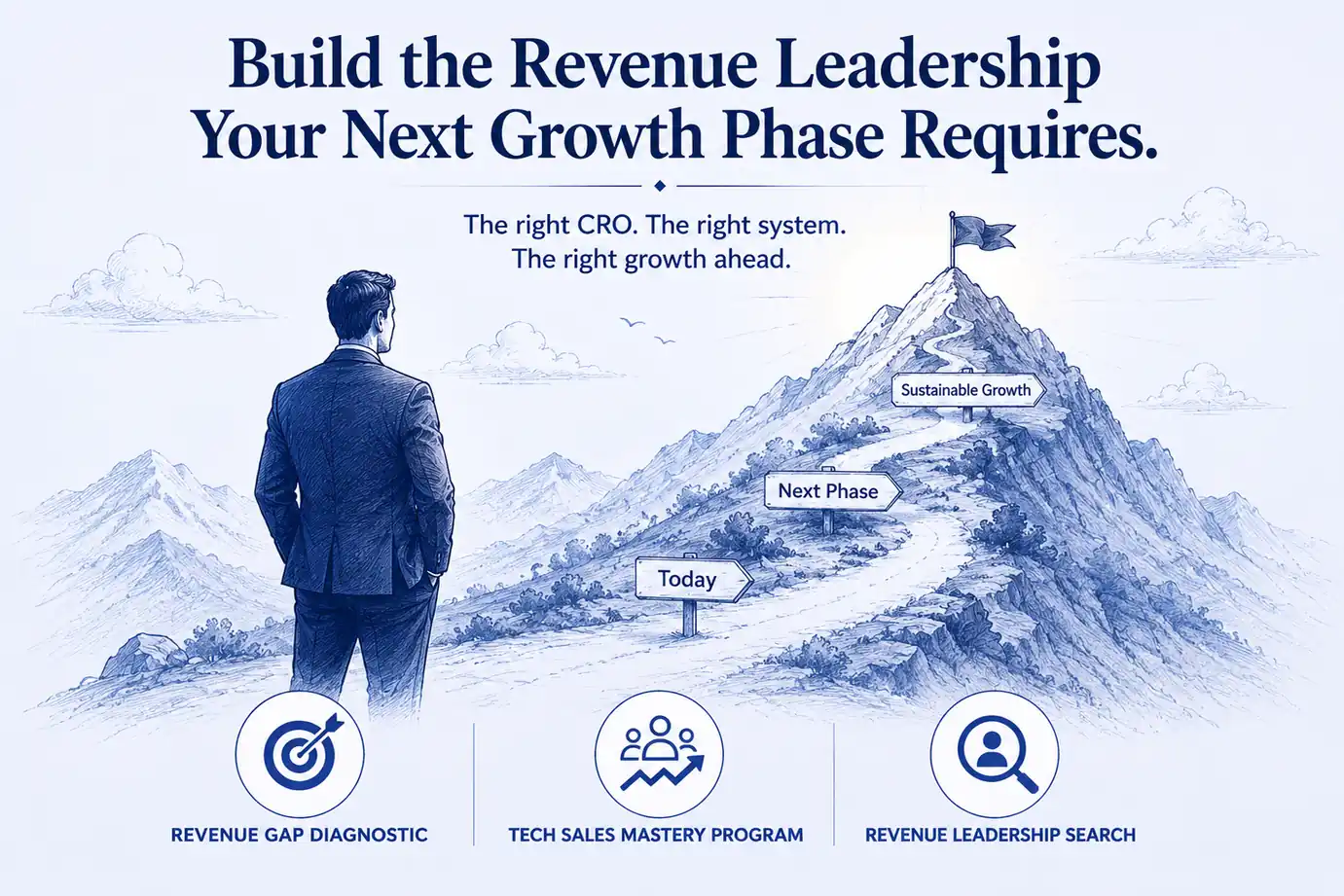
Priya hired a CRO six months after that board meeting. The diagnostic ran before the search began. It identified that the core problem was not pipeline volume but revenue architecture: three functions operating with no shared definition of what a qualified opportunity looked like. The CRO who was placed had rebuilt exactly that process before, in a comparable B2B tech company at a comparable stage. By month eight, forecast accuracy had improved from 61% to 84%. By month twelve, customer retention had recovered seven percentage points.
The nine signs in this article are not about hiring a CRO because the company is struggling. Most of the companies that need a CRO are growing. The question is whether the growth is sustainable, predictable, and compounding rather than fragile, reactive, and rep-dependent.
When Vertex moved from founder-led sales into structured commercial execution, the hire that mattered was not a better VP Sales. It was a CRO who had made that specific transition before, who understood how to connect every revenue function around a single architecture, and who could build the team that would carry the company through the next growth phase.
The Revenue Gap Diagnostic is the starting point. It maps where the current system is breaking down and produces the precise leadership profile the search should be built around. The Tech Sales Mastery Program is what the incoming CRO uses to assess and develop the capability of the existing team. Revenue Leadership Search is how the right CRO is found in the first place.
Take the Next Step
Run the Revenue Gap Diagnostic before any CRO search begins. The diagnostic takes twenty minutes and produces a precise capability brief that the search should be built around. Without it, the search begins in the wrong place and often ends with the wrong hire.
When growth becomes too complex for sales leadership alone, it is time to build a leader for the entire revenue engine.
Run the Revenue Gap Diagnostic Before the Search
Identify exactly where your revenue system is breaking down. Build the CRO brief around the gap, not the title. Free. 20 minutes. Get An Instant Report.
TALSMART is a global revenue execution partner and specialist CRO executive recruitment firm for B2B technology companies, operating across 100 + countries and 23 languages.
Frequently Asked Questions
When should a tech company hire a CRO?
When revenue growth becomes unpredictable, when sales, marketing, and customer success are operating as disconnected functions, when the sales team has scaled without proportional revenue growth, or when the company is entering a new growth phase that the current VP Sales structure cannot support. The signal is not that the company is failing. It is that the revenue architecture has outgrown the leadership structure managing it.
What is the difference between a VP Sales and a CRO?
A VP Sales owns the sales pipeline and quota attainment. A CRO owns the entire revenue lifecycle from pipeline generation to customer retention and expansion. A VP Sales manages execution within an existing go-to-market strategy. A CRO designs, aligns, and adapts the go-to-market strategy across every revenue-generating function. The distinction is between managing a function and architecting a system.
How do you assess a CRO candidate?
Start with a revenue gap diagnostic to define the specific commercial challenge the incoming CRO must solve. Then evaluate the candidate’s experience against that specific gap rather than their general track record. Assess their coaching and capability-building methodology, their hiring track record, their ability to align cross-functional teams, and their cultural fit with the company’s current growth stage.
How long does CRO executive recruitment take?
Traditional executive search for a CRO typically takes four to six months. Specialist CRO executive recruitment with ongoing passive talent outreach delivers vetted shortlists in under two weeks. The difference is not speed of execution during the search. It is that the passive talent outreach runs continuously rather than starting when the vacancy appears.
What makes CRO recruitment different for tech companies?
Technology companies require a CRO who understands multi-stakeholder enterprise sales, complex go-to-market design, product-led and sales-led growth motions, and the specific talent market for revenue leaders in B2B tech. A generalist executive search firm assessing a CRO candidate is evaluating a domain they do not operate in. Specialist recruitment for tech CROs produces a categorically different quality of candidate assessment.