
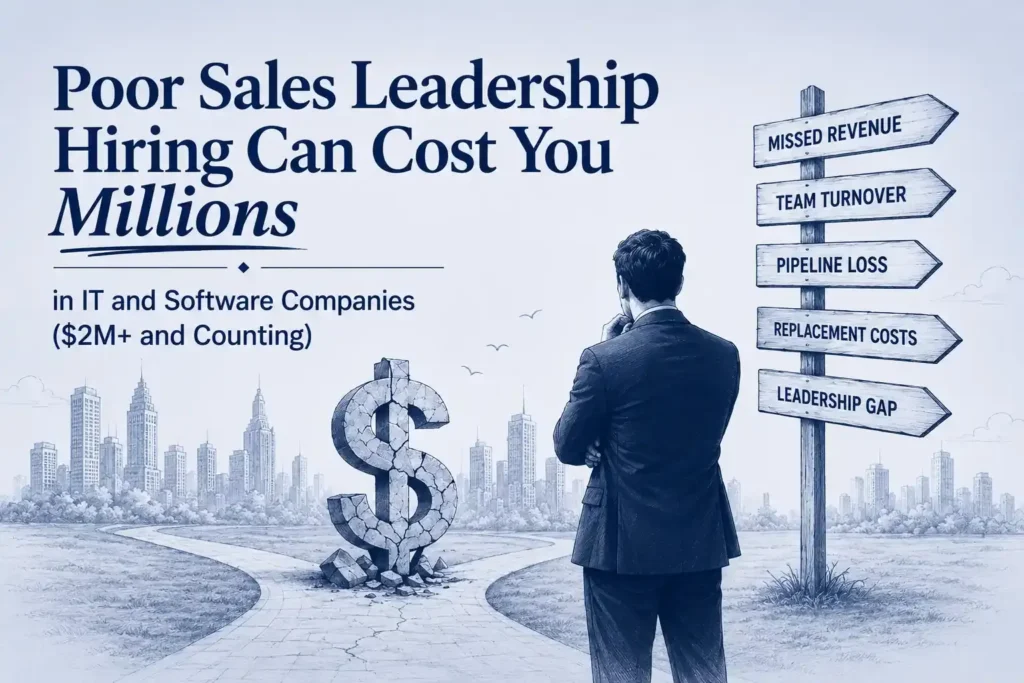
Hiring a VP Sales should fix a revenue problem. Not create one.
And yet, in boardrooms across IT and software companies every week, the same scene plays out. A strong hire is made. The team is optimistic. The board is satisfied. And twelve months later, the pipeline is thinner, the best reps have started leaving, and nobody is willing to say out loud what they all know.
The wrong person is in the role.
Michael had built a software company from eight people to eighty. He had survived two funding rounds, two product pivots, and one year where payroll was genuinely uncertain. What he had not survived was the VP Sales hire he made at Series B.
The candidate was exceptional on paper. Three previous VP Sales roles at recognizable technology companies. Consistent quota attainment. Strong references. An interview performance that impressed everyone in the room. Michael offered the role the same week.
By month six, the team had stopped bringing him problems. By month nine, two of the top three reps had handed in their notice. By month twelve, the pipeline that Michael had spent three years building had deteriorated to the point where the board was asking questions he could not answer.
The VP Sales departed in month fourteen. The total cost of that hire, including missed revenue, team turnover, pipeline recovery, and a second search, came to $2.3 million.
The salary had been $280,000.
If any part of that story feels familiar, the problem is not that you hired the wrong person. The problem is that you used a process designed to find an executive, for a role that requires a revenue builder. Those are not the same thing. And no interview process in the world reliably tells you the difference.
Hiring a VP Sales through a standard executive search process is like hiring a Formula 1 driver because they have a driver’s license.
Every candidate can drive. That doesn’t mean they can win a race.
Every VP of Sales has managed a team. That doesn’t mean they can:
- Scale from $5M to $25M ARR.
- Build a repeatable sales process from scratch.
- Coach managers to coach their own reps.
- Forecast accurately under board pressure.
- Recruit top performers in a competitive market.
- Lead a team through hypergrowth without losing the culture.
Finding those capabilities requires far more than reading a resume. And most IT and software companies use a process that does exactly that.
Sales Leadership Is a Revenue Role, Not Just a Leadership Role. The best executive search partner is not the one that fills the most executive roles. It is the one that best understands the role being hired for. The Revenue Execution System (Diagnose, Build, Execute, Lead) starts with a precise diagnosis of the revenue problem the incoming leader must solve. Without that diagnosis, the search begins in the wrong place. And as Michael discovered, it ends there too.
Know Your Revenue Gap Before the Next Leadership Search Begins
The Revenue Gap Diagnostic maps exactly where your current sales system is breaking down. That diagnosis defines the leadership profile your next hire must have. Free. 20 minutes. Get an Instant Report.
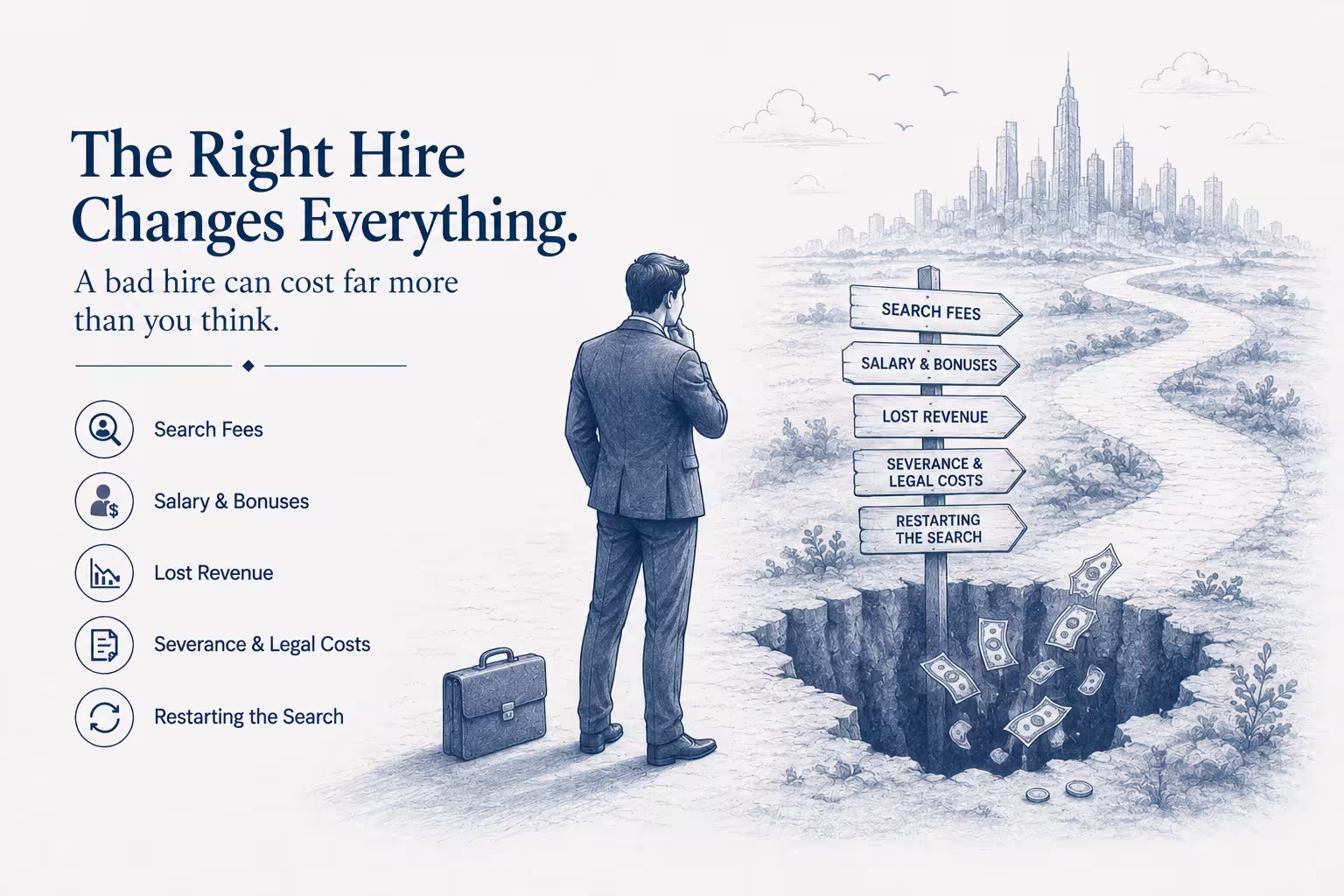
What Does a Bad Sales Leadership Hire Really Cost?
The answer depends on the stage of the company and the complexity of the sales environment. In IT and software businesses with long enterprise cycles and high-value deals, the combined cost of a poor sales leadership hire consistently reaches $2M and above. The table below maps each cost category across two environments.
| Cost Category | Conservative Estimate | High-Growth IT/Software Environment |
|---|---|---|
| Missed revenue targets (12-18 months) | $400K to $800K | $1M to $2M+ |
| Sales team turnover (2 to 3 reps) | $150K to $300K | $300K to $600K |
| Pipeline deterioration | $100K to $250K | $300K to $700K |
| Recruitment and replacement | $50K to $100K | $100K to $200K |
| Leadership transition gap | $75K to $150K | $150K to $400K |
| Total combined impact | $775K to $1.6M | $1.85M to $3.9M+ |
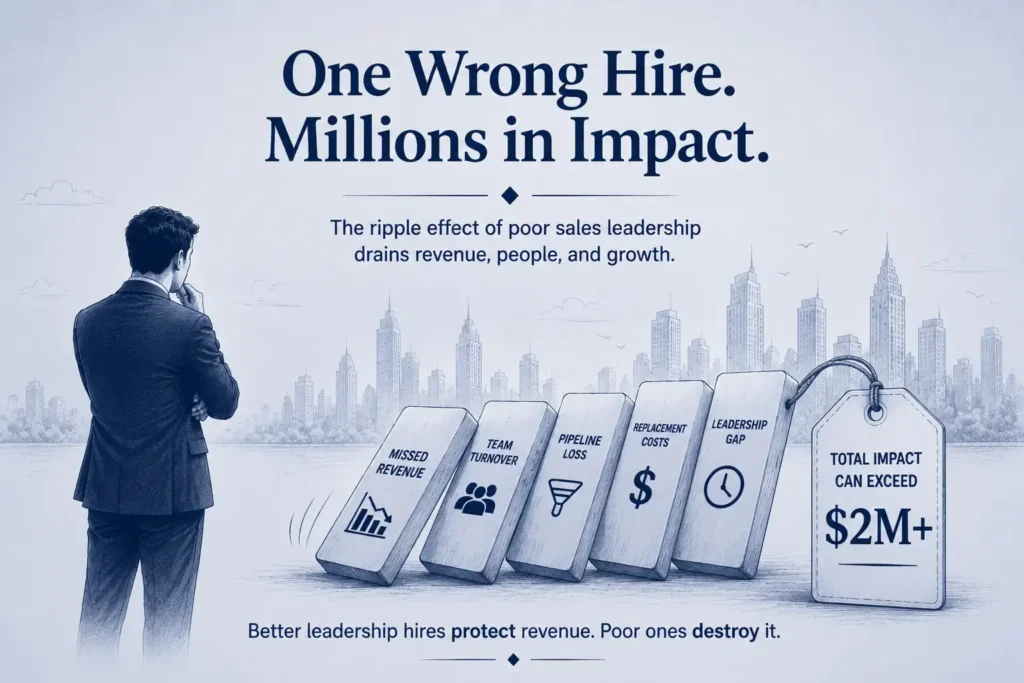
Lost Revenue and Missed Sales Targets
A new VP Sales typically needs three to six months to understand the product, the market, and the team before they can meaningfully influence the pipeline. If they are the wrong hire, that window extends to twelve months or more of missed targets before the problem is formally recognized. In IT and software companies where average deal cycles run six to twelve months (Ebsta x Pavilion, 2025), a single leadership-driven pipeline failure can eliminate a full year of enterprise deal value.
Sales leadership hiring mistakes in technology companies compound faster than in other sectors because the sales cycle is long, the buying committees are large, and every stalled deal represents months of lost team time, not just lost revenue.
Sales Team Turnover and Productivity Loss
High-performing reps leave under ineffective leadership before the company recognizes the hire was wrong. Research from Harvard Business Review estimates the cost of replacing a high-performing sales representative at 1.5 to 2 times their annual salary, including lost productivity during the ramp period. A poor VP Sales who loses three top reps in their first year has already cost the company $300,000 to $600,000 before a single missed quota is counted.
Sales coaching capability is one of the clearest predictors of whether a VP Sales will retain high performers or lose them. A leader who cannot develop their reps through coaching creates a ceiling on individual performance that the best sellers will not accept.
Customer and Pipeline Impact
Poor deal execution under ineffective leadership does not just miss revenue. It damages relationships with enterprise accounts that took years to build. A sales leader who mismanages a strategic deal, over-promises to close a number, or fails to coordinate a complex buying committee leaves a mark that outlasts their tenure. The pipeline that was inherited in reasonable health deteriorates within two quarters under the wrong leader.
The Cost of Replacing the Wrong Hire
When the decision to replace a VP Sales is finally made, the cost cycle begins again. Recruitment fees for senior sales leadership roles typically run 20 to 30 percent of first-year compensation. In IT and software companies where VP Sales packages range from $300,000 to $500,000, that is $60,000 to $150,000 in search fees alone, on top of the revenue already lost. Add a six-month transition gap during which the team operates without clear leadership direction and the compounding cost reaches well beyond the original hire.
Is Your Current Sales Leadership Hire Costing You More Than You Think?
The Revenue Gap Diagnostic identifies exactly which stage of your sales process is breaking down. Know before the next quarter closes. Free. 20 minutes. Get an Instant Report.
Why Sales Leadership Hiring Is Particularly Risky in IT and Software Companies
Not all bad sales leadership hires cost the same. A poor hire in a transactional, low-complexity sales environment produces a different scale of damage than the same hire in an enterprise technology company. Several factors make IT and software companies disproportionately exposed.
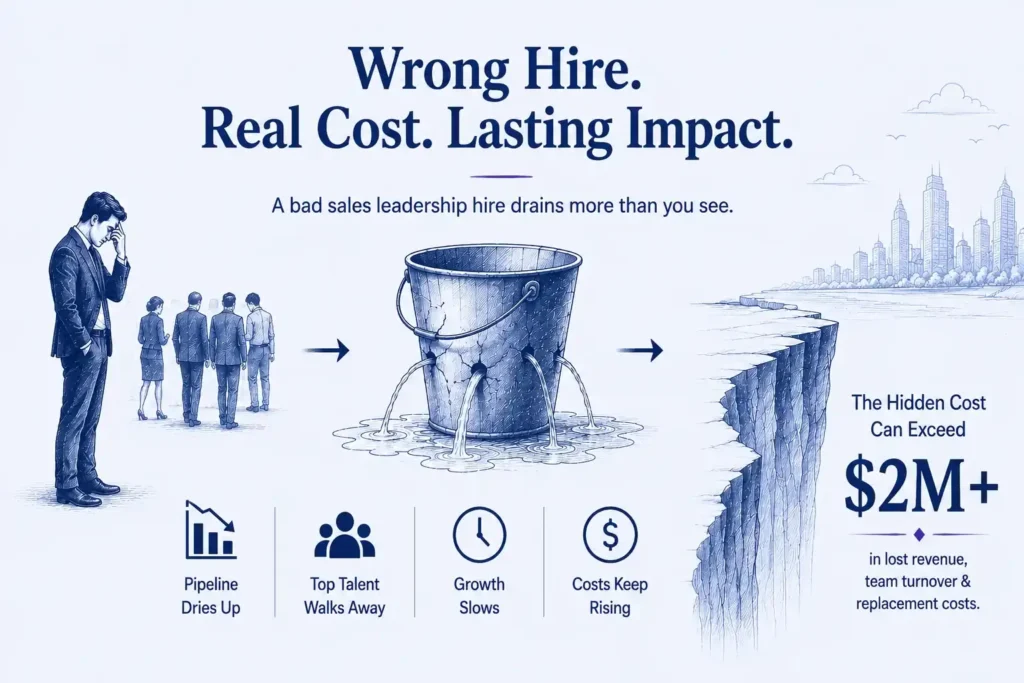
Enterprise technology products require a sales leader who can navigate complex, multi-stakeholder buying processes across procurement, legal, security, and technical evaluation. Average B2B tech buying committees now include ten to thirteen stakeholders. (Gartner, 2025) A sales leader who has only managed transactional sales teams will misread the committee dynamics of every major deal.
Long sales cycles mean that the damage from poor leadership takes months to surface. A B2B tech sales leader who is making the wrong calls in month two will not show clear evidence of failure until month eight or nine. By that point, the pipeline has been set on a trajectory that cannot be corrected within the same financial year.
A B2B tech sales strategy built around the wrong leadership profile creates structural problems that survive the leader’s departure. The sales process they set, the team they built, and the pipeline habits they embedded all require time to repair.
The Hidden Revenue Gap Behind a Bad Sales Leadership Hire
Identify the Revenue Gap Before Hiring
Most sales leadership searches begin with a job description. They should begin with a revenue gap diagnostic. Before approaching a single candidate, the company needs to understand whether the underlying challenge is pipeline volume, pipeline quality, conversion rate, forecast accuracy, or team capability. Each of these requires a different leadership profile. A company with a prospecting gap needs a leader who can build outbound motion from scratch. A company with a negotiation problem needs a leader who has defended margin under board pressure.
Running a structured revenue gap diagnostic before the search begins converts a generic job description into a precise capability brief. Without it, the search is built on assumptions rather than evidence, and the hire reflects those assumptions.
Hire for the Business Problem, Not Just the Job Description
The best executive search partner is not the one that fills the most executive roles. It is the one that best understands the role being hired for. Spencer Stuart and Korn Ferry have built genuinely strong search processes across many executive functions. For VP Sales and CRO roles in high-complexity IT and software environments, the specific revenue-building capability those processes were not designed to assess is exactly the capability that determines whether the hire succeeds or fails.
Sales leadership recruiters who specialize exclusively in technology companies understand this distinction. They do not evaluate candidates on executive presence and leadership narrative alone. They evaluate whether the candidate has solved the specific revenue problem the company is actually facing.
Why Traditional Sales Leadership Recruitment Can Miss the Mark
Interviews and CVs capture what a candidate has been responsible for. They do not reliably capture whether the candidate built what they inherited, improved it, or simply maintained it through a favorable market cycle. A VP Sales who hit 110% of quota for three years at a company where the territory was already built, the brand was established, and the product had category leadership is a very different profile from a VP Sales who built the same result from a blank sheet.
Previous quota attainment is a lagging indicator. It tells you what happened, not why, and not whether the same conditions exist in your company. Culture fit is equally difficult to assess through a standard interview process. A leader who performed brilliantly in a structured enterprise with a large support team may underperform in a scaling technology company that expects the leader to roll up their sleeves alongside the team.
Executive sales recruiters who have themselves carried quotas and built sales teams can challenge a candidate’s narrative in ways that a generalist recruiter cannot. They know what a genuine revenue-building track record looks like, because they have lived it.
How Data, AI and Expert Assessment Reduce Hiring Risk
Every day a senior sales role stays vacant, revenue disappears. The whitepaper Revolutionizing Recruitment: Leveraging Data Mining and AI quantifies this precisely. A senior sales role carrying an annual quota of $5 million costs $13,700 per day when left vacant. Over 60 days, that vacancy costs $821,880 in unrealized revenue. Three scenarios illustrate the scale: a $5 million quota role vacant for 30 days costs $410,959; a $3 million quota role vacant for 60 days costs $493,151; and a $1 million quota emerging market role vacant for 90 days costs $246,575. These figures are calculated from daily revenue targets multiplied by actual average time-to-hire. The company that reduces its time-to-hire from 90 days to under two weeks does not just fill the role faster. It eliminates a compounding cost that no replacement hire can recover.

Moving Beyond CV-Based Candidate Selection
Traditional recruiting approaches rely on posted job advertisements, networking, and third-party agencies. They are slow and linear. They rely on guesswork about candidates beyond what their resume shows. And they consistently overlook passive candidates, the leaders who are not actively searching but who are open to the right opportunity. The whitepaper data is clear: traditional methods offer only a 15% probability of finding exceptional candidates within a critical two-week window. AI algorithms now analyze candidate signals across multiple platforms simultaneously, surfacing leaders who would never appear in a conventional search.
Combining Data With Human Expertise
AI and data mining enabled recruitment methods produce a 77% probability of finding exceptional candidates within a two-week window. Traditional methods produce 15%. Assessment-enabled methods reach 30%. Data mining alone reaches 55%. The combination of all three produces the 77% outcome. (Source: Revolutionizing Recruitment: Leveraging Data Mining and AI)
AI identifies signals. Experienced human judgment validates them. A candidate flagged by data mining requires assessment by someone who understands what good B2B tech sales leadership looks like in practice. That assessment is conducted by coaches who have built revenue functions at scale, including professionals with experience at organizations like Google and Oracle. Data without that expert layer produces a shortlist. Data with it produces the right hire.
How to Avoid a $2M+ Sales Leadership Hiring Mistake
| What to Do | Why It Matters |
|---|---|
| Diagnose the revenue gap first | Defines the exact leadership profile before the search begins |
| Define measurable outcomes for the role | Prevents hiring based on titles or CV prestige alone |
| Validate technology and enterprise sales experience | Ensures the candidate has sold in your complexity, not just any complex sale |
| Assess leadership and coaching capability | A great seller is not automatically a great sales leader |
| Evaluate cultural fit alongside commercial capability | The right leader in the wrong culture leaves within 18 months |
| Combine data-driven assessment with expert human judgment | AI surfaces signals. Experienced practitioners validate them. |
Case Study: The Biggest Sales Hiring Crisis of the Modern History
Tech sales vacancies have risen 65% to over 700,000 open roles nationally. The IT and software companies that wait for the right candidate to apply are falling further behind by the week. The companies winning on talent are not the ones with the largest budgets. They are the ones who stopped treating sales leadership hiring as a reactive event.
Watch the video: https://youtu.be/Nj5gm-Yv6tI?si=ZRkM_k6qOzbrqDmg
The TALSMART Difference: Putting Skin in the Game
The goal of sales leadership recruitment is not to present an impressive shortlist. It is to predict revenue leadership success. These are two different briefs, and most executive search processes are built around the first one.
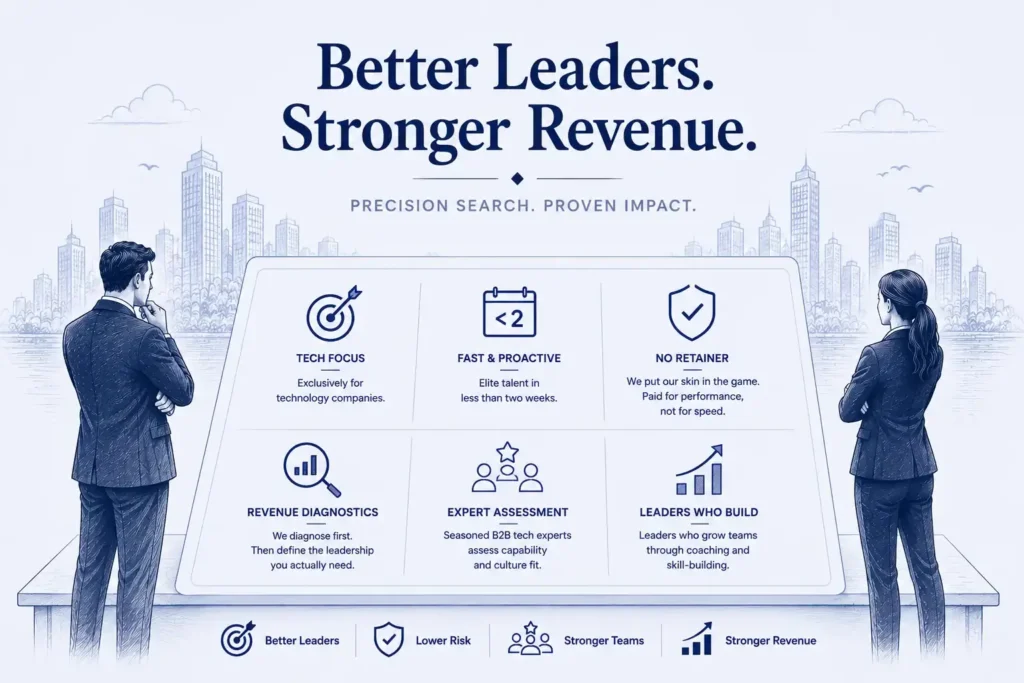
Exclusively technology companies. Every search, every assessment, and every evaluator is built around the specific demands of B2B tech revenue leadership. This is not a generalist practice that serves tech companies. It is a specialist practice that serves nothing else.
Elite talent in less than two weeks. Because passive talent outreach runs continuously rather than reactively, vetted shortlists exist before the vacancy is formally declared.
No retainer. Own skin in the game. Own money and own time are committed before a fee is earned. Payment is tied to the performance of the placed leader, not to the speed of the placement. When the recruiter’s success depends on the hire’s commercial success, the quality of the search changes.
Revenue-gap diagnostics before every search. The diagnostic runs before the first candidate is approached. The output defines the leadership profile the search is built around.
Expert assessment and culture fit. Candidates are evaluated by professionals who have built B2B tech revenue functions, including coaches with experience at Google and Oracle. Assessment evaluates both commercial capability and culture fit. The right capability in the wrong culture produces an eighteen-month departure.
Tech sales training and leadership capability are evaluated in combination. The incoming leader must not only have the right commercial track record. They must be able to develop the team they inherit through structured coaching and deliberate skill-building.
Define Your Revenue Challenge Before the Next Search Begins
The Revenue Gap Diagnostic maps where your current sales system is breaking down and produces the precise capability brief that should drive your next sales leadership hire. Free. 20 minutes.Get Instant Report. No sales call required.
Conclusion: The Cost of Getting Sales Leadership Wrong
The board that approved the hire in the opening of this article did not make a reckless decision. They made an uninformed one. The process they used was designed to find an executive. The role required a revenue builder. Those are different briefs. The candidate who impressed in the interview was the wrong person for the specific problem the company was facing. Nobody in the room had defined what that problem was before the search began.
That is the cost of getting sales leadership wrong. Not the salary. Not the search fee. The eighteen months of compounding damage that follows when the search begins in the wrong place.
Globant defined its revenue gap before its most recent sales leadership hire. The diagnostic revealed that the challenge was not pipeline volume but conversion rate and deal cycle length. The resulting leadership profile was built around those specific gaps. The incoming leader closed the largest enterprise deal in the company’s history within the first two quarters.
The best executive search partner is not the one that fills the most executive roles. It is the one that best understands the role being hired for. That understanding starts not with a search, but with a diagnosis.
TALSMART is a global revenue execution partner and specialist sales leadership recruitment firm for B2B technology companies, operating across 100 + countries and 23 languages.
Frequently Asked Questions
How much does a bad sales leadership hire cost a company?
In IT and software companies with enterprise sales cycles, the combined cost of missed revenue, sales team turnover, pipeline deterioration, and replacement consistently reaches $2M or above. The salary is typically the smallest component. The largest is the compounding revenue loss across the eighteen months it takes to recognize and resolve the wrong hire.
Why do sales leadership hires fail?
The most common causes are poor role definition before the search begins, relying on CVs and interviews that reveal what a candidate managed rather than what they built, culture mismatch that becomes visible only after twelve months in role, and hiring based on title, company name, or past quota attainment without assessing whether those results were produced in comparable conditions.
What should companies look for when hiring a sales leader?
Revenue growth in conditions comparable to your own, not just at a larger company in a more favorable market. Technology and enterprise sales experience with complex buying committees. Pipeline and forecasting capability validated against specific deal data. Leadership and coaching ability assessed by practitioners who have done both. Strategic thinking and culture fit evaluated simultaneously, not sequentially.
How can companies reduce the risk of a bad sales leadership hire?
Diagnose the revenue gap first. Define measurable outcomes for the role before writing the job description. Use data-driven candidate assessment that surfaces signals beyond CV screening. Evaluate leadership and culture fit with assessors who have built sales teams themselves. Combine AI-assisted candidate identification with experienced human judgment that validates the signals technology surfaces.
How does AI improve sales leadership recruitment?
Data mining and AI identify candidate signals from digital footprint analysis, publication records, and pattern-matching against high-performer profiles. This surfaces passive candidates who are performing but not visible in active markets. AI identifies the signals. Experienced practitioners validate them. Without the human layer, data produces a shortlist. With it, data produces the right hire.
How long does it take to find a sales leader?
Traditional executive search firms typically take four to six months from brief to placement. Specialist sales leadership recruiters who maintain ongoing passive talent pipelines deliver vetted shortlists in under two weeks for most technology sales leadership searches. The difference is not speed of execution during the search. It is that the passive talent outreach happened before the vacancy was declared.
What makes a specialist sales leadership recruiter different from a traditional executive search firm?
Specialization in one function within one industry. Pre-built relationships with passive candidates who will not be visible in any active search. Assessment led by practitioners who have carried quotas and built revenue teams. Revenue-gap diagnostics that define the precise capability profile before the search begins. A no-retainer model where payment is aligned to the performance of the placed leader, not to the speed of the placement.
How can companies tell if they need a new sales leader?
Persistent missed revenue targets across more than two consecutive quarters. Weak pipeline performance not explained by market conditions. Poor forecast accuracy that the current leader cannot credibly attribute to external factors. Sales team turnover among high performers. Stalled growth in markets where the product and competitive position should support improvement. The question to ask before replacing the leader is whether the issue is genuinely leadership-related or whether the structural conditions for success were never put in place.