
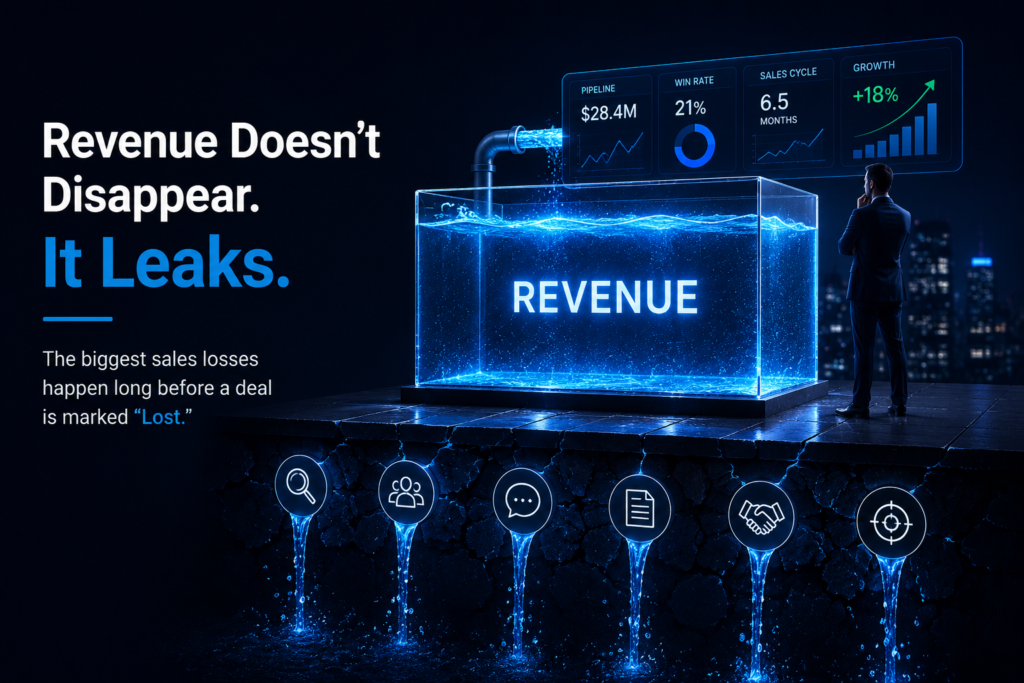
The hardest part of being a sales leader today isn’t setting the target, it’s watching a team struggle against a game that has changed.
Only 43 percent of B2B sales reps hit quota in 2024. Win rates across B2B tech have declined to 20 to 21 percent, down from 29 percent in 2022. Sales cycles have stretched to 6.5 months, 38 percent longer than in 2021 (Ebsta x Pavilion, 2025). These are not isolated trends. They reflect a buying environment that has structurally changed while most sales improvement methods have not.
The problem is that technology evolves every few years, but sales capability doesn’t.
The most consistent reason this gap persists is that performance problems in B2B tech are stage-specific. Deals are being lost at particular points in the deal cycle, and the interventions being applied are landing somewhere else entirely. A team-wide training event does not reach a qualification gap. A new CRM dashboard does not fix a discovery problem. More outreach does not recover margin lost in negotiation.
If this sounds familiar, you are not alone. The question is no longer whether your team has a performance gap, it’s whether you know exactly where that gap exists and how much revenue it is costing you.
This article gives you a six-step practical framework to identify exactly where your team’s performance is breaking down and what to do about it at each stage. The goal is not to describe the sales process. It is to answer the specific question in the title: how do you improve sales performance in a B2B tech company, and what does that look like in practice.
Why B2B Tech Sales Performance Requires a Different Approach
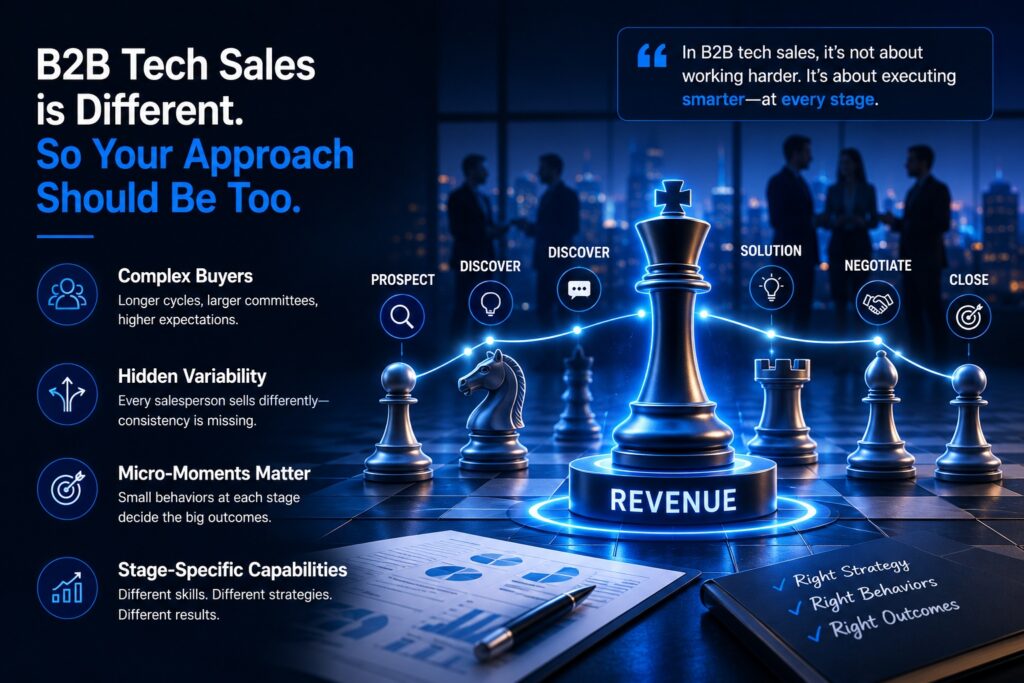
B2B tech sales has changed in ways that generic performance improvement frameworks have not caught up with. Most sales leaders think and are educated that a coherent sales performance strategy for this environment has to account for longer buying cycles, larger buying committees, and a procurement process that introduces new risks at stages the rep was not present for. But the complexity isn’t in the buyer, it’s in the hidden variability of your own sales execution.
Every salesperson is selling a different thing
Most companies think they’re selling one product or service. In reality, every salesperson is selling a different version of it.
- One rep positions value around ROI.
- Another leads with technical features.
- Another competes on price.
- Another sells relationships.
The result is inconsistent messaging, unpredictable win rates, and a pipeline that depends more on individual habits than a repeatable sales process.
Revenue is won or lost in micro-moments
Most leaders measure outcomes:
- Pipeline
- Quota
- Win rate
- Revenue
Top-performing organizations measure the behaviors that create those outcomes.
Examples:
- Asking the right discovery questions
- Uncovering business pain
- Handling objections
- Gaining executive access
- Negotiating value before price becomes the discussion
Revenue leaks occur long before a deal is marked “Lost.”
Every stage requires a different capability
- Prospecting requires deep market research and business environment analysis.
- Discovery requires drilling beyond pain to expose the business impact and value gap.
- Solution selling requires clearly articulating your Competitive Advantage.
- Negotiation-Close requires knowing your BATNA (Best Alternative To No Agreement)
Training everyone on everything usually improves nothing.
The Practical Framework to Improve Sales Performance in B2B Tech Companies
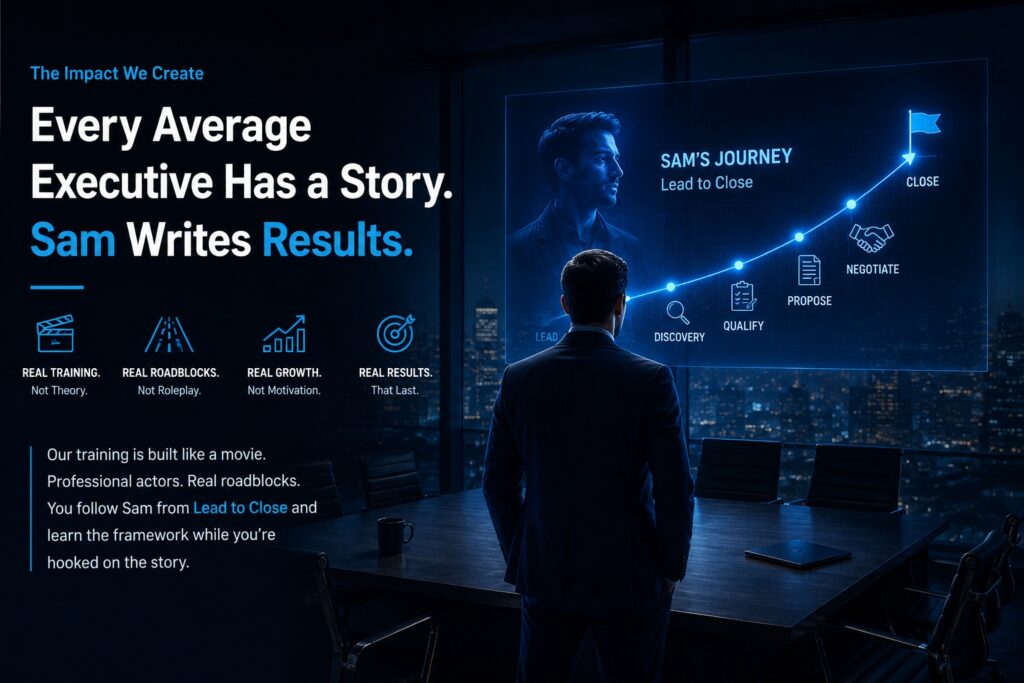
The six steps below form a sequence. Each step answers a specific part of how to improve sales performance. Applying them in order produces compounding improvements. Applying them selectively produces isolated ones. TALSMART’s Revenue Execution System (Diagnose, Build, Execute, Lead) is the foundation this framework sits on.
| Step | Objective | Business Outcome |
|---|---|---|
| Step 1 | Identify Performance Gaps | Focus improvement on the specific stage where the most revenue is being lost. |
| Step 2 | Standardize Top Performer Behaviors | Raise team consistency, not just the ceiling of top performers. |
| Step 3 | Improve Qualification and Multi-Threading | Increase qualified pipeline and reduce single-threaded risk. |
| Step 4 | Shorten Deal Cycles | Accelerate revenue without inflating the pipeline. |
| Step 5 | Improve Proposal and Negotiation | Prioritize value over price and know your walk-away point. |
| Step 6 | Build Continuous Sales Coaching | Sustain performance beyond any single training initiative. |
Step 1: Identify the Biggest Sales Performance Gaps
You cannot improve what you have not measured at the right level. Team-wide quota attainment tells you the result. It does not tell you which deal stage produced it, which reps have the most concentrated gap, or what the gap is costing in annual revenue
Analyze pipeline performance
Look at where deals are stalling, not just where they are closing. A pipeline conversion rate below 35 percent from qualified lead to closed-won is a prospecting and qualification problem. If post-proposal conversion is healthy but overall win rate is low, the issue is upstream. If deals advance to the late stage and then stall, discovery or stakeholder alignment is where the gap sits.
Review conversion rates at every sales stage
Tracking conversion at the stage level reveals the breakdown point that aggregate win rate hides. Stage-by-stage conversion data is the most actionable diagnostic a sales leader can run, and most teams do not track it routinely.
Compare top performers with the rest of the team
The behavioral comparison is more valuable than the revenue comparison. What do your top performers do differently at discovery? How many stakeholders do they engage before the proposal? Sales productivity at the individual level is almost always higher in top performers not because they work more hours but because they spend their capacity on real opportunities and qualify out the rest early.
Prioritize the highest-impact improvement opportunities
Not every performance gap costs the same amount. Identify the stage producing the most deal loss and address that first.
A 5 percent improvement in win rate for a team running $200,000 average deal values produces more revenue than a 20 percent increase in outreach volume. Performance gains in B2B tech come from fixing the right stage, not from scaling activity across the wrong ones.
The pattern that most consistently undermines this step is measuring activity instead of outcomes. Call volume, emails sent, and meetings booked confirm effort. They do not confirm whether the effort is reaching the right stage of the right deals.
A second, quieter cause sits one step earlier: when sales and marketing are working from different definitions of a qualified lead, reps inherit pipeline that was never going to convert, and the stage-level data above gets harder to trust.
If your pipeline reviews can tell you which deals are at risk but not which stage created the risk, the diagnostic is not yet specific enough to drive the right intervention.
KPI to track
Track: Pipeline Conversion Rate, the percentage of qualified leads that reach closed-won. Most B2B tech teams sit below 22 percent; teams with stage-level qualification discipline convert above 35 percent.
Visual Brief: Performance Gap Heat Map
A grid. Rows are rep names or anonymized rep numbers. Columns are five deal stages: Prospecting, Qualification, Discovery, Solution, Negotiation-Close. Each cell is color coded: dark navy for strong execution, amber for partial, light grey for consistent gap. Legend at the bottom.
Caption: The heat map shows which reps have which gaps at which stages. Coaching becomes targeted, not generic.
Step 2: Standardize the Behaviors of Top Sales Performers
Every B2B tech sales team has a top performer who closes deals that others cannot. The question is what they are doing differently at each stage of the deal, and whether those specific behaviors can be transferred to the middle 60 percent of the team through a documented playbook and coaching on real deals.
Identify winning sales behaviors
Top performers in B2B tech typically engage multiple stakeholders before the proposal stage, ask discovery questions that surface business impact rather than feature preferences, and include buyer process mapping in their qualification conversations. Document these from actual closed-won deal data: the questions asked, the stakeholders engaged, the objections raised and how they were handled.
Build repeatable sales playbooks
A playbook built from real deals is recognizable to the team. A playbook built from theory is not. Take the three to five deals your top performers closed in the last two quarters and extract the specific behaviors at each stage. That becomes the playbook.
Companies with formally documented sales playbooks achieve quota attainment rates 22 percent higher than those without structured processes. (CSO Insights) The playbook produces the result through the coaching that comes from it, not through the document itself.
Coach middle performers using real deal data
Once the playbook exists, coaching conversations become precise. A rep whose discovery-to-proposal conversion rate is 30 percent against a team benchmark of 60 percent has a specific gap that a specific coaching conversation can address.
Measure behavioral improvement
Output metrics like close rate and quota attainment lag the actual behavior changes by 60 to 90 days. Track leading indicators instead: stakeholders contacted by the end of stage two, whether qualification notes include a documented buyer process, whether discovery outputs include a confirmed pain statement at business requirement level.
Mistake to avoid
What makes this fail most often is when each rep runs their own version of every stage and there is no shared architecture to transfer top performer insights into. Standardization is not about constraining strong reps. It is about giving every rep the starting point that your best performers already have.
Step 3: Improve Qualification and Multi-Threading
Qualification is where the largest performance gains in B2B tech sit. A deal advancing on a champion’s enthusiasm, without evidence the buying committee is aligned, will consume three to four months of rep capacity before dying at procurement or in the committee meeting where the champion had no real decision authority.
Strengthen qualification early
The BANT-PR framework extends standard qualification (Budget, Authority, Need, Timeline) with two layers specific to B2B tech: buyer Process and Risk. Buyer Process mapping asks how the decision will actually be made internally and what the procurement, legal, and security review process looks like. Risk mapping surfaces the objections that will arise in those reviews before they become late-stage blockers.
Map the buying committee
Mapping the full buying committee by stage two means the rep knows who will be in the room when the proposal is reviewed, what each person’s priorities are, and whose objection is most likely to stall the deal.
Engage multiple stakeholders
Research from Gong Labs shows that deals with three or more stakeholder contacts have a 24 percent higher close rate than single-threaded deals (Gong Labs, 2025). Most B2B tech pipelines are still mostly single-threaded and champion-led, which is exactly the gap this closes.
Reduce dependency on a single champion
After every discovery conversation, identify which stakeholders have not yet been contacted and create a specific plan to engage them with the champion’s support, not around them.
Building multiple stakeholder relationships feels uncomfortable when a rep has a strong connection with one person and does not want to risk it by involving others. That discomfort is understandable. The risk of not doing it is a deal that disappears when one person leaves the room.
Mistake to avoid
The two patterns that most consistently undermine performance at this stage are letting unqualified deals advance into the pipeline, and building the entire deal relationship through one person. Both produce the same outcome: a pipeline that looks healthy until the final stage.
If your average deal has fewer than three named contacts by the proposal stage, the pipeline is more vulnerable than it looks.
Not sure which stage is slowing your team down?
The Revenue Gap Diagnostic benchmarks your reps across all five B2B tech deal stages against the top 4% of performers globally. It identifies exactly where cycles are extending before you invest in fixing the wrong stage. Free. 20 minutes. Get Instant Report.
Step 4: Shorten Sales Cycles Without Sacrificing Deal Quality
Long deal cycles in B2B tech are almost always a symptom of something that went wrong upstream: unqualified deals consuming pipeline capacity, discovery conversations that did not surface the full buying process, or proposals that created interest from one stakeholder rather than conviction across the committee. Revenue acceleration comes from removing the conditions that make deals slow, not from adding pressure at close.
Remove weak opportunities earlier
Every unqualified deal in the pipeline carries a cost: the rep time it consumes and the real deal that did not receive that attention. If a deal cannot answer who the decision makers are, what the buyer’s internal approval process looks like, and what the cost of inaction is to the business, it should not advance.
Improve discovery conversations
When discovery surfaces pain at the business requirement level rather than the feature preference level, proposals do not need rework. Rework at the proposal stage is the single biggest source of avoidable delay in B2B tech deal cycles.
Eliminate proposal delays
The most common cause of delay between proposal submission and a decision is unanswered objections from stakeholders the rep never mapped. When the buying committee has been engaged during discovery, the proposal lands into a prepared audience rather than a skeptical one.
Keep opportunities progressing consistently
A mutual action plan agreed with the buyer sets shared milestones, assigns internal owners on the buyer side, and creates urgency that is real rather than artificial. Research from Ebsta shows that delayed deals reduce win rates by 113 percent (Ebsta x Pavilion, 2025).
Track and proof
Track: Sales Cycle Length (days from qualified opportunity to close) and Pipeline Velocity (revenue generated per day in active pipeline), both split by stage rather than as one overall number. Average B2B tech deal cycles run 6.5 months; teams with structured qualification and proposal process run 34 percent faster.
Globant applied a structured approach to qualification and proposal delivery and reduced its average deal cycle by 34 percent in six months. (TALSMART Revenue Gap Diagnostic) The reduction came from removing the conditions upstream that were making deals slow, not from closing pressure.
Step 5: Increase Win Rates During Proposal and Negotiation
Proposals lose deals on relevance, not on price. When a buying committee receives a proposal that could have been written for any company in their industry, the internal case they need to make to approve the investment collapses before it is ever presented.
Personalize proposals around business outcomes
A CFO needs to see the financial cost of the current problem. A CTO needs to see the technical risk of the status quo. A procurement lead needs to see that the vendor understands their approval process. A single proposal that leads with product features gives none of them what they need.
Handle objections proactively
The P2QOC method (Pause, Paraphrase, Question, Offer, Confirm) gives reps a structured way to surface and address objections before they become blockers. The rep pauses and paraphrases each stakeholder’s stated priority, then a question surfaces what has not yet been said, before offering the solution mapped to confirmed priorities and confirming a specific next step with a named owner and a date.
Reduce unnecessary discounting
When price pressure arises at negotiation, it almost always signals that the value case was not fully built in stages three and four. The CLEPT framework (Compromise, Logic, Emotion, Power, Trade) structures how reps respond to negotiation pressure without defaulting to margin erosion: logical objections handled with evidence, emotional concerns acknowledged before reframing, power moves met with firmness, and trade options that create movement without unilateral concession.
Build buyer confidence before closing
High-performing B2B tech teams track whether proposal content has been forwarded internally, whether new stakeholders have become accessible after submission, and whether the buyer’s internal timeline is accelerating or stalling. These signals arrive days before the formal response does.
Step 6: Create a Continuous Sales Coaching System
Track and proof
Track: Win Rate, the percentage of deals closed won. It is the most direct measure of proposal and close effectiveness. Average B2B tech teams close 20 to 21 percent; top 4% teams close 30 percent or above.
If late-stage discounting is a recurring pattern in the team’s deals, the negotiation is not where the problem started. The value conviction was not fully built in discovery and proposal.
Worth knowing
TALSMART’s Tech Sales Mastery Program teaches BANT-PR, P2QOC, and CLEPT in the context of real B2B tech deal stages. Stage by stage. Neuroscience based. Top rated on Udemy.
Explore the Tech Sales Mastery Program ->
Every performance improvement initiative eventually faces the same question: why did the gains fade after 90 days? The answer in almost every case is that the coaching stopped when the initiative did. 87 percent of training content is forgotten within 30 days without reinforcement (CSO Insights). Dynamic coaching embedded in active deals correlates with a 21.3 percent improvement in quota attainment and a 19 percent improvement in win rates (Ebsta x Pavilion, 2025).
Coach active opportunities instead of closed deals
Post-deal review is valuable for learning. It does not change the outcome of the deal being reviewed. A coaching conversation inside a live pipeline review, on an opportunity still in play, changes what a rep does on the next call. That is where revenue impact is created.
Conduct structured pipeline reviews
A structured pipeline review is a coaching conversation built around specific deal evidence: which stakeholders have been contacted, what the buyer has explicitly committed to, what the BANT-PR risk profile looks like, and what the rep will do differently in the next conversation.
Use performance dashboards
When a rep’s discovery-to-proposal conversion rate is 30 percent against a team benchmark of 60 percent, the coaching conversation is specific. Performance dashboards that surface stage-level conversion data for each rep are what make coaching precise rather than general.
Reinforce learning through regular coaching
Weekly 30-minute deal coaching conversations produce more sustained improvement than quarterly full-day workshops. Cadence builds habit. Habit builds behavior. Behavior change produces the performance improvement that compounds across quarters.
Mistake to avoid and KPI to track
What makes coaching fall flat most often is when it is based on a manager’s general impression of how a rep is performing rather than on specific deal evidence. Track: Quota Attainment (% of reps hitting their number), split by cohort. Coaching that is embedded in live deals produces 2.1x higher quota attainment than coaching that is not, and 43 percent of reps hit quota on average without it.
Building a genuine coaching culture requires managers to change how they spend their time. That shift is harder than it sounds when they are under quota pressure themselves. UGAM grew pipeline by 28 percent in 90 days by embedding exactly this kind of structured coaching into live pipeline reviews. (TALSMART Revenue Gap Diagnostic) Account expansion in existing accounts responded fastest, because those relationships already existed and coaching could improve them immediately.
Visual Brief: Structured Pipeline Review Template
A one-page coaching framework. Four sections: 1 (Deal Evidence): stakeholders mapped, last buyer commitment documented, pain confirmed at business level. 2 (Risk Assessment): BANT-PR status, procurement timeline, legal and security flags. 3 (Next Action): specific next step, named internal owner on buyer side, date agreed. 4 (Coaching Focus): one specific behavior the rep applies differently in the next conversation. Navy headers, white cells.
Caption: A pipeline review functions as a coaching session only when it changes what the rep does next.
90-Day Action Plan to Implement This Framework
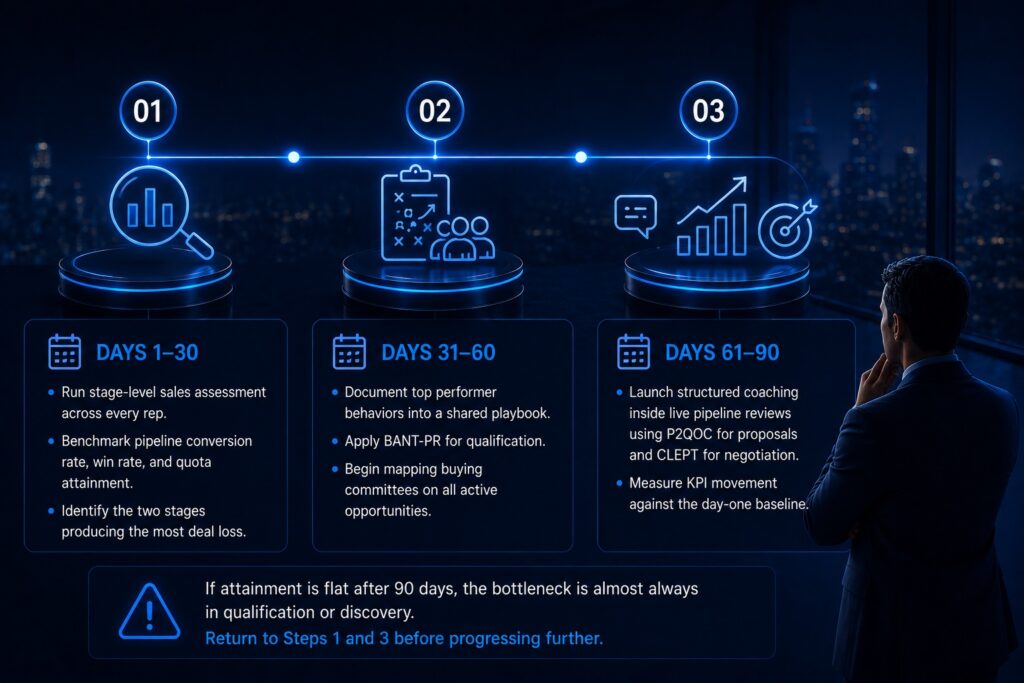
This framework produces visible results within 90 days when the six steps are applied in sequence. Leading indicators move first: discovery quality, multi-threading, and qualification completion improve within the first 60 days. Win rate and quota attainment follow in the subsequent quarter as the pipeline built during this period matures.
| Phase | Focus | Specific Actions |
|---|---|---|
| Days 1 to 30 | Assess |
Run a stage-level sales assessment across every rep. Benchmark pipeline conversion rate, win rate, and quota attainment. Identify the two stages producing the most deal loss. |
| Days 31 to 60 | Standardize |
Document top performer behaviors into a shared playbook. Apply BANT-PR for qualification. Begin mapping buying committees on all active opportunities. |
| Days 61 to 90 | Coach and Measure |
Launch structured coaching inside live pipeline reviews using P2QOC for proposals and CLEPT for negotiation. Measure KPI movement against the day-one baseline. |
If attainment is flat after 90 days, the bottleneck is almost always in qualification or discovery. Return to Steps 1 and 3 before progressing further.
Conclusion
Improving sales performance in B2B tech is not about applying more pressure on the same levers. It is about applying the right intervention at the right stage, with the coaching infrastructure to make the improvement compound across quarters rather than fade after a single initiative.
The six steps in this framework are a sequence built for exactly that: identify the stage-level gaps, transfer what top performers do into a shared playbook, improve qualification and stakeholder engagement, remove the friction that makes deal cycles long, raise win rates at proposal and negotiation, and build a coaching system that keeps all of it working after the program ends.
A sustainable B2B tech sales strategy does not depend on a few top performers carrying the rest. It depends on a structure where consistent execution is the default across the team.
Start With the Right Diagnosis
Before investing in training, coaching, or headcount, know exactly which stages are costing your team the most deals. The Revenue Gap Diagnostic benchmarks your reps against the top 4% of B2B tech sales professionals across all five deal stages. Free. 20 minutes. Get Instant Report. No sales call required.
Frequently Asked Questions
How do you improve sales performance in B2B tech companies?
Start with a stage-level sales assessment before choosing any intervention. Performance problems in B2B tech sit at specific stages of the deal cycle, not uniformly across the team. The six-step framework in this article gives you the sequence: identify stage-level gaps, standardize top performer behaviors, improve qualification and multi-threading, shorten deal cycles, raise win rates at proposal and negotiation, and build continuous coaching. Apply them in order for compounding results rather than isolated improvements.
What are the biggest causes of poor sales performance in B2B tech?
The most consistent causes are deals advancing on rep optimism rather than buyer evidence, single-threaded selling that collapses when one stakeholder loses momentum, and coaching that happens after deals close rather than inside live pipeline reviews. All three are structural, not talent gaps.
Which KPIs should B2B tech companies track to measure performance improvement?
Track pipeline conversion rate by stage, post-proposal win rate, sales cycle length by stage, and quota attainment by cohort. Together these show where deals are breaking down, whether proposals are converting, how fast pipeline is moving, and whether coaching is compressing the gap between your highest and lowest performing rep groups.
How long does it take to improve sales performance in a B2B tech team?
Leading indicators move in 60 to 90 days: discovery quality, multi-threading, and qualification completion rates improve when coaching is embedded in active pipeline reviews. Win rate and quota attainment follow in the next quarter. Globant reduced deal cycle length by 34 percent in six months. UGAM grew pipeline by 28 percent in 90 days. Both outcomes came from fixing specific stage-level gaps with structured coaching, not from running team-wide training events.
What is the role of sales coaching in improving performance?
Sales coaching converts framework knowledge into field behavior. 87 percent of training content is forgotten within 30 days without reinforcement (CSO Insights). Coaching embedded in active deals produces 3x the ROI of coaching delivered separately from live pipeline, because a rep applies guidance immediately when it is tied to the deal in front of them.
How can technology help improve B2B sales performance?
Technology improves performance when it surfaces the right information at the right moment in a live deal, not when it generates reports that confirm what already happened. The highest-impact tools give managers real-time visibility into stage-level deal health, connect coaching to specific pipeline evidence, and benchmark each rep’s execution against top performer behavior at the stage level.