
For more than 30 years, sales leaders have searched for the “right” sales methodology.
- MEDDIC
- SPIN
- Sandler
- Challenger
Millions of dollars are spent every year training sales teams to follow these frameworks, yet most organizations continue to struggle with inconsistent performance, unpredictable pipelines, and win rates that refuse to improve.
The obvious conclusion is that companies are choosing the wrong methodology.
The real answer is far more uncomfortable.
Sales methodologies were never designed to improve sales performance.
They were designed to organize the sales conversation.
Those are two very different things.
MEDDIC has been a staple of enterprise sales training for over thirty years. SPIN Selling has been in print since 1988. Sandler has built a global training business on its methodology. All three are respected, and all three, applied without modification to the modern B2B tech environment, will leave significant revenue on the table.
The problem is not what these methodologies teach. It is what they were not designed for:
Sales methodologies are not the engine of sales performance. They are navigation systems. The engine is stage-by-stage capability.
Every sales methodology assumes the salesperson already possesses stage-specific selling skills.
That assumption is exactly why most sales transformations fail.
This article explains exactly where MEDDIC, SPIN, and Sandler leave gaps in B2B tech sales, what high-performing teams do differently to close those gaps, and how the right skills turns those behaviors into a repeatable revenue system rather than a set of individual habits that live or die with your top performers.
Why Traditional Sales Frameworks Struggle in Modern B2B Tech Sales
This is not an argument against MEDDIC, SPIN, or Sandler.
- Each has made valuable contributions.
- MEDDIC improves qualification.
- SPIN improves questioning.
- Sandler improves buyer psychology.
The problem is that each focuses primarily on how to conduct part of the conversation, not why a salesperson succeeds or fails inside each sales stage.
MEDDIC, SPIN, and Sandler were developed when a primary economic buyer often held sufficient authority to make a technology decision independently. The modern B2B tech deal is structurally different. Average buying committees now include ten to thirteen stakeholders (Gartner, 2025). Average enterprise sales cycles have stretched to 6.5 months, thirty-eight percent longer than in 2021 (Ebsta x Pavilion, 2025). Win rates have declined to 20 to 21 percent, down from 29 percent in 2022 (Hyperbound, 2025).
The consequence is not that these frameworks stop working entirely. It is that they stop working at the committee level, the procurement level, and the consensus level where modern B2B tech deals are ultimately decided. A rep who has executed MEDDIC perfectly can still lose a deal because procurement raised a security objection that nobody had mapped. A rep who has run a textbook SPIN discovery can still produce a proposal that the champion loves and the committee rejects. A rep who has applied Sandler with precision can still watch a deal stall because the buying committee never aligned around a shared definition of the problem.
A methodology assumes the salesperson already possesses the necessary skills. Reality is different.
A SaaS sales strategy built entirely on traditional frameworks produces inconsistent results not because the frameworks are wrong, but because the buying environment has changed faster than the methodology has been updated to reflect it.
The Biggest Mistake Sales Leaders Make
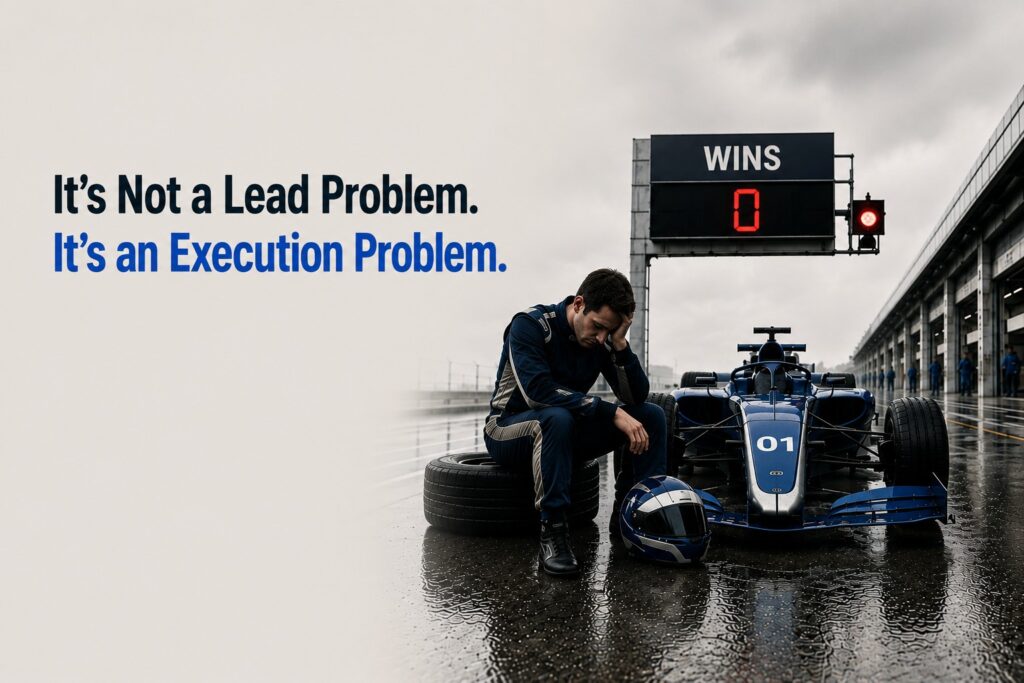
- Imagine you own a Formula 1 team.
- Your drivers are losing races.
- Would you solve the problem by giving every driver the same racing manual?
- Of course not.
- You would first determine why they are losing.
- One driver brakes too late.
- Another accelerates too early.
- Another loses time exiting corners.
- Another struggles in wet conditions.
- The problem isn’t the racing methodology.
- The problem is execution.
- Sales works exactly the same way.
Most organizations respond to declining revenue by introducing another methodology, assuming that every salesperson suffers from the same problem.
- They don’t.
- One salesperson struggles to prospect.
- Another asks weak discovery questions.
- Another cannot uncover business pain.
- Another fails to build emotional urgency.
- Another discounts too quickly.
- Another loses deals during procurement.
- All of these people need different coaching.
- Yet they all receive exactly the same training.
- That is like prescribing the same medication to every patient regardless of the diagnosis.
The Four Gaps That MEDDIC, SPIN, and Sandler Don’t Fully Address
If your team has been trained on one or more of these frameworks and the results are inconsistent, that is not a failure of your people or your training budget. It is a mismatch between the framework’s design context and the environment your reps are selling into every day.
Qualification Doesn’t Reflect the Entire Buying Committee
The MEDDIC sales methodology is one of the most rigorous buyer qualification frameworks ever built. It forces reps to identify the economic buyer, document decision criteria and process, confirm the pain, and develop a champion. In modern B2B tech, these six elements are necessary but not sufficient. MEDDIC identifies who the economic buyer is. It does not provide a structured approach to mapping the full buying committee or to surfacing the procurement, legal, and security risks that will arise in stages where no selling happens. The result is deals with well-qualified champions that still die at procurement because the risk landscape beyond the champion was never mapped.
Sales qualification in this environment needs to go beyond champion identification. It needs to document every stakeholder with sign-off authority, surface the internal approval process, and map the specific risks that each review stage will raise.
If your reps can name the economic buyer and articulate decision criteria but cannot describe the procurement risk profile, the sales qualification is incomplete for the environment they are selling in.
Discovery Doesn’t Scale Across Multiple Stakeholders
SPIN Selling introduced one of the most important ideas in consultative selling techniques: that the right questions, asked in the right sequence, move a buyer from implied to explicit need in a way that no feature presentation can. Its limitation in B2B tech is architectural. SPIN assumes a primary buyer who can be guided through a linear discovery framework. In an enterprise tech deal, sales discovery must happen across multiple stakeholder groups, each arriving with a different definition of the problem. The technical evaluator’s implication questions are not the same as the CFO’s need-payoff questions. Running SPIN with a single champion produces a proposal that satisfies that champion and confuses the committee.
A discovery framework designed for this environment runs parallel conversations across stakeholder groups rather than a single linear sequence. It maps each stakeholder’s definition of the problem, the business impact they attach to it, and the internal timeline they are working to.
Buyer Psychology Alone Doesn’t Remove Technical Roadblocks
Sandler’s psychological sophistication is genuine. Understanding that reps who appear too eager create resistance, and that upfront contracts reduce late-stage objections, is correct and valuable. Where Sandler leaves a gap is in what happens beyond the primary buyer relationship. Technical buyer resistance in enterprise tech is often structural, not psychological. A security team has a standard objection process that does not change based on relationship quality. A procurement department has a standard negotiation playbook regardless of how much the champion likes the product.
The reps who close complex B2B tech deals consistently are not the ones with the best relationship instincts alone. They are the ones who know which structural objections will surface at procurement, have evidence ready to address them before they arise, and have built enough committee alignment that no single stakeholder’s concern can stall the deal. Psychology gets you to the committee meeting. Structure is what gets you through it.
Modern Procurement Creates Challenges Traditional Frameworks Don’t Cover
None of the three frameworks were developed in an environment where enterprise procurement routinely included security audits, data privacy reviews, legal contract negotiations, and compliance sign-off as standard steps in a technology purchase. These processes now add weeks or months to deals the rep and champion consider essentially closed. A complex sales process in B2B tech does not end when the champion approves.
The table below summarizes where each framework was designed to operate and where the gap opens in modern B2B tech.
| Framework | What It Does Well | Where It Falls Short in B2B Tech |
|---|---|---|
| MEDDIC Sales Methodology | Identifies economic buyer and decision criteria. | Does not map the full buying committee or procurement risks in multi-stakeholder deals. |
| SPIN Selling | Uncovers implied and explicit buyer needs. | Linear discovery assumes one buyer and does not scale across diverging stakeholder groups. |
| Sandler System | Manages buyer psychology and upfront contracts. | Does not address procurement friction or consensus selling across large buying committees. |
| BANT-PR (TALSMART) | Adds buyer process and risk to qualification. | Closes the committee and procurement gaps the three above leave open. |
| P2QOC (TALSMART) | Structures proposals for multi-stakeholder alignment. | Creates committee consensus rather than relying on single-champion enthusiasm. |
The right answer is not to discard these frameworks. It is to add the layers they are missing at the committee, procurement, and consensus level.
Not sure which stage is slowing your team down?
The Revenue Gap Diagnostic benchmarks your reps across five B2B tech deal stages against the top 4% of performers globally. Free. 20 minutes. Get Instant Report.
What High-Performing B2B Tech Sales Teams Do Differently
Sales is not a collection of isolated activities. It is a chain reaction.
- Poor prospecting creates weak qualification.
- Weak qualification creates poor discovery.
- Poor discovery produces generic proposals.
- Generic proposals create price pressure.
- Price pressure destroys negotiations.
- Weak negotiations delay closing.
- One weak stage contaminates every stage that follows.
- No methodology can compensate for a broken sales process upstream.
At TALSMART, we don’t begin with methodology. We begin with sales engineering. Every sales stage is broken down into measurable competencies that influence buyer decisions. Our proprietary 3D learning models deconstruct each sales stage further into these measurable components, allowing sales leaders to identify precisely where execution breaks down and coach the underlying capability, not merely reinforce a generic methodology.
High-performing sales organizations don’t become great because every rep memorized the same framework. They become great because every stage of the sales process is executed with speed, precision, and consistency. The methodology simply provides structure. Capability creates results.
Sales performance is not built by teaching everyone the same process.
- It is built by diagnosing individual capability gaps, strengthening each sales stage, and continuously reinforcing those skills through coaching in live opportunities.
- When every stage improves, the entire revenue engine improves.
- That is how predictable sales organizations are built.
Build Relationships Beyond a Single Champion
High-performing teams treat multi-threading as a qualification standard, not an optional tactic. A deal that has reached proposal stage with fewer than three named stakeholder contacts is a single-threaded deal wearing the appearance of a qualified opportunity. Research from Gong Labs shows that deals with three or more stakeholder contacts have a twenty-four percent higher close rate than single-threaded ones (Gong Labs, 2025). After every discovery conversation, the rep should identify which stakeholders have not yet been contacted and build a specific engagement plan with the champion’s support.
Multi-threading also protects pipeline health. When a rep has relationships at three levels of the buying organization, a single stakeholder changing roles, going on leave, or losing internal support does not collapse the deal.
Run Discovery for Every Stakeholder Group
Improving B2B tech sales performance at the discovery stage means running structured conversations with each stakeholder group, not a single conversation with the primary champion. The economic buyer’s definition of the problem is financial. The technical evaluator’s is architectural. A discovery process that surfaces only the champion’s definition produces a proposal built for one person and reviewed by ten.
The practical test for quality discovery in a B2B tech deal is whether the rep can articulate the specific business impact of the problem from the perspective of at least three different stakeholders before writing the proposal. If they can only articulate it from the champion’s perspective, discovery is incomplete.
Address Procurement Risks Earlier
The BANT-PR framework extends standard qualification (Budget, Authority, Need, Timeline) with two layers specific to B2B tech: buyer Process and Risk. Decision mapping at this level documents how the decision will actually be made internally, which approval stages exist, and what procurement, legal, and security review looks like in practice. Risk mapping surfaces the specific objections those stages will raise before they arrive as late-stage blockers.
Teams that address security and legal objections as part of the qualification conversation, instead of waiting for them to surface at stage four, consistently show shorter procurement timelines in the TALSMART Revenue Gap Diagnostic benchmark data. The objection does not disappear. It just gets handled while there is still time to route around it.
Create Stakeholder Consensus Before Proposals
The P2QOC method (Pause, Paraphrase, Question, Offer, Confirm) structures proposal delivery for multi-stakeholder B2B tech deals. Before presenting any solution, the rep pauses and paraphrases each stakeholder’s stated priority. A question surfaces what has not yet been said. Only then does the rep offer the solution, mapped to the confirmed priorities, and confirm a specific next step with a named owner and a date.
The effect of this approach is that the proposal is experienced by the committee as something they helped shape rather than something the vendor brought in. In consensus selling environments, that distinction is the difference between a committee that approves and a committee that asks for another meeting.
Structure Negotiation So Price Pressure Doesn’t Default to Discounting
When price pressure arises at negotiation, it almost always signals that the value case was not fully built in the stages before it. The CLEPT framework (Compromise, Logic, Emotion, Power, Trade) gives reps a structured way to respond to negotiation pressure without defaulting to a discount. Logical objections are handled with evidence. Emotional concerns are acknowledged before they are reframed. Power moves are met with firmness rather than concession. Trade options create movement in the deal without unilateral margin erosion.
If discounting is the first response to resistance rather than the last, it signals to the buyer that the value case was weaker than the rep believed. CLEPT exists to give reps other moves to make before price becomes the only lever left.
Reinforce Methodology Through Live Deal Coaching
Eighty-seven percent of training content is forgotten within thirty days without reinforcement (CSO Insights). Sales coaching that reinforces BANT-PR, P2QOC, and multi-threading is most effective when it happens inside a live pipeline review on an active deal, not in a retrospective conversation about one that has already closed.
Live deal coaching also raises the floor of the whole team rather than depending on the ceiling of the top performers. When a manager uses real deal data to coach a middle-performing rep on why a specific discovery conversation did not surface the procurement risk that showed up three stages later, that rep applies the lesson on the next active deal.
Turning Modern Sales Principles Into a Repeatable Revenue System
The behaviors above compound when they are connected inside a structured system. A sound B2B tech sales strategy does not replace MEDDIC, SPIN, or Sandler. It extends them with three additional layers: committee qualification that maps every stakeholder and procurement risk, discovery that runs parallel conversations across stakeholder groups, and consensus-building that creates internal alignment before the proposal. TALSMART’s Revenue Execution System (Diagnose, Build, Execute, Lead) connects these layers into a structure where the right behavior at each stage reinforces the next.
Globant implemented structured committee mapping and procurement risk qualification as standard deal entry criteria and reduced its average deal cycle by thirty-four percent in six months. (TALSMART Revenue Gap Diagnostic)
What makes this a system rather than a set of techniques is that each element depends on the previous one. Multi-threading enables better discovery because more stakeholders are accessible. Better discovery enables better proposals because each stakeholder’s pain is documented before the value case is built. Better proposals enable consensus because the committee recognizes their priorities in what is being presented. And coaching that reinforces each of these behaviors at the deal level is what makes the system run consistently rather than depending on individual reps to figure out the sequence on their own.
Why Even the Best Sales Methodology Needs Reinforcement
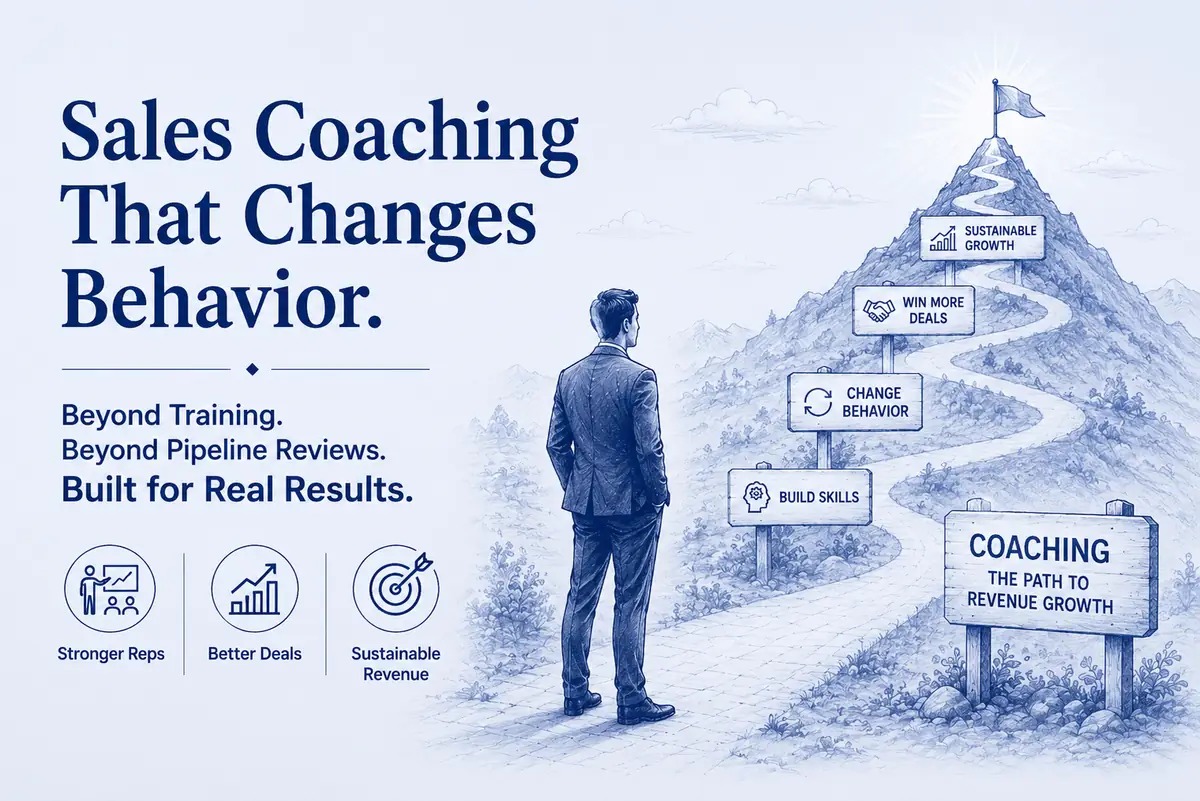
Tech sales training delivers lasting value only when it is embedded in real deal activity. Without reinforcement, the methodology fades. With sales coaching inside active pipeline reviews, it compounds. Dynamic coaching in live deals correlates with a twenty-one percent improvement in quota attainment and a nineteen percent improvement in win rates (Ebsta x Pavilion, 2025). An effective sales enablement strategy treats coaching as the mechanism connecting methodology to field behavior, not as an add-on after training is complete.
The question most sales leaders ask after investing in a methodology is not whether the training was good. It is why the improvement did not sustain past the first quarter. The answer is almost always the same: the reinforcement layer was missing. The methodology was trained in a workshop and then left to transfer to the field independently. Without a coaching infrastructure that connects what was learned to what is happening in live deals right now, the improvement is real but temporary.
Find Out Which Framework Gaps Are Costing Your Team Deals
The Revenue Gap Diagnostic benchmarks your team against the top 4% of B2B tech sales professionals across five deal stages. Free. 20 minutes. Get Instant Report. No sales call required.
Conclusion
MEDDIC, SPIN, and Sandler are not wrong. They are incomplete for the environment in which B2B tech deals are now made. The gaps they leave open are specific: qualification that does not cover the full buying committee, discovery that assumes a linear conversation with one buyer, and negotiation tools that do not address structural procurement friction. What high-performing teams do differently is close those gaps systematically, through multi-threading, stakeholder-specific discovery, early procurement risk mapping, committee consensus at proposal, structured negotiation, and methodology reinforced through live deal coaching.
The enterprise sales framework that produces consistent results in this environment is not a single methodology. It is a system that connects the right approaches to the right stages and builds the coaching infrastructure that keeps them alive in the field between training events.
Frequently Asked Questions
What is the MEDDIC sales methodology and why is it not enough for B2B tech?
MEDDIC (Metrics, Economic Buyer, Decision Criteria, Decision Process, Identify Pain, Champion) is a strong foundation for buyer qualification, particularly for identifying the economic buyer and decision criteria. Its limitation in modern B2B tech is that it does not map the full buying committee beyond the economic buyer, does not surface procurement or security risks as part of qualification, and does not provide structure for multi-stakeholder discovery or consensus selling.
Why do SPIN and Sandler fall short in complex B2B tech deals?
SPIN Selling assumes a linear discovery process with one primary buyer, which does not scale across B2B tech deals where discovery must happen across multiple stakeholder groups with diverging priorities. Sandler’s strength is in buyer psychology but it does not address structural procurement friction that enterprise tech deals encounter at stage four.
What is multi-threading in B2B sales and why does it matter?
Multi-threading is the practice of building active relationships with multiple stakeholders inside a buying organization rather than depending on a single champion. In B2B tech deals involving an average of ten to thirteen decision makers (Gartner, 2025), a single-threaded deal collapses when one stakeholder changes roles or loses momentum. Deals with three or more stakeholder contacts have a twenty-four percent higher close rate than single-threaded deals (Gong Labs, 2025).
What is the BANT-PR framework and how does it improve qualification?
BANT-PR extends standard qualification (Budget, Authority, Need, Timeline) with buyer Process and Risk. Process mapping documents how the decision will actually be made internally and which approval stages exist. Risk mapping surfaces the specific objections procurement, legal, and security review will raise before they arrive as late-stage blockers.
What is the CLEPT framework and when is it used?
CLEPT (Compromise, Logic, Emotion, Power, Trade) is TALSMART’s structured approach to handling negotiation pressure without defaulting to a discount. It gives reps a specific response for each type of resistance: evidence for logical objections, reframing for emotional concerns, firmness for power moves, and trade options that create movement without giving away margin.
How does sales coaching connect to methodology effectiveness?
Sales coaching prevents methodology from fading after training ends. Eighty-seven percent of training content is forgotten within thirty days without reinforcement (CSO Insights). Coaching embedded in active pipeline reviews produces twenty-one percent higher quota attainment and nineteen percent higher win rates than training alone (Ebsta x Pavilion, 2025).
What does a complete enterprise sales framework for B2B tech look like?
A complete enterprise sales framework for B2B tech combines MEDDIC’s qualification depth with committee mapping and procurement risk analysis, SPIN’s discovery rigor with stakeholder-specific questioning, and Sandler’s psychological sophistication with structural tools for procurement friction. TALSMART’s BANT-PR, P2QOC, and CLEPT frameworks fill each of these gaps and produce their full impact when reinforced through sales coaching embedded in live pipeline reviews.