
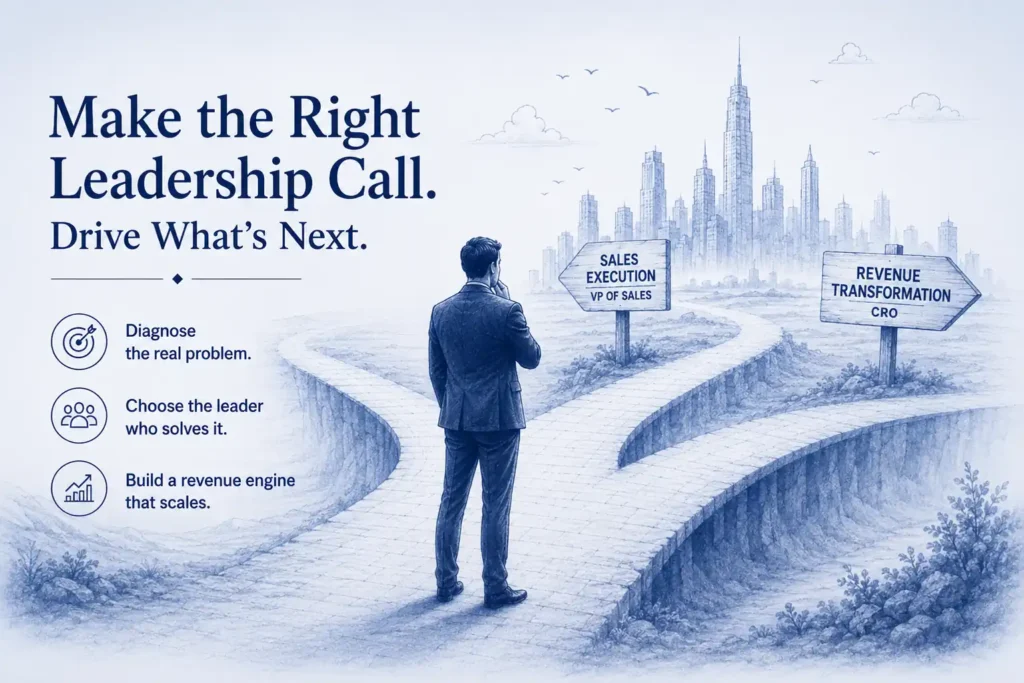
Asking whether you need a CRO or a VP of Sales is the wrong question.
Not because the distinction does not matter. Because the answer you get depends entirely on a question nobody asks first: what revenue problem are you actually trying to solve?
Get that question wrong and it does not matter which title you hire. The revenue problem survives the hire.
Clara’s software company had just passed $12 million ARR. She had a VP Sales she trusted. The team was performing. The pipeline was active. But three consecutive quarters had produced results that were close to target without ever hitting it. The board was patient but not indefinitely. Clara decided she needed a CRO.
The CRO she hired had scaled two previous companies from $10 million to $50 million. The board approved the decision inside a week. Twelve months later, Clara’s revenue problem looked exactly the same. Not because the CRO was wrong. Because the problem was not a CRO problem. The sales motion was working. The qualification discipline was inconsistent. What the company needed was deeper sales execution capability and a VP Sales who could build it.
The CRO title had answered the wrong question.
If you have promoted or hired a senior revenue leader and felt the revenue pressure ease briefly before returning to exactly where it was, the hire was probably targeted at the symptom rather than the cause. That is not a hiring failure. It is a diagnostic failure. The role was defined before the problem was.
Choosing between a CRO and VP of Sales without defining the revenue challenge first is like choosing between a structural engineer and an interior designer before deciding whether you are building a new house or renovating an existing one. Both are qualified. Only one is relevant. And picking the wrong one does not make the building better. It makes the project longer and more expensive.
The Revenue Execution System (Diagnose, Build, Execute, Lead) starts with the diagnosis. The Lead layer, which is where revenue leadership sits, cannot be correctly specified until the gap it must close has been identified. Before the title comes the problem. Always.
Not Sure Which Revenue Problem You Are Actually Solving?
The Revenue Gap Diagnostic maps exactly where your commercial system is breaking down. That output tells you which leadership capability you need. Free. 20 minutes. Get an Instant Report.
The Biggest Hiring Mistake: Choosing Based on Title Instead of Capability
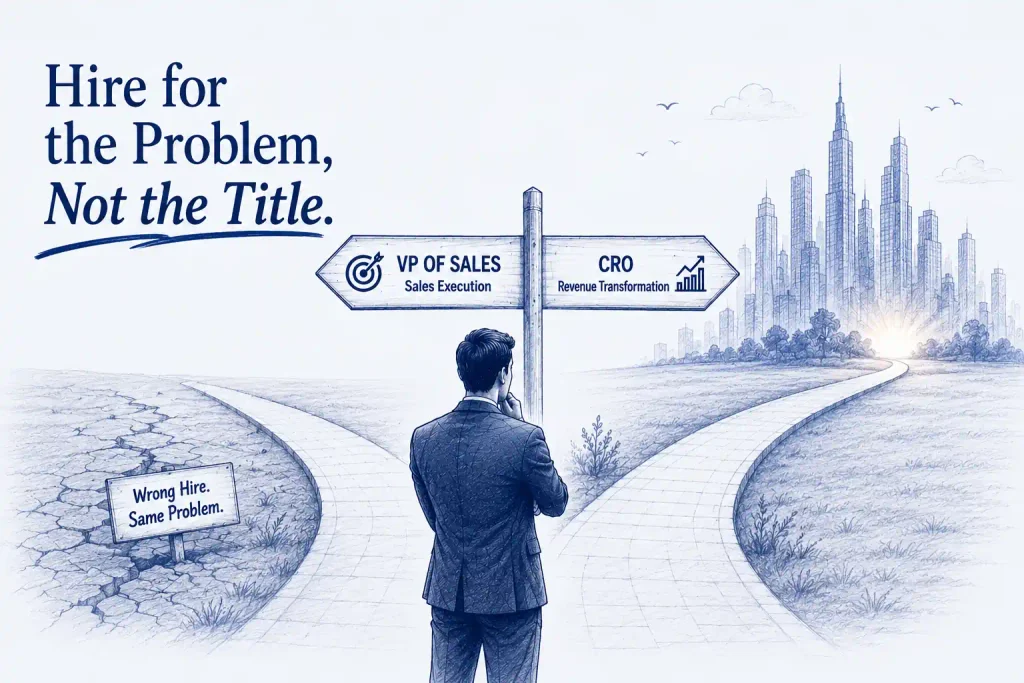
The most expensive revenue hiring mistake is not hiring the wrong person. It is hiring for the wrong problem. A VP Sales with the wrong brief and a CRO with the wrong brief produce the same outcome: the revenue problem that prompted the hire is still there twelve months later, and now there is a new search to run on top of it.
Companies make this mistake in a specific sequence. The board asks why growth has stalled. The CEO identifies that revenue leadership is the gap. The conversation moves immediately to which title to hire rather than to what specific commercial problem the incoming leader must solve. The job description is written before the revenue problem is defined. The search produces the best available candidate. The wrong role gets filled correctly.
Sales Execution vs. Revenue Transformation
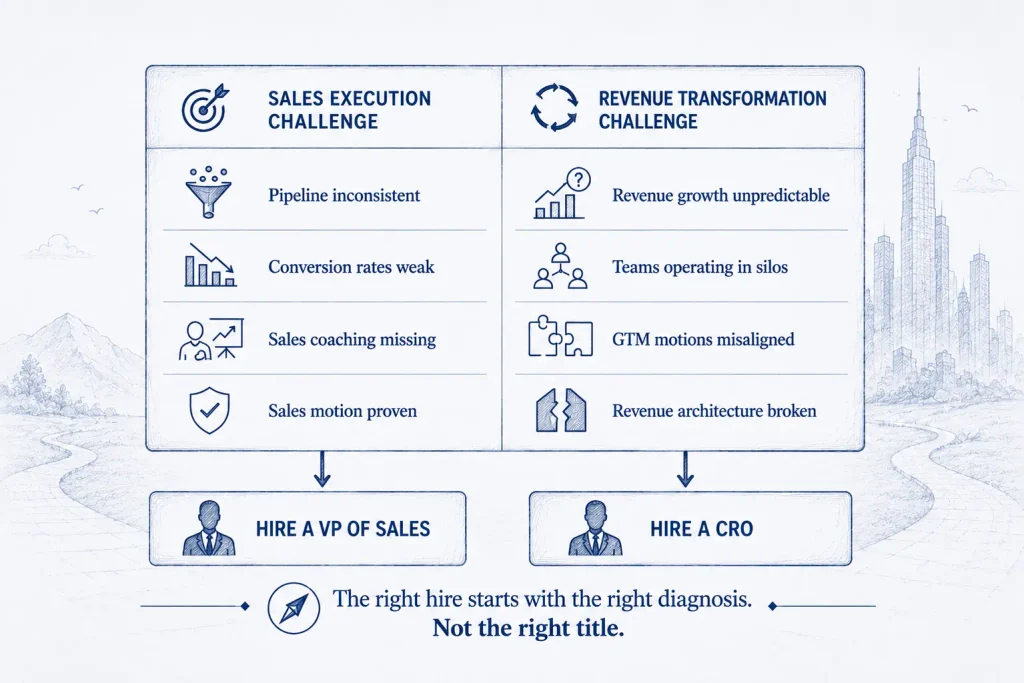
A sales execution challenge looks like this: the pipeline is there, the product is competitive, the sales motion has worked before, but conversion rates are inconsistent, forecast accuracy is poor, or individual rep performance varies too widely. The problem lives inside the sales function. The fix requires stronger sales leadership, better coaching infrastructure, and tighter execution discipline.
A revenue transformation challenge looks different: growth has become unpredictable not because of how sales is run but because sales, marketing, and customer success are operating as separate functions with misaligned goals. The pipeline exists but the hand-offs are broken. Customer retention is undermining the revenue growth that new business is creating. The go-to-market model that worked at $5 million ARR is straining against a $20 million environment. The problem is not inside sales. It is across the entire revenue system.
Identifying which type of challenge exists before defining the role is the most important decision in the hiring process. Everything that follows from it either compounds or corrects the outcome.
What Does a VP of Sales Actually Own?
A VP of Sales owns the sales function. Pipeline quality and volume. Conversion rates at every stage of the sale. Sales team performance, capability development, and coaching. Forecast accuracy and revenue predictability within the sales channel. The improvement and optimization of an existing sales motion.
The VP of Sales role is fundamentally an execution role. When the commercial strategy exists and the GTM motion is defined, the VP of Sales is the leader who makes that motion run consistently, trains the team to execute it, and improves the system wherever it is leaking revenue.
When a VP of Sales Is the Right Choice
Choose a VP of Sales when the sales motion is fundamentally working but execution is inconsistent. When the pipeline is the right size but conversion is the problem. When the existing sales team needs stronger leadership, coaching, and accountability. When the revenue challenge lives inside the sales function rather than across the entire commercial organization.
Sales coaching capability is the clearest indicator of whether a VP of Sales will improve team performance or simply manage it. The VP of Sales who builds a coaching infrastructure that runs without their constant presence is the one who creates compounding improvement rather than a temporary lift.
If your sales motion is validated, your team is the right size, and the gap is execution discipline rather than revenue architecture, a VP of Sales is the right hire. Bringing a CRO into that environment adds cost and complexity without solving the actual problem.
What Does a CRO Actually Own?
A CRO owns the entire revenue model. Not just sales. Revenue operations, pipeline design, go-to-market strategy, marketing and sales alignment, customer success, and the commercial architecture that connects them. The CRO’s mandate is not to optimize what exists. It is to design and build the system that produces predictable revenue at the company’s next stage of scale.
The CRO is the right hire when the revenue challenge has grown beyond what any single function can solve. When the problem is structural, cross-functional, and strategic rather than execution-level and contained within sales.
When a CRO Is the Right Choice
Choose a CRO when revenue teams are operating in silos with misaligned metrics and broken hand-offs. When growth has become unpredictable in a way that sales management changes cannot fix. When multiple GTM motions exist and none of them are being optimized together. When the company is entering a growth phase that requires a revenue architecture redesign rather than a sales execution improvement.
Executive search for a CRO is a different exercise from executive search for a VP of Sales. The CRO candidate pool is smaller, the assessment is more complex, and the revenue gap diagnostic that precedes the search is not optional. Without it, the search optimizes for an impressive candidate rather than the right one.
If revenue growth has become unpredictable despite a functioning sales team, if customer success is losing accounts that sales are closing, if marketing and sales cannot agree on what a qualified opportunity looks like, the problem is a CRO problem. Hiring a VP of Sales into that environment adds execution capacity to a broken architecture.
CRO vs. VP of Sales: The Key Differences
The most common mistake in this decision is treating CRO and VP of Sales as points on a seniority scale. They are not. A CRO is not a more senior VP of Sales. They are structurally different roles with different mandates, different ownership, and different success criteria. A company that hires a CRO to solve a VP of Sales problem does not get a better result. It gets a more expensive version of the same outcome. The six dimensions below show where the roles diverge in practice.
| Dimension | VP of Sales | CRO |
|---|---|---|
| Primary Focus | Sales execution and team performance | Revenue transformation across all functions |
| Core Ownership | Sales organization | Sales, marketing, customer success, and revenue operations |
| Main Challenge | Pipeline and conversion performance | Revenue alignment, predictability, and strategic growth |
| GTM Scope | Existing and optimized sales motion | Multiple or evolving GTM motions designed for scale |
| Cross-Functional Responsibility | Primarily within sales | Across every revenue-generating function |
| Growth Requirement | Optimize what exists | Transform the revenue system for the next stage |
| Leadership Need | Sales management and execution | Strategic revenue leadership and architecture |
The distinction is not seniority. It is scope. A VP of Sales can be the right hire at $50 million ARR and a CRO can be the right hire at $8 million ARR. The growth challenge determines the role.
Define Your Revenue Challenge Before Defining the Role
The Revenue Gap Diagnostic maps which commercial functions are breaking down and which leadership capabilities are needed to fix them. Free. 20 minutes. Get an Instant Report.
How to Decide Which Revenue Leader You Need
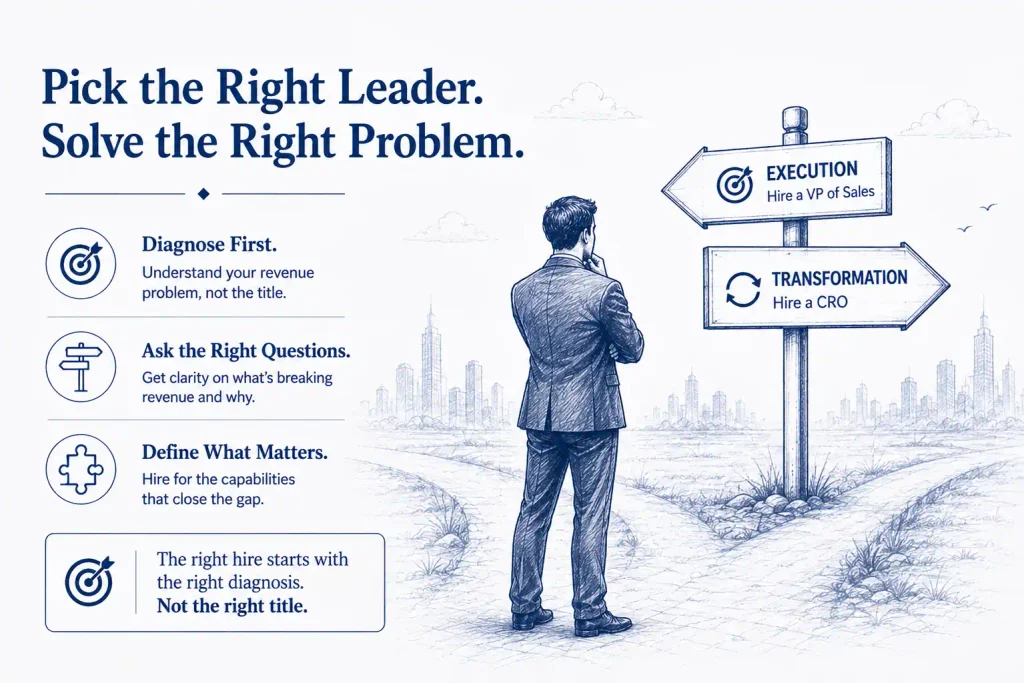
The decision is a diagnostic exercise. Not a benchmarking exercise. The question is not what other companies at your stage have hired. It is what specific revenue problem your company is facing and which leadership capability will solve it.
Choose a VP of Sales If Your Problem Is Execution
The sales motion is validated and works when executed well. Pipeline execution is inconsistent. Sales management needs strengthening. Forecast accuracy varies because of rep behavior, not because of structural misalignment across functions. Conversion at the qualification or discovery stage is the primary drag. The organization primarily needs better sales execution, not a redesigned revenue system.
Tech sales training and capability development within the sales team are often part of what a VP of Sales needs to implement. A VP Sales who inherits a team with uneven stage-level execution needs to understand where each rep is breaking down and build targeted development plans around those specific gaps. That is a sales execution mandate, not a revenue transformation one.
Choose a CRO If Your Problem Is Transformation
Revenue functions are disconnected and operating with different definitions of success. Growth has become unpredictable in a way that improving sales execution alone will not fix. Multiple GTM motions exist across different products, markets, or customer segments that are not being aligned. Revenue ownership genuinely extends beyond sales into marketing, customer success, and operations. The company needs strategic transformation of the revenue system rather than optimization of the sales function within it.
Ask These Questions Before You Hire
Is the sales motion fundamentally working, or is it structurally broken? Where is revenue actually breaking down, inside sales or across the commercial organization? Is the predictability problem caused by sales execution or by misalignment between revenue functions? How complex is the current GTM model and is it increasing in complexity? What capabilities will the revenue function need at the next stage of growth that it does not have today?
Answering these five questions produces a leadership profile that is specific to the company’s actual situation rather than a generic description of a CRO or VP of Sales role. That profile is the only brief worth building a search around.
Define the Leadership Capabilities Before Searching
Before searching for a revenue leader, define the leadership capabilities required for the next stage of growth. This is the most important step in the hiring process and the one that is most consistently skipped in favor of getting the search started quickly.
Start With the Growth Challenge
What does the company need to accomplish in the next eighteen months that its current revenue structure cannot deliver? Is the constraint pipeline volume, conversion quality, forecast predictability, GTM alignment, or revenue architecture? Defining the growth challenge with this level of specificity produces a leadership profile that is actionable rather than aspirational.
Build the Leadership Capability Profile
The capability profile maps required experience and skills against six dimensions: sales leadership and team development, revenue strategy and architecture, GTM design and execution, cross-functional alignment across sales, marketing, and customer success, revenue operations and data capability, and organizational leadership at the executive level. Not every role requires depth in all six. The revenue gap diagnostic identifies which dimensions matter most for this specific company at this specific stage.
Assess Capability, Not Just the Resume
Previous titles do not automatically demonstrate capability. A CRO who scaled revenue at a company with a mature product, an established brand, and a large marketing budget may not be the right candidate for a company that needs to build its GTM motion from scratch. A VP Sales who improved execution in a stable environment may not have the strategic capability required for a company entering a new market.
The assessment evaluates whether the candidate can solve the specific revenue problem identified in the diagnostic, not whether their title and revenue numbers look comparable. Before searching for a revenue leader, define the leadership capabilities required for the next stage of growth. That definition is the search brief.
How TALSMART Helps Companies Choose the Right Revenue Leader
The decision between a CRO and a VP of Sales is a diagnostic exercise before it is a hiring exercise. Most companies skip the diagnostic and go straight to the search. The result is a well-executed search for the wrong role. The approach below reverses that sequence deliberately: the revenue gap is identified first, the leadership capability profile follows from it, and the search is built around the profile rather than the title.
Revenue-Gap Diagnostics
The Revenue Gap Diagnostic maps where the company’s commercial capability is breaking down, which leadership capabilities are required to address the gaps, and what the right leadership profile looks like for the company’s specific revenue challenge. The diagnostic output replaces the job description as the starting point for the search.
Expert-Led Assessment
Sales and revenue leadership capability is assessed by coaches with experience at organizations like Google and Oracle. Assessment covers commercial track record in comparable conditions, leadership and coaching methodology, GTM design capability, cross-functional alignment experience, and cultural fit with the company’s current stage of growth.
Built Exclusively for Technology Companies
The practice works exclusively with B2B technology companies. Every assessment framework, evaluator, and candidate relationship is calibrated for the specific demands of technology revenue leadership across every stage of scale.
A Recruitment Model With Skin in the Game
Elite revenue leadership candidates are identified within two weeks. No retainer is charged upfront. Own money and own time go into the search before a fee is earned. Payment is tied to the commercial performance of the placed leader. The incentive is not to fill the role. It is to find the leader who solves the problem.
A sales recruitment agency that specializes exclusively in B2B technology revenue leadership does not need to be told what a complex technology GTM environment looks like. It has built relationships inside that community continuously and reaches candidates that generalist firms never see.
B2B tech sales strategy at the leadership hiring level is not about finding someone who has read the right books. It is about finding someone who has built and adapted a revenue architecture inside the environment that actually resembles yours. That match requires a diagnostic to define and a specialist to find.
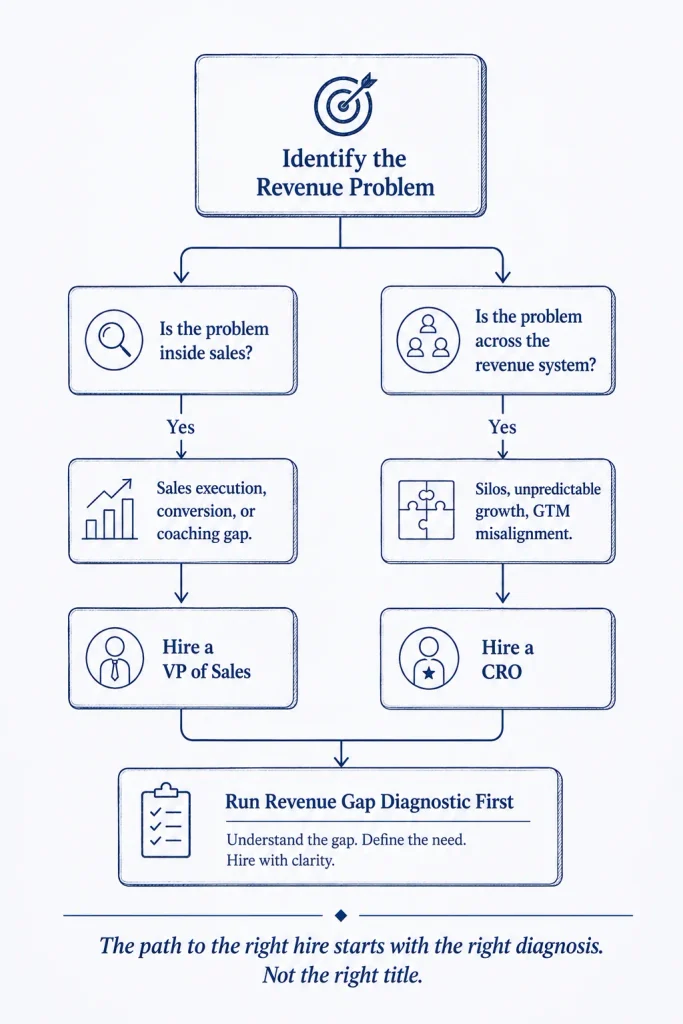
CRO or VP of Sales? Use This Decision Checklist
Most revenue leadership decisions stall because the conversation skips straight from the symptom to the title. Growth is stalling, so the answer must be a CRO. Win rates are declining, so the answer must be a VP of Sales. The reality is more specific than that. Work through the conditions below that describe your current commercial situation. The column where most of them land is the role that fits the problem.
| Role | Condition |
|---|---|
| VP of Sales | The sales motion is fundamentally working |
| VP of Sales | Pipeline execution is the primary constraint |
| VP of Sales | Sales management depth is the gap |
| VP of Sales | Forecasting or conversion needs improvement |
| VP of Sales | The business needs optimization more than transformation |
| CRO | Revenue teams operate in silos with misaligned goals |
| CRO | Growth has become unpredictable and hard to forecast |
| CRO | Multiple GTM motions exist and need alignment |
| CRO | Revenue ownership needs to extend beyond sales |
| CRO | The business needs strategic revenue transformation |
Hire for the Growth Challenge, Not the Title
Clara eventually ran the revenue gap diagnostic. The output confirmed what her instinct had been telling her for two quarters before the CRO hire: the problem was qualification discipline and coaching infrastructure inside the sales function. The sales motion was working. The execution was inconsistent.
She hired a VP Sales with a specific track record of building coaching systems in comparable B2B technology environments. Within six months, forecast accuracy had improved from 64% to 83%. The next three quarters all hit the target. The revenue problem that had survived a CRO hire was resolved by the right VP Sales.
There is no universally better choice between a CRO and a VP of Sales. The right choice depends entirely on the growth challenge the company is facing and the leadership capability required to meet it. A VP of Sales is the stronger hire when the core need is sales execution and optimization. A CRO becomes the right hire when the challenge involves broader revenue alignment, GTM complexity, and structural transformation.
Don’t ask: Do we need a CRO or VP of Sales?
Ask: What revenue problem are we trying to solve, and which leadership capabilities will solve it?
Define the Revenue Leadership Your Next Stage Requires
The Revenue Gap Diagnostic identifies where your commercial system is breaking down and produces the precise leadership capability profile the search should be built around. Free. 20 minutes.Get an Instant Report. No sales call required.
TALSMART is a global revenue execution partner and specialist revenue leadership recruitment firm for B2B technology companies, operating across 100+ countries and 23 languages.
Frequently Asked Questions
What is the difference between a CRO and a VP of Sales?
A VP of Sales owns sales execution: pipeline, team performance, conversion, forecasting, and the optimization of an existing sales motion. A CRO owns the full revenue system: sales, marketing, customer success, revenue operations, and the strategic architecture that connects them. The distinction is not seniority. It is scope. A CRO is not a more senior VP of Sales. It is a different role with a different mandate.
When should a company hire a CRO instead of a VP of Sales?
When revenue growth has become structurally unpredictable across multiple functions rather than execution-variable within sales. When sales, marketing, and customer success are operating with misaligned goals. When multiple GTM motions exist and none are being optimized as a system. When the revenue challenge requires cross-functional transformation rather than sales improvement.
When is a VP of Sales the better choice?
When the sales motion is fundamentally working but execution is inconsistent. When pipeline quality or conversion is the primary constraint. When sales management, coaching, or team development is the gap. When the revenue problem is contained within the sales function rather than spread across the commercial organization.
Does every growing technology company need a CRO?
No. Many technology companies at significant revenue scale operate effectively with a strong VP of Sales and functional heads of marketing and customer success. A CRO becomes relevant when the complexity of connecting those functions exceeds what individual function leaders can manage without a unified revenue architecture above them.
How do you determine which revenue leadership role a company needs?
Start with a revenue gap diagnostic. Identify where commercial capability is breaking down: inside sales, across functions, or at the strategic architecture level. The diagnostic output defines the leadership capability required. Match the role to that output rather than to a general sense of what companies at a similar stage typically hire.
What capabilities should companies assess when hiring a CRO or VP of Sales?
For a VP of Sales: sales execution track record in comparable environments, coaching and team development methodology, pipeline management and forecasting capability, and cultural fit with the company’s current growth stage. For a CRO: revenue architecture experience, cross-functional alignment track record, GTM design and adaptation capability, strategic leadership at the executive level, and culture fit with the company’s complexity and ambition.
How can companies assess revenue leadership capability beyond the resume?
Test problem-solving on live revenue scenarios from the company’s actual situation. Evaluate the diagnostic quality of the candidate’s questions before their answers. Reference people who have worked for the candidate, not alongside them. Measure every candidate against the revenue gap diagnostic output rather than against each other.
What role does GTM complexity play in choosing between a CRO and VP of Sales?
GTM complexity is one of the clearest signals for CRO hiring. A single validated sales motion that needs optimization is a VP of Sales mandate. Multiple products, markets, customer segments, or channel motions that need to be aligned into a coherent go-to-market architecture is a CRO mandate. The threshold is not the number of reps or the revenue figure. It is the structural complexity of the commercial model.