
When the VP of Sales left Renata’s 1,600 employee SaaS company generating roughly 60 million dollars in annual recurring revenue, she and her Head of Talent Acquisition brought in a well known retained executive search firm to find a replacement. The fee was 30% of the executive’s projected first year cash compensation, payable in installments regardless of outcome. Eleven months later, the hire was gone.
The retainer alone had run past 150,000 dollars. Add eleven months of base salary, a sign-on bonus, unearned performance incentives, a severance package, and the legal cost of the exit, and the total crossed seven figures before the company had even opened a second search. The recruiting fee, the part everyone budgets for, turned out to be the smallest line on the bill.
Renata blamed the interview process. The board blamed the market. The recruiter blamed timing. Nobody blamed the fee structure that had already been paid in full before anyone knew whether the hire would work.
This is not a story about one bad hire. It is what happens when the financial model behind executive search is built to reward placement, not performance. The résumé was strong. The interviews went well. None of that changed what the failure actually cost.
If your last executive search felt like a thorough process and still cost you well past the placement fee, the problem was never the interview. It was the financial model behind the search itself.
Paying a large upfront retainer for a SaaS executive search is a bit like buying an insurance policy that only pays out if nothing ever goes wrong. The moment the hire underperforms, the policy is void, and every other bill, salary, severance, legal fees, the cost of starting the search over, still comes due in full.
Executive hiring sits at the top of what is known internally as the Revenue Execution System: Diagnose, Build, Execute, Lead. The first three layers determine how a revenue team performs day to day. The fourth layer, Lead, determines whether any of that performance survives a leadership transition. Get this layer wrong, and the cost is rarely contained to one bad quarter.
The True Cost of a Failed SaaS Executive Hire
Most companies budget for one number when they start a search: the recruiting fee. That number is real, but it is only the entry point into a much larger cost equation.

- Executive recruiting and search fees
- Salary and compensation
- Sign-on bonuses and incentives
- Lost revenue and missed growth opportunities
- Severance and legal costs
- Cost of restarting the search
None of these costs are hidden exactly. They are simply never added together until the hire has already failed, which is precisely when the total becomes impossible to ignore. The recruiter fee is only one part of the financial risk, and treating it as the whole risk is how companies end up underestimating a bad hire by a factor of five or six.
You Can’t Price a Risk You Haven’t Diagnosed
The Revenue-Gap Diagnostic shows you exactly what capability gap your next executive needs to close, before you sign a search agreement or a retainer invoice. Free. 20 minutes. Get an instant report.
High Executive Search Fees Increase the Cost of a Bad Hire
Retained executive search firms typically calculate their fee as a percentage of the executive’s first year total cash compensation, commonly cited in the 25% to 33% range. That range is an industry norm, not a universal rule, but it holds across most retained mandates for SaaS leadership roles.
For a VP of Sales or CRO with an on-target-earnings package of 350,000 to 500,000 dollars, that fee alone lands between 87,500 and 165,000 dollars, due regardless of whether the executive is still in the role a year later. The financial exposure scales directly with how senior and expensive the role is, which means the highest-stakes hires carry the highest upfront risk before a single deal has closed.
Whether the firm markets itself as a retained executive search partner or a straightforward sales recruitment agency, the fee is structured the same way: due on placement, not on performance. That distinction, paying for a completed search versus paying for a proven outcome, is the one most companies never negotiate.
Resume Credentials Don’t Guarantee SaaS Executive Performance
An impressive résumé and a proven ability to solve your company’s specific business problem are two different things, and executive search often conflates them. A candidate who scaled revenue at a well known SaaS company may have done so with a different product, a different buyer, or a different growth stage than the one you are hiring for.
Title, company pedigree, and years of experience are the easiest things to verify and the least predictive of what happens next. What should be verified instead is whether the candidate’s specific track record maps onto your company’s actual growth problem, validated through structured assessment rather than a polished interview.
A résumé also says nothing about whether an executive can turn their own track record into structured sales coaching for the team they are about to inherit, and that gap rarely surfaces until months after the offer letter is signed. Executive talent that looks identical on paper can produce completely different outcomes depending on whether the underlying skills actually transfer to your environment. This is where revenue-gap diagnostics and role-specific assessment earn their place in the process: they replace résumé pattern-matching with evidence of what the candidate actually did, stage by stage, and whether it transfers.
The Wrong Hiring Incentives Can Prioritize Placement Over Long-Term Fit
A completed search and a long-term successful executive are not the same outcome, and a recruiter paid on placement has no financial reason to distinguish between them. Speed to close the seat should never substitute for business fit, leadership fit, cultural fit, and role-specific capability, but under a placement-based fee, speed is exactly what gets optimized.
This is not a claim that recruiters are acting in bad faith. It is a description of how the incentive is built. A firm paid on placement earns its fee the moment a candidate accepts, regardless of whether that candidate is still in the role in twelve months. There is no financial mechanism inside that model that rewards the firm for saying “this candidate is impressive but wrong for your growth stage” instead of moving them forward.
SaaS companies need a recruiter who understands the company’s actual growth problem well enough to say no to an impressive candidate who does not solve it. This is precisely the incentive problem that separates good SaaS executive recruiters from firms simply filling seats, and it is also what separates disciplined leadership hiring from a staffing transaction with an executive title attached. If a recruiter cannot explain which specific revenue problem your next executive is being hired to solve, the search is optimizing for speed, not for fit.
Inflated Executive Compensation Can Make a Bad Hire Even More Expensive
Executive compensation packages usually stack five components: base salary, equity, sign-on bonuses, performance incentives, and guaranteed compensation. Each one is negotiable, and each one compounds the exposure if the hire fails.
Compensation should reflect the scope of the role, the expected contribution, and the market value of comparable positions, not simply escalate until the candidate says yes. Third-party recruiters paid a percentage of total compensation have a direct incentive to push every one of those five components upward, since a larger package means a larger fee.
This dynamic shows up most clearly in a dedicated executive search CRO mandate, where compensation packages are large enough that a few inflated points on base salary or equity can add hundreds of thousands of dollars to the exposure before the executive has closed a single deal. Across C-suite executives generally, the same math applies. The more senior the seat, the more expensive each unnecessary concession becomes.
The Hidden Cost of Paying an Executive Who Isn’t Delivering
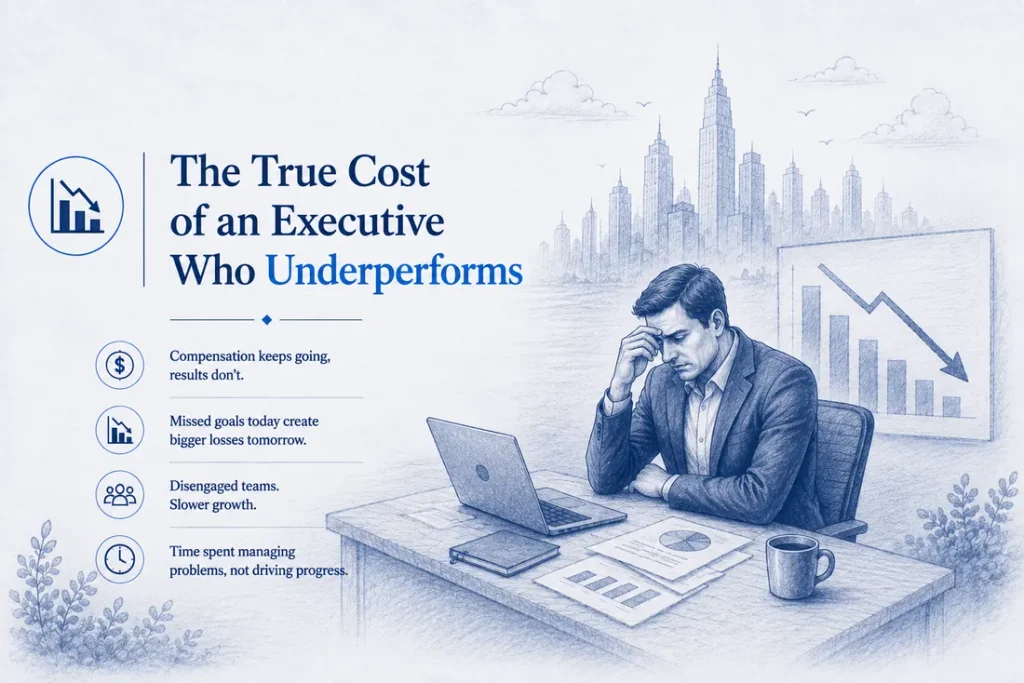
Underperformance does not stop the meter. Compensation keeps being paid during the underperformance period, along with bonuses, incentives, equity commitments already vesting, benefits, and the less visible cost of executive-level overhead. Layer on top of that the CEO’s own time spent managing around a leader who should be managing the business, and the true drain extends well beyond the paycheck.
The cost of a bad sales leadership hire rarely shows up as a single line item. It is spread across payroll, benefits, missed pipeline, and the opportunity cost of a leadership team compensating for a gap at the top. An underperforming executive costs the company both the compensation paid and the revenue growth that executive was hired to create, and the second number is usually larger than the first.
Even a Strong Executive Inherits a Team as It Is
An underperforming leader is often standing on top of a team that was never trained for the stage the company is actually at. The Tech Sales Mastery Program builds that capability so the gap does not get blamed entirely on one hire.
The Failure Doesn’t End When the Executive Leaves
Termination is not the end of the cost. It is the point where a second wave begins: the original search fee already paid, a severance package, legal and HR expenses to manage the exit cleanly, leadership disruption across the team the executive managed, lost commercial momentum, the cost of a new executive search, and the months of onboarding and ramp-up before the replacement is fully productive.
Each of those items alone looks manageable on a spreadsheet. Added together, they routinely exceed the original search fee by a factor of three or four, because severance negotiations, legal review, and the disruption to the team left behind rarely get priced until the exit is already underway. A company that budgeted 120,000 dollars for the search can easily spend another 400,000 to 500,000 dollars closing it out, before the second search has even opened.
If the total cost of a failed executive hire is only calculated at the moment of termination, the real number is already understated, because the disruption to the team and the delay to the next quarter’s pipeline rarely make it into the spreadsheet.
What SaaS Companies Should Look for in an Executive Recruiter
This is the part of the decision that actually reduces exposure, so it is worth staying specific rather than turning it into a generic checklist. The criteria that separate strong SaaS executive recruiters from generalist search firms are:
- SaaS or technology specialization.
- Performance-focused candidate evaluation.
- Revenue-gap analysis before the candidate profile is defined.
- Structured cultural-fit assessment.
- Genuine executive-level expertise, not generalist placement experience.
- Alignment with the company’s specific business objectives.
- A commercial model that creates accountability rather than rewarding speed.
An executive who cannot connect to the company’s broader B2B tech sales strategy is a hiring risk no matter how strong the interview went, because strategy alignment is what determines whether the leader’s playbook actually fits the business they are joining.
Traditional Retained Search vs. Performance-Aligned Search
| Dimension | Traditional Retained Search | Performance-Aligned Search |
|---|---|---|
| Fee structure | 25% to 33% of first year comp, paid on placement | Paid when the executive performs |
| Risk exposure | Full fee due regardless of outcome | Recruiter shares exposure to the outcome |
| Vetting depth | Interview and reference driven | Revenue-gap diagnostic and structured evaluation |
| Sector specialization | Often generalist across industries | Exclusively technology companies |
| Time to hire | Commonly four to six months | Under two weeks for qualified candidates |
The fee structure is only the most visible difference. The vetting depth is the one that actually determines whether the hire survives.
A search built around this second column still needs to be paired with a team that can execute once the right leader is in place, which is exactly where stage specific tech sales training closes the remaining gap after an executive search concludes.
How TALSMART Takes a Different Approach to SaaS Executive Recruiting

Everything above describes the exposure created by a placement-based model. This approach was built specifically to remove it.
No Traditional Retainer: This search model works without an upfront traditional retainer, which removes the single largest fixed cost in the failure scenario described earlier.
Pay When the Resource Performs: The commercial model is built around performance, not around the completion of a placement. Payment follows the outcome, not the signature.
Specialized Revenue-Gap Diagnostics: Before a candidate profile is defined, the diagnostic identifies what business and revenue capability the company actually needs, so the search starts with the problem rather than a generic executive job description.
Expert-Led Cultural and Leadership Vetting: Candidates are assessed by expert coaches with backgrounds at organizations including Google, Oracle, and IBM, adding a layer of cultural and leadership vetting beyond a standard reference call.
Built for Technology Companies: TALSMART works exclusively with technology companies, so the pattern recognition behind every placement is built on SaaS and B2B tech specifically, not adapted from generalist executive search.
Faster Access to Elite Talent: This search process identifies elite talent in less than two weeks, a service claim specific to how candidates are sourced and vetted, not a general industry benchmark.
Skin in the Game: This model invests its own time and resources into every search, positioning the firm as a partner with real exposure to the outcome rather than a vendor collecting a placement fee.
Reduce the Cost of Getting the SaaS Executive Hire Wrong
The objective was never simply to find an executive quickly. It is to identify someone who can perform, fit the organization, and address the company’s actual business gap, which is a different filter than résumé strength or interview polish.
Renata ran a revenue-gap diagnostic before opening her second search. It showed the first hire had never had a real qualification framework for a committee-based enterprise buyer, the exact motion her company needed. The second search was built around that specific gap, paid for on performance instead of on placement, and closed in eleven days. Fourteen months later, that leader was still in the seat, and the fee her company had paid for the search was less than the severance package alone had cost the first time around.
When Vertex needed to bring in commercial leadership without absorbing the exposure of a failed retained search, the mandate was built around a revenue-gap diagnosis first, not the most decorated candidate available. That sequencing is the difference between a search that reduces financial risk and one that simply transfers it from the recruiter to the company.
A performance-aligned SaaS executive recruiting model does not guarantee a perfect hire. Nothing does. It does remove the specific financial exposure created by a fee structure that gets paid whether or not the executive succeeds, which is the exposure most companies never priced in until they had already paid for it twice.
Quick reference: what a failed SaaS executive hire actually costs
- The original search fee, paid regardless of outcome.
- Full compensation for every month the executive underperforms.
- Sign-on bonuses and incentives that were never earned back.
- Lost revenue and missed growth during the tenure.
- Severance and legal costs to manage the exit.
- A second search, plus months of onboarding before the replacement is productive.
If recognizing this list feels uncomfortable, that is a useful signal, not a failure. It is usually the point where companies start asking their recruiter how the fee is actually structured, instead of assuming the industry standard is the only option.
Looking for SaaS Executive Recruiters Who Are Aligned With Your Business Outcomes?
TALSMART works exclusively with technology companies, charges no traditional retainer, and ties payment to performance. Every search begins with a revenue-gap diagnostic and includes expert-led cultural and leadership vetting, so the mandate is built around your actual business gap before a single candidate is approached.
Diagnose the Revenue Gap. Hire the Right Leader.
Define the leadership profile before the search begins. Free. 20 minutes. Get an instant report. Start the Revenue-Gap Diagnostic
TALSMART is a global revenue execution partner and specialist SaaS executive recruitment firm for B2B technology companies, operating across 100 + countries and 23 languages.
Frequently Asked Questions
Why do SaaS executive recruiter failures cost more than a normal bad hire?
A failed executive hire stacks costs that a normal bad hire does not carry at the same scale: a large upfront search fee paid regardless of outcome, months of executive-level compensation and unearned incentives, lost revenue and growth the executive was hired to produce, severance and legal costs to manage the exit, and the expense of restarting the search from zero. Each of these compounds the others, which is why the total routinely reaches seven figures for a single failed placement.
Why do retained executive search fees stay high even when the hire fails?
Retained search firms are typically paid a percentage of the executive’s first year compensation, commonly in the 25% to 33% range, due on placement rather than on performance. Because the fee is earned the moment the candidate signs, the firm has already been paid in full before anyone knows whether the hire will actually succeed.
How can a company tell if an executive recruiter is incentivized to prioritize speed over fit?
Ask whether the recruiter can explain, in specific terms, which revenue problem the executive is being hired to solve, and how they validated that the candidate has solved a comparable problem before. A recruiter optimizing for a fast placement will speak in general terms about experience and leadership qualities. A recruiter optimizing for fit will speak in terms of the specific stage of revenue growth your company needs solved.
What is a revenue-gap diagnostic and why does it matter for executive hiring?
A revenue-gap diagnostic identifies where a company’s revenue engine is actually breaking down before a candidate profile is written, so the search is built around a defined business problem rather than a generic executive job description. This replaces résumé pattern-matching with a specific capability brief the search can be evaluated against.
Does a performance-aligned recruiting model guarantee a successful executive hire?
No model guarantees a successful hire. What a performance-aligned model changes is who carries the financial exposure if the hire does not work out. Under a traditional retainer, the company absorbs the full fee regardless of outcome. Under a performance-aligned model, payment is tied to the executive actually performing in the role.