

Arjun’s company had scaled past 1,500 employees, with a sales organization of 130 reps built over nearly a decade across four regions. When the longtime VP of Sales left to run a larger organization elsewhere, the CEO and the Head of Talent Acquisition ran what looked like a thorough search. A well known executive search firm delivered a candidate who looked built for exactly that, two decades of enterprise experience, a résumé naming three recognizable companies. Nine months in, the team was not performing the way anyone expected. Quota attainment had dropped to 34%. Deal cycles were running 20% longer than before he arrived. Two of the strongest regional sales leaders had already left.
At the quarterly leadership review, the question was not whether the hire had failed. It was why a résumé this strong had produced a result this weak.
Arjun did not need a more impressive VP of Sales. He needed a recruiter who understood what problem this VP of Sales was actually supposed to solve.
If you have hired a VP of Sales who looked perfect on paper, checked every box in the interview, and still isn’t moving the number, the problem is probably not the candidate. It is the process that found them.
Choosing a VP of Sales through a generalist executive recruiter is a bit like asking a family doctor to perform a specialist procedure. Competent, but trained for something adjacent to the problem in front of them.
The Revenue Execution System, Diagnose, Build, Execute, Lead, exists because none of the first three layers hold without the right person running them. Executive search sits inside the Lead layer for exactly this reason, the same layer where a company’s broader B2B tech sales strategy either compounds or quietly stalls.
Not Sure Where Your Revenue Is Actually Breaking Down Before You Hire?
The Revenue-Gap Diagnostic maps exactly where your sales system is losing ground before you bring in a new VP of Sales. Free. 20 minutes. Get an instant report.
What to Look for in a VP of Sales Executive Recruiter
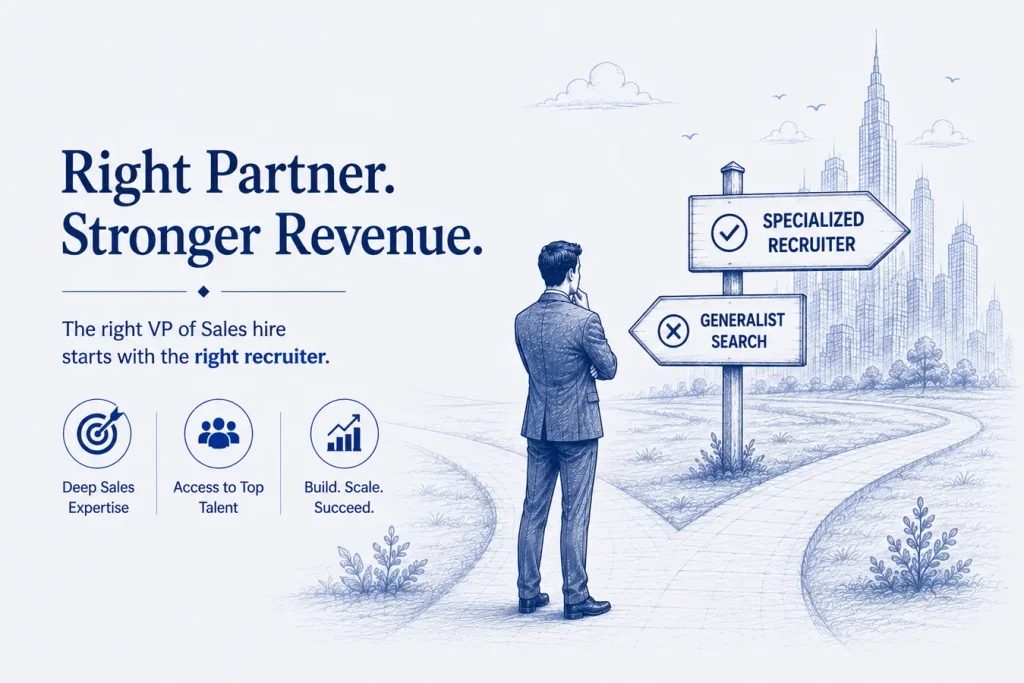
Most companies spend more time interviewing the candidate than evaluating the recruiter running the search. That is backward. The recruiter’s process determines which candidates you ever see in the first place. Whether you are the CEO sponsoring the search, the sales leader who will inherit the hire, or the Head of Talent Acquisition managing the relationship, the same rule applies: process before candidate. Whether the firm calls itself an executive search partner or a sales recruitment agency, that rule does not change.
Before signing a search agreement, evaluate a recruiter against eight factors:
- Technology sector specialization
- Passive talent access
- Data driven candidate evaluation
- Growth stage alignment
- Revenue gap diagnostics
- Leadership and culture fit assessment
- Global sales leadership validation
- Performance aligned engagement
Prioritize Technology Sector Specialization
The right VP of Sales for a technology company rarely comes from a search that treats every industry the same way. Sector fluency is the first filter that determines whether the rest of the process even matters.
Why Technology Expertise Matters in VP of Sales Recruiting
Technology sales runs on its own logic: multi-stakeholder buying committees, product led growth alongside enterprise deals, and procurement cycles shaped by security review. General executive recruiting experience does not automatically translate into effective VP of Sales recruiting for tech, and that gap usually stays invisible until the hire has already cost a quarter or two.
What to Ask a Recruiter About Their Technology Experience
Ask how extensively the firm works with technology companies, whether they have placed VP of Sales leaders in comparable go-to-market models, and whether they understand your specific sales environment.
A recruiter that works exclusively with technology companies carries no generalist mandate diluting its pattern recognition for what a strong tech VP of Sales actually looks like.
Evaluate Access to Passive VP of Sales Talent
The candidates who actually move a company’s number rarely raise their hand. Where a recruiter looks determines who ever makes it onto your shortlist.
Why Passive Talent Matters for Executive Search
The strongest VP of Sales candidates are rarely applying to postings. High performing sales leaders are often years into building something they are proud of, quietly declining most calls that reach them. A recruiter needs a proactive strategy for reaching people who are not looking.
How to Assess a Recruiter’s Talent Reach
Ask how many relevant passive candidates the firm can realistically reach, then evaluate the quality of that network, not just its size. The strongest specialist recruiters can reach up to 2,000 passive candidates per position, well beyond what a job posting alone would surface.
Demand Data-Driven Evaluation, Not Executive Charm
An interview reveals how someone presents. It rarely reveals how someone performs, and that gap is where most bad VP of Sales hires get made.

What Recruiters Should Validate
A polished résumé and a confident interview should never be enough to hand someone your revenue number. A serious recruiter validates quota attainment across the entire team the candidate managed, pipeline discipline, conversion by stage, forecasting accuracy, and experience scaling revenue through a comparable stage.
Look for Evidence of Repeatable Sales Leadership
The real question is not whether the candidate tells a good story. It is whether they can demonstrate measurable outcomes that transfer to your environment. A leader who cannot turn individual performance into structured sales coaching for the reps underneath them has only solved half the problem. If a track record cannot be traced to specific behavior, your search is still running on charm instead of evidence.
Match the VP of Sales to Your Company’s Growth Stage
The leadership skills that build a sales team from nothing are not the same skills that scale one, and they are nothing like the skills that run a mature, complex organization.
Early-Stage Sales Leadership
Build sales infrastructure from close to nothing, establish repeatable process, and work in close daily contact with early leadership. This leader is a builder first, often still closing deals personally.
Growth-Stage Sales Leadership
Scale the organization without breaking it, build genuine management depth, and create revenue that is predictable rather than dependent on a handful of top performers.
More Mature Sales Organizations
Manage larger, more complex teams, improve productivity across a motion that already exists, and lead growth initiatives into adjacent markets. The job here is optimization, not invention.
Core takeaway: The best recruiter matches the executive to the company’s growth stage rather than presenting the most impressive candidate available. A leader exceptional at building a five person founding team can genuinely struggle running forty reps, and that is a mismatch, not a character flaw.
Diagnose the Revenue Gap Before Defining the Candidate
A search that starts with a job description instead of a diagnosis is already solving the wrong problem.
Identify the Revenue Challenge
A recruiter should understand the business problem behind the search before sourcing a single name. The gap could sit in pipeline generation, conversion, sales management, forecasting, or the transition from a regional sales structure to a global one, and each points to a different leadership profile.
Turn the Revenue Gap Into a Leadership Profile
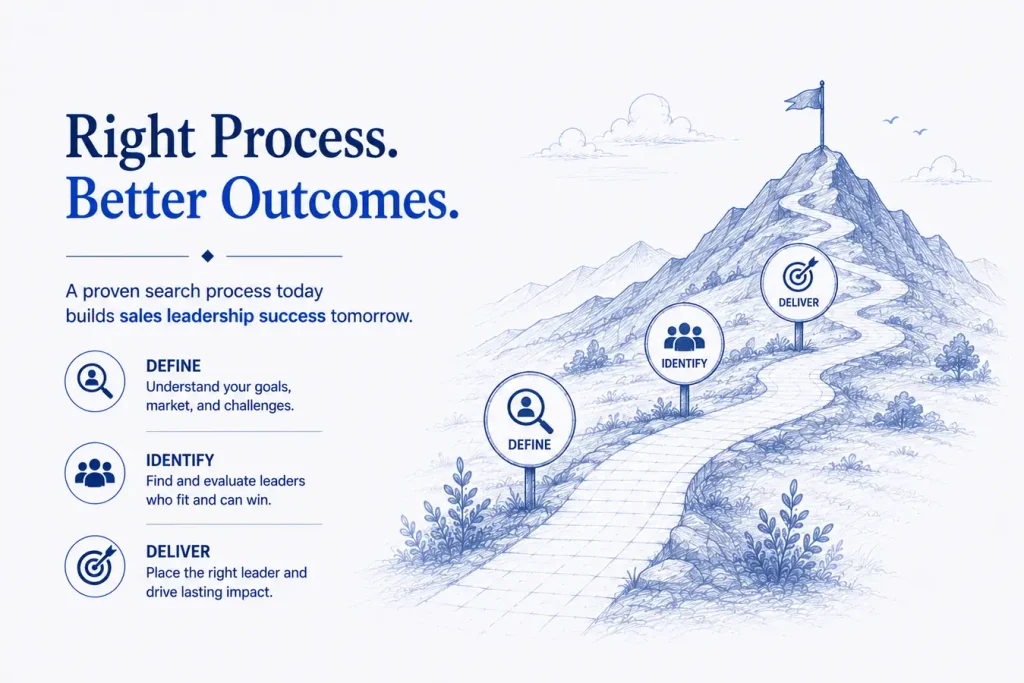
The sequence should run: revenue gap, then required capability, then candidate validation. A specialized revenue-gap diagnostic run before sourcing begins is what lets the search start with your actual problem instead of a copied job description.
This is also where the cost of a bad sales leadership hire stops being theoretical: a wasted search fee, a lost quarter of pipeline momentum, reps who leave, and a second search that starts under leadership skepticism.
Assess Leadership and Culture Fit
A track record of hitting quota somewhere else says nothing about whether a leader will succeed inside your specific organization, under your specific CEO, with your specific team already in place.
What Should Be Evaluated?
Leadership style, decision making, communication, the dynamic with the CEO, existing team relationships, and genuine cultural alignment.
Use Structured Leadership and Culture-Fit Assessment
Culture fit should be assessed through a structured process, not whether an executive simply feels right across a dinner and two video calls. Feeling right and being right are not the same thing.
The strongest search partners bring in expert coaches with backgrounds at Google, Oracle, and IBM, among other organizations, for culture fit vetting that goes beyond a standard reference call.
Consider Global Sales Leadership Certification
Companies operating across multiple markets need more than confident assurance that a candidate can handle it. They need a way to verify that before the hire is made.
Why Global Validation Matters
International experience listed on a résumé does not automatically prove consistent sales leadership capability across markets. A leader who thrived selling into one region is not automatically equipped to navigate different regulatory environments and buyer expectations elsewhere. Structured certification adds a layer of validation that a résumé bullet point cannot provide on its own.
Evaluate Search Speed Without Sacrificing Candidate Quality
A VP of Sales vacancy is an active revenue leadership gap, and every week it stays open is a week of pipeline decisions being made without the person who should be making them. Speed matters, but faster recruitment should never mean weaker evaluation.
A search built this way can identify elite talent in less than two weeks, without shortening the evaluation that catches the mismatches described above.
Consider the Recruiter’s Commercial Model and Skin in the Game
How a recruiter gets paid shapes how hard they work after signature. That detail deserves as much scrutiny as any candidate’s résumé, and it holds true whether the mandate is a VP of Sales search or a broader executive search CRO engagement.
Retainer-Based vs. Performance-Aligned Search
In one model, you pay a retainer regardless of outcome. In the other, compensation is directly connected to the resource’s actual performance.
Evaluate Recruiter Incentive Alignment
A recruiter that invests its own time and money into a search has real exposure to the outcome, not just a fee collected at signature. The strongest version of this model charges no retainer and ties payment directly to performance. Once the right leader is in place, stage specific tech sales training closes the remaining gap, building capability across the existing team instead of leaving the new leader to fix everything alone.
How to Compare Executive Recruiters for a VP of Sales Search
Every factor covered above rolls up into a single table worth keeping in front of you during any search.
| Evaluation Factor | What to Look For |
|---|---|
| Technology specialization | Proven experience with technology companies |
| Passive talent access | Real reach into qualified passive VP of Sales talent |
| Data-driven evaluation | Evidence of measurable, repeatable sales performance |
| Growth-stage alignment | Ability to match leaders to your company’s growth stage |
| Revenue-gap diagnosis | Understanding of the specific problem behind the hire |
| Leadership and culture fit | Structured assessment beyond résumé credentials |
| Global validation | Ability to validate sales leadership across markets |
| Search speed | Efficient search without compromising quality |
| Incentive alignment | Genuine financial and operational skin in the game |
A recruiter that cannot speak to every row here is running a generalist search with a technology label attached to it.
Why Choose TALSMART for VP of Sales Executive Search?
None of the criteria above are theoretical. They are the exact standard TALSMART built its own search process around.
Technology-focused executive search.
Works exclusively with technology companies, with no generalist mandate bending itself around an unfamiliar sales motion.
Deep passive talent access.
Reaches up to 2,000 passive candidates per position, built through continuous outreach rather than a database refreshed only when a search opens.
Revenue-focused candidate matching.
Every search begins with a revenue-gap diagnostic and matches candidates to the company’s growth stage, relying on data instead of charm.
Expert leadership and culture-fit vetting.
Candidates are assessed by expert coaches with backgrounds at Google, Oracle, and IBM, with sales leadership certification supported across 100+ countries.
Fast, performance-aligned search.
Identifies elite talent in less than two weeks, charges no retainer, and gets paid only when the resource performs.
Conclusion: Choose the Recruiter That Understands the Revenue Challenge

The best recruiter is not necessarily the biggest firm or the one with the largest candidate database. The right recruiter understands a sequence: technology sector, passive talent, sales performance, growth stage, revenue gap, leadership fit, and global capability, applied to your company specifically.
Arjun ran a diagnostic before his second search. It showed the real gap was not sales talent, but that his previous hire’s track record sat in single stakeholder deals, while the business needed someone who had navigated multi-stakeholder buying committees. By month six, quota attainment had recovered to 71%.
When Globant needed to replace a VP of Sales leading an already established, multi-region sales organization, the search that worked was built around the specific revenue gap, not the most decorated résumé available
Run the Revenue-Gap Diagnostic Before the Search
Identify exactly where your revenue system is losing ground. Build the VP of Sales brief around the gap, not the title. Free. 20 minutes. Get an instant report.
TALSMART is a global revenue execution partner and specialist VP of Sales executive recruitment firm for B2B technology companies, operating across 100+ countries and 23 languages.
Frequently Asked Questions
What should I look for in an executive recruiter for a VP of Sales role?
The clearest indicator is whether the recruiter’s process starts with your revenue problem instead of a generic job description. Look for proven experience placing sales leaders specifically inside technology companies, real access to passive candidates who are not actively job hunting, data driven evaluation of past performance rather than interview polish, growth stage alignment, and a commercial model where the recruiter is paid only once the hire actually performs.
Why should technology companies use specialized VP of Sales executive recruiters?
Technology sales runs on mechanics most industries never touch: multi-stakeholder buying committees, product led growth running alongside enterprise deals, and procurement cycles shaped by security review. A generalist executive recruiter can source confident, well credentialed candidates from any sector, but usually cannot validate whether that candidate’s instincts for closing a complex SaaS deal will actually transfer, which is exactly the gap specialized VP of Sales executive recruiters are built to close.
How do executive recruiters find passive VP of Sales candidates?
Passive candidates are found through continuous, relationship driven outreach into a specific professional network, not through job postings or résumé databases. The strongest VP of Sales leaders are usually already employed and performing well, so a recruiter needs an existing pipeline of relationships built before a search even opens. TALSMART maintains ongoing outreach across a network of up to 2,000 passive candidates per position, which is why qualified names can surface within days rather than months.
How do recruiters evaluate VP of Sales candidates beyond their résumé?
A rigorous evaluation validates quota attainment across the entire team the candidate managed, not just their individual number, along with pipeline generation discipline, conversion rates by deal stage, forecasting accuracy, and direct evidence of scaling a revenue organization through a comparable growth stage. The goal is confirming the outcomes are repeatable and specific to the candidate’s own leadership, not a byproduct of a strong market or a team someone else already built.
How do I choose the right VP of Sales for my company’s growth stage?
Start by identifying what the company actually needs next: a builder who can create sales infrastructure from close to nothing, a scaler who can grow an existing motion without breaking it, or an operator who can run a larger, more complex organization. Many failed VP of Sales hires are strong leaders placed at the wrong stage, not weak leaders placed at the right one, so growth stage alignment deserves the same rigor as the candidate’s track record.
How long does a VP of Sales executive search typically take?
Traditional executive search for a VP of Sales commonly takes four to six months, largely because sourcing only begins once the search is announced. Specialist recruiters that run continuous passive talent outreach can move significantly faster, since the candidate pipeline already exists before the vacancy is confirmed. TALSMART identifies elite VP of Sales talent in under two weeks without shortening the evaluation that catches the mismatches described throughout this guide.
What questions should I ask an executive recruiter before hiring them?
Ask how extensively they work with technology companies specifically, how many relevant passive candidates they can realistically reach for your role, how they validate a candidate’s performance data rather than relying on interview impressions, how they assess leadership and culture fit, and exactly how their commercial model is structured, including whether they get paid regardless of whether the hire succeeds. TALSMART, for comparison, is paid only when the placed leader performs.