
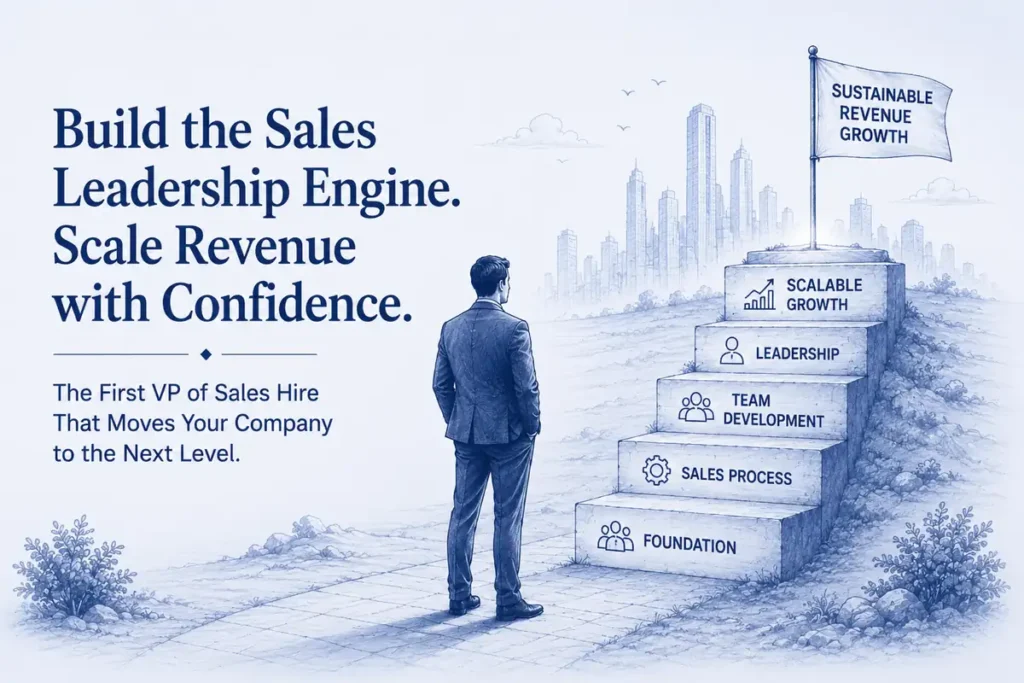
Devon’s company had crossed 1,100 employees. Product, engineering, and customer success all ran without her in the room. Sales did not. Every enterprise deal over 200,000 dollars in annual value still needed her personally on the call, because she had closed the first version of that pitch five years earlier and nobody had ever rebuilt it into something someone else could run.
Then she was unreachable for two days during a family emergency, and the largest renewal of the quarter, 340,000 dollars in annual recurring revenue, went quiet. The champion stopped responding. Procurement raised an objection nobody had prepped for. By the time Devon called back, the deal had slipped to the following quarter.
The board blamed the sales team’s inexperience. The head of customer success blamed the champion going quiet. Nobody blamed the fact that revenue at an 1,100 person company still ran through one person’s calendar.
This is not a story about one missed renewal. It is what happens when a company scales every function except sales past the point where any single person, founder or not, can keep carrying it personally.
If your company has scaled everywhere except the one function that determines whether it survives its next stage, the problem is not your team’s experience. It is that revenue is still running through a calendar instead of a system.
Hiring a first VP of Sales without defining the revenue problem first is a bit like hiring a head chef without deciding what restaurant you are actually running. Impressive technique does not matter if nobody agreed on the menu.
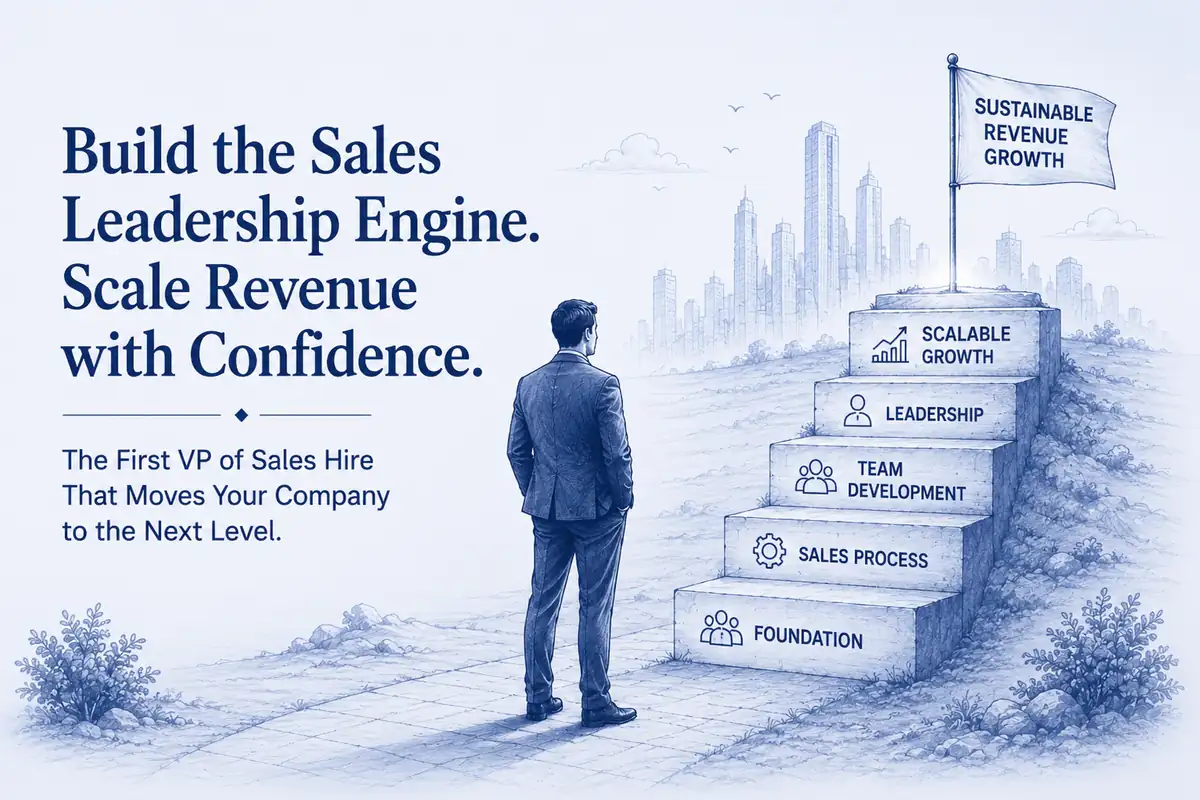
Executive hiring is the fourth and final layer of what is known internally as the Revenue Execution System: Diagnose, Build, Execute, Lead. A company can have disciplined pipeline generation, a trained team, and consistent coaching, and still stall completely if the leader sitting on top of all three does not match what the business actually needs next. Knowing when to hire a VP of Sales, and hiring your first VP of Sales well once you decide, are two different skills, and most companies have only ever practiced neither.
You’re Not Behind Because You Waited. You’re Behind Because You Never Defined the Gap.
The Revenue-Gap Diagnostic shows you exactly what capability your business needs before you write a single line of the job description. Free. 20 minutes. Get an instant report.
When Is It Time to Hire Your First VP of Sales?
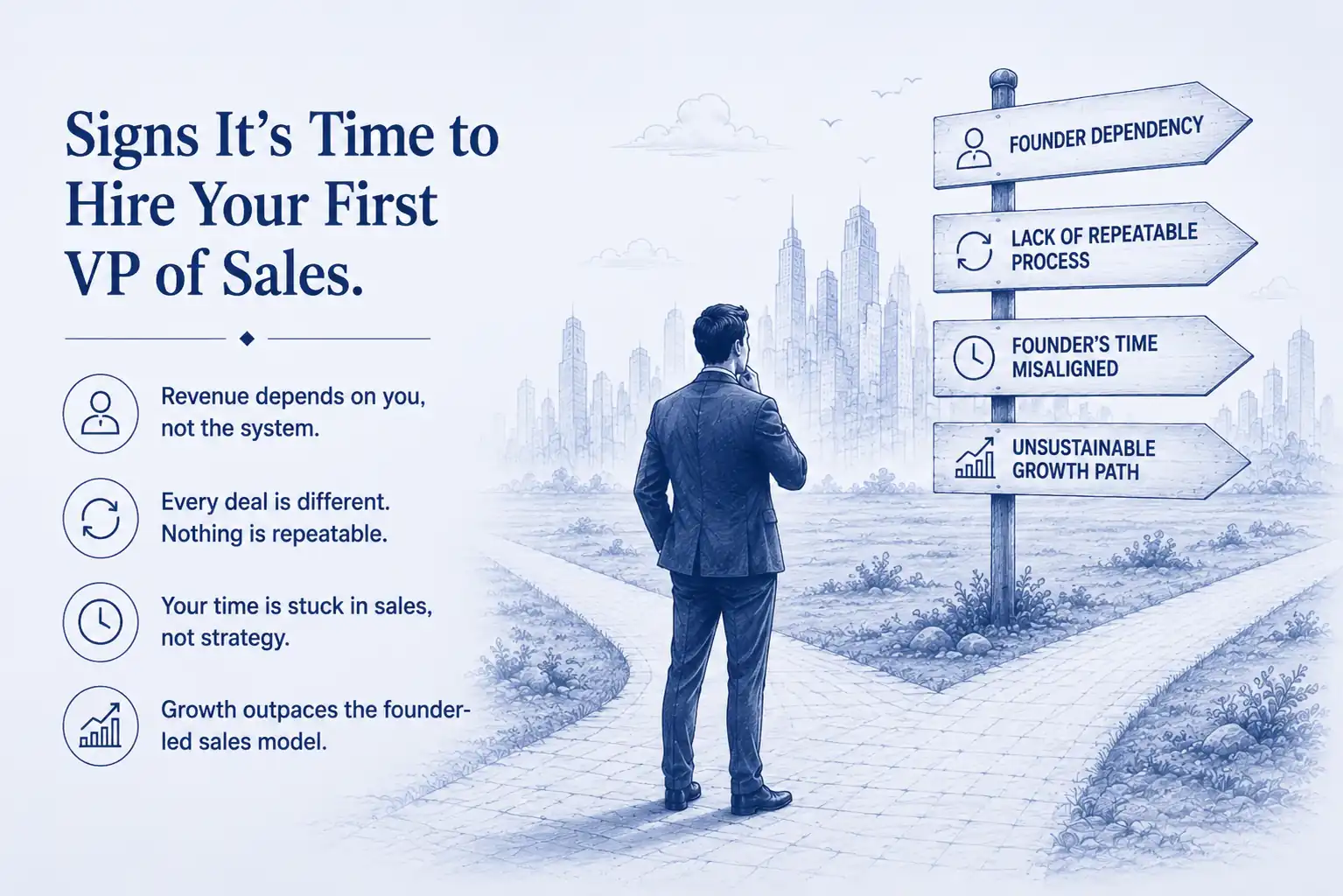
Founder-led sales does not announce its own expiration date. It just gets more expensive to ignore, one quarter at a time.
The clearest sign is dependency, not size. If revenue and pipeline still move only when the founder personally pushes them, the company has outgrown the model regardless of headcount. A second sign is repeatability. If every closed deal has a slightly different story, a different discount, a different improvised concession, there is no sales process to hand to anyone else, only a set of relationships in one person’s head.
The third sign is where the founder’s time actually goes. A founder who is still closing deals personally is, by definition, not spending that time running the parts of the company that only they can run: product direction, capital strategy, culture, the next stage of growth. Every hour spent in a sales call is an hour not spent on the decisions nobody else is positioned to make.
Growth stage matters more here than a specific revenue number. A company can hit eight figures in revenue through one or two enterprise relationships and still have zero repeatable sales infrastructure. Another company at half that revenue might already have a functioning, coachable sales motion. The trigger is not a dollar amount. It is whether the current model can survive the founder being unavailable for a week.
If your best rep is still the founder and everyone on the team privately knows it, the system has already hit its ceiling, whether the company has 50 employees or 1,500.
Why the First VP of Sales Hire Is So Difficult
The role itself changes shape depending on the company’s growth stage, which is exactly why a first VP of Sales hire fails so often even when the candidate looks strong on paper.
A proven VP of Sales from a much larger organization can still be the wrong fit for a business that has never had a formal sales process at all. Someone who has spent a decade managing an existing eighty-person team, tuning quota structures and territory maps, has a completely different skill set from someone who has to build a ten-person team’s entire operating rhythm from nothing. Both are legitimate, accomplished executives. Only one of them has actually done the specific job your company needs done next.
This is the difference between hiring for résumé credentials and hiring for the company’s actual revenue problem. A candidate’s title, their last employer’s brand name, and their years of experience are the easiest things to evaluate and the least predictive of whether they can solve your specific gap. The common mistake is hiring someone who has managed a much larger sales organization but has never built the system your company currently needs, because managing an existing machine and building one from raw parts are not the same job, even though both carry the same title.
Define the Revenue Problem Before You Define the VP of Sales Role
Most first-time VP of Sales searches start with a job description copied from a similar-sounding role at another company. That is backward. The job description should be the last thing written, not the first.
Before a single requirement goes on paper, identify the specific revenue gap the business is actually facing. Determine whether the company needs pipeline generation because the top of the funnel is too thin, sales process development because deals close inconsistently, enterprise sales expertise because the motion is shifting upmarket, team building because there is no sales organization to inherit, forecasting and accountability because leadership cannot predict next quarter with any confidence, or the ability to scale an existing motion that already works but has hit a ceiling on one person’s bandwidth.
Each of those six problems calls for a genuinely different leadership profile, and a recruiter who cannot tell you which one your company has is running a generic executive search with a job title attached to it. A revenue leadership search built around the actual gap turns a vague mandate like “find us a great VP of Sales” into something specific enough to evaluate against: a leader who has built pipeline from near zero, or one who has professionalized a chaotic sales process, or one who has taken a team upmarket into enterprise accounts.
Once the gap is identified, turn it into measurable outcomes the new VP of Sales will actually be accountable for, not vague expectations about “driving growth.” A leader hired to fix forecasting should be measured on forecast accuracy within a defined range by a specific quarter. A leader hired to build a team from scratch should be measured on ramped headcount and quota attainment by a defined date. Vague mandates produce vague accountability, and vague accountability is how a bad hire survives undetected for two full quarters.
What to Look for in Your First VP of Sales
Relevant SaaS or technology experience matters because B2B tech sales runs on a different rhythm than most other industries: multi-stakeholder buying committees, technical evaluations, and a sales cycle shaped by product complexity rather than relationship alone.
Beyond sector experience, look for someone who has solved a comparable revenue problem, not just an impressive one. A candidate needs the ability to build rather than simply manage, since a first VP of Sales inherits little to no existing infrastructure. Look for a track record of measurable sales performance that can be verified against actual numbers, not just described in an interview, along with genuine leadership and team-building capability, since this person will likely make the company’s first several sales hires.
Ability to operate at the company’s current stage deserves its own line item, separate from general competence. A leader who thrives running eighty reps across four regions may be miserable and ineffective running four reps personally, and the reverse is just as true. Sales coaching ability belongs in this list too, and it is the one most searches skip entirely. A VP of Sales who cannot coach a rep through a stalled deal in real time will eventually just close deals themselves, which quietly recreates the exact founder-dependency problem the hire was supposed to solve.
Cultural and leadership fit closes the list, and it cannot be assessed through résumé review alone. It requires structured evaluation of how this person will actually operate alongside the CEO and the existing leadership team, not a gut feeling from a good dinner conversation.
How to Evaluate VP of Sales Candidates Beyond the Résumé
Validate actual revenue outcomes, not titles. A candidate who says they “grew revenue 3x” was one input among many at that company. Ask what they specifically built, decided, and changed, and what happened to performance after they left.
Examine comparable sales motions and customer segments directly. A leader who sold six-figure annual contracts to enterprise IT buyers has different instincts than one who sold five-figure deals to mid-market marketing teams, even if both carry a VP of Sales title from well known companies. Assess how the candidate actually built or improved a sales process elsewhere, in specific, sequential detail, not as a general philosophy statement.
Test their approach to your company’s specific revenue gap directly in the interview process. Describe the actual problem and ask them to walk through how they would diagnose and address it in the first ninety days. A strong candidate will ask sharp, specific questions before answering. A weak one will recite a generic playbook that would apply to any company in any industry.
Evaluate leadership style and the ability to work closely with a CEO who has, until now, been the primary sales driver. This is a specific and often underweighted risk. Some strong VP of Sales candidates struggle badly reporting to a founder who is used to being the best seller in the room, and some CEOs struggle to actually hand off the relationships they built personally. This is the same rigor a well run executive search CRO engagement applies, just scoped to a first sales leader instead of a full commercial executive. Use structured interviews and evidence-based evaluation criteria throughout this process, not a series of increasingly friendly conversations that never surface disagreement.
Avoid the 90-Day Hiring Trap
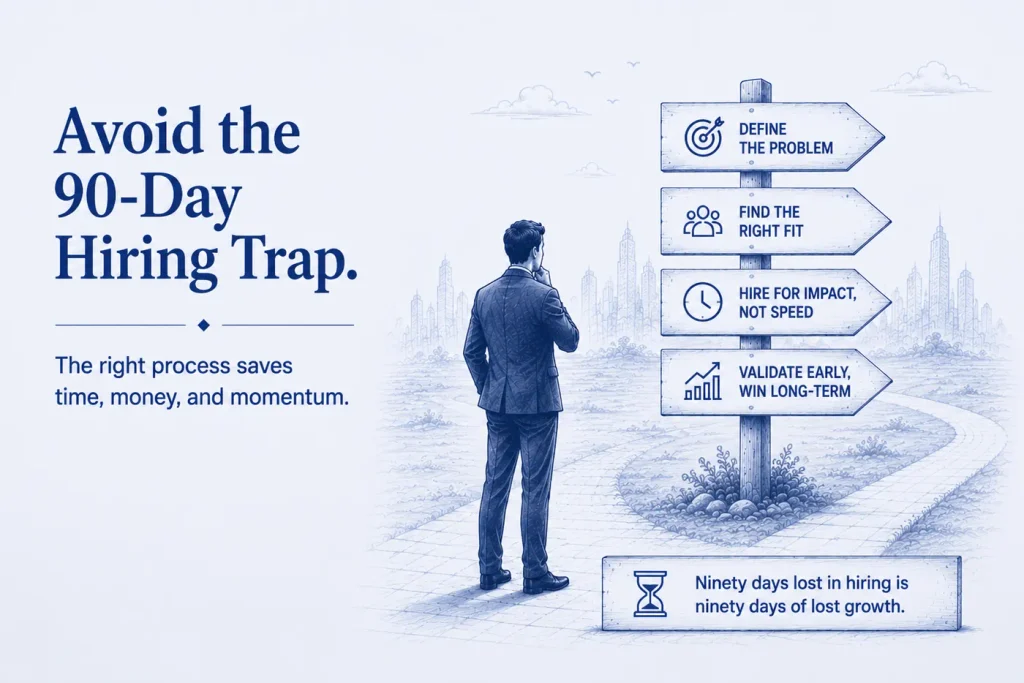
Executive hiring timelines go wrong in four consistent, avoidable ways.
Companies spend too long defining the role, often because leadership cannot agree internally on what problem they are actually solving. They interview too many poorly matched candidates because the job description was too generic to filter effectively in the first place. They prioritize availability over fit, hiring whoever can start sooner rather than whoever actually solves the gap. And they fail to validate performance early, discovering six months in that the hire’s track record never matched what the company actually needed.
A focused search process moves quickly without lowering the evaluation standard. The two are not in tension. Speed comes from clarity about the revenue problem and disciplined access to genuinely qualified candidates, not from skipping the diagnostic work upfront. A search that starts with a defined gap and a specific capability profile can move faster than a generic search, precisely because it is not evaluating candidates against a vague, ever-shifting mental picture of “someone great.”
The cost of a bad sales leadership hire is highest exactly when this trap is sprung, because the ninety days lost defining the role and running a scattershot search are ninety days the company still does not have a repeatable revenue engine, on top of whatever the eventual bad hire costs afterward.
Even the Right Hire Inherits a Team With No System Yet
The Tech Sales Mastery Program builds the stage-specific selling capability a first sales team needs, so a new VP of Sales is not starting from zero with the team as well as the strategy.
From Founder-Led Sales to a Revenue-Led Organization
Something specific changes the day the right VP of Sales actually starts, and it is not simply that the founder gets time back on their calendar.
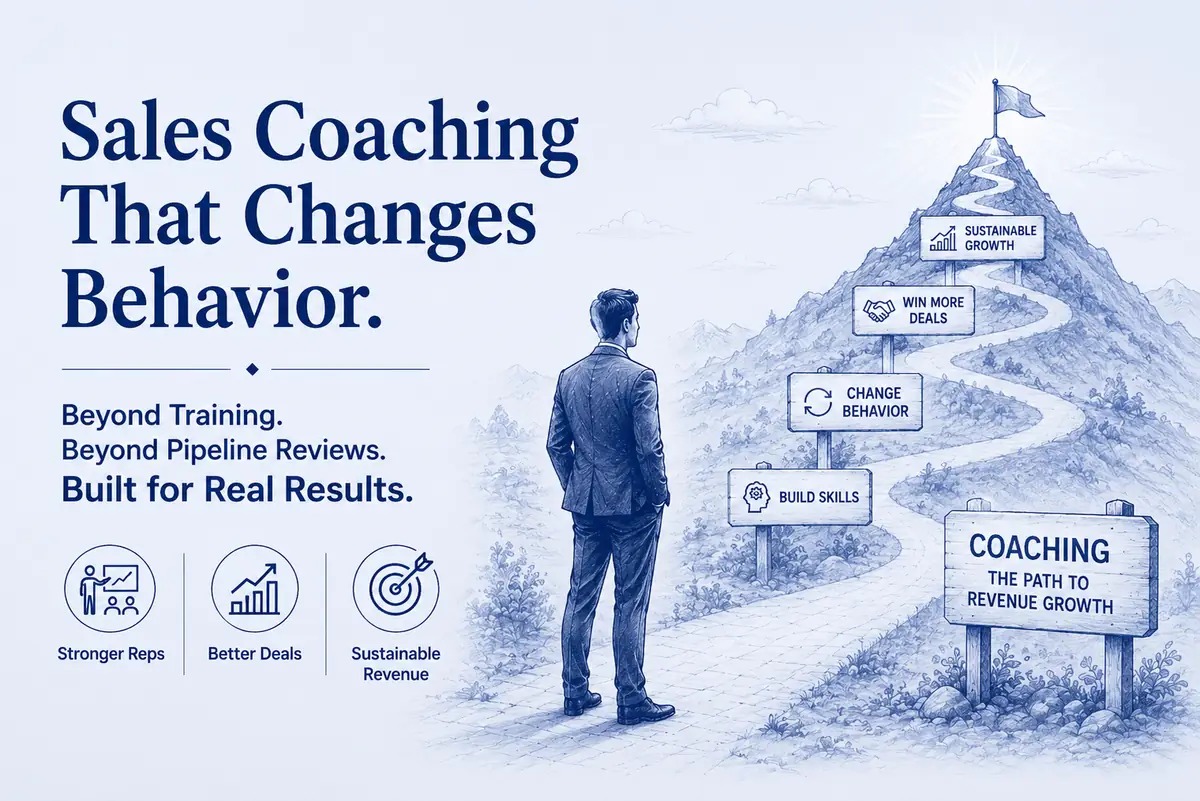
Sales knowledge that lived only in the founder’s head starts moving into a repeatable system: a defined process, documented objection handling, a playbook a new hire can actually learn from instead of shadowing the founder for six months. Accountability builds around pipeline, conversion, forecasting, and revenue as measurable stages rather than a founder’s instinct about how the quarter “feels.” The sales team develops through structured coaching instead of relying on the founder’s personal relationships to rescue stalled deals.
This is where a genuine B2B tech sales strategy replaces a collection of relationships. The company stops being one enterprise renewal away from a bad quarter and starts operating a sales motion that survives any single person’s calendar being unavailable for two days. That is the actual definition of revenue-led: not a bigger sales team, but a sales function that no longer depends on one irreplaceable person to function.
The Cost of Hiring the Wrong First VP of Sales
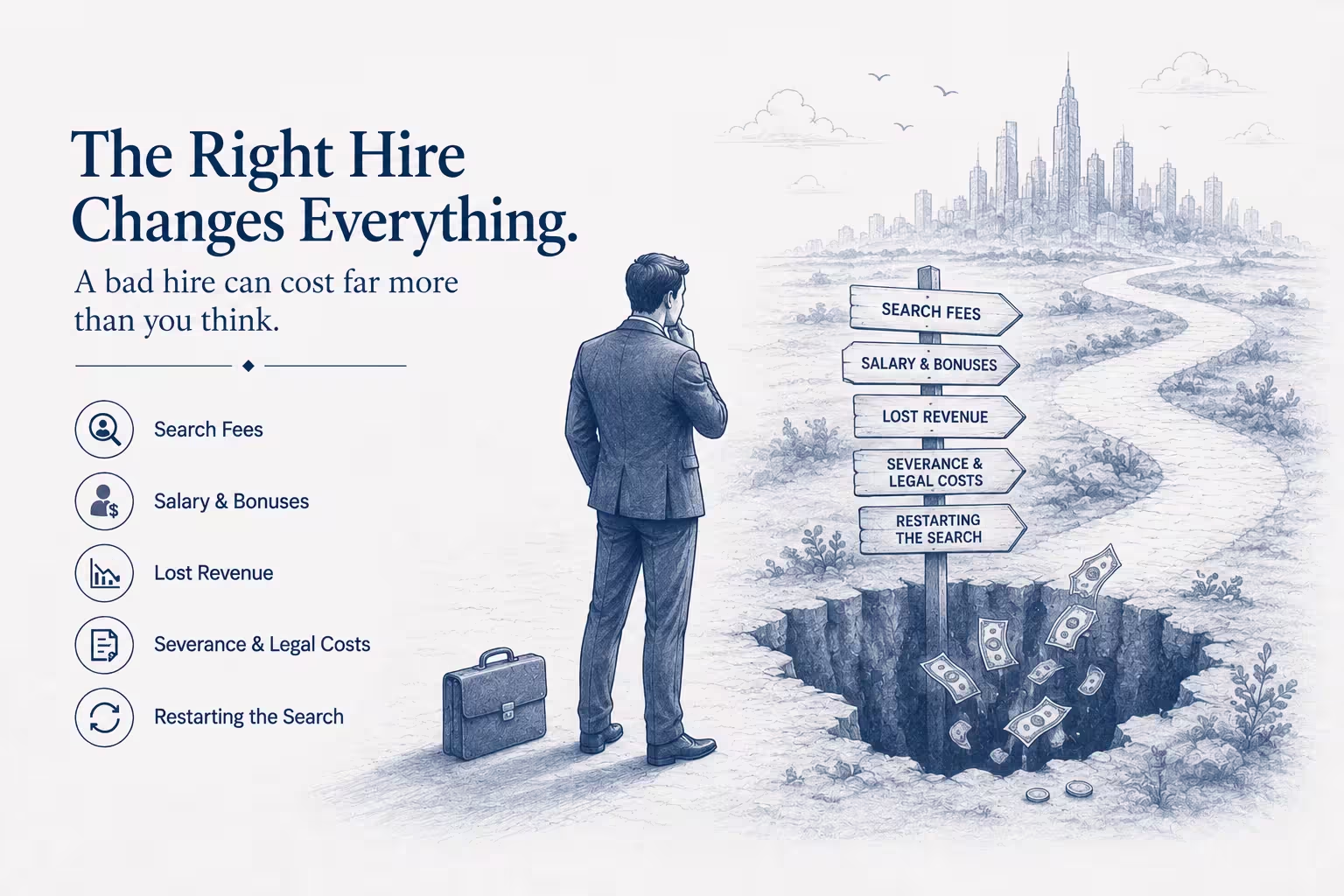
A failed first VP of Sales hire costs considerably more than the recruiting fee, and the gap between those two numbers is where most companies get blindsided.
Executive compensation during underperformance keeps accruing every month the wrong hire stays in the seat. Pipeline and revenue get lost during that same window, often permanently, since enterprise relationships damaged by an ineffective sales leader do not simply reset once that person is gone. The team the failed hire was supposed to build experiences real disruption and loss of confidence, particularly if this was the company’s first attempt at professionalizing sales at all. The founder or CEO ends up spending significant time managing the fallout, which is precisely the time this hire was supposed to free up in the first place. And then there is the cost and time required to restart the entire search from zero, usually under more internal pressure and skepticism than the first attempt carried.
Stack all of that against a recruiting fee that might represent 20 to 30 percent of the executive’s first year compensation, and the fee itself is almost always the smallest number on the page. None of this is solved by tech sales training alone either, since training a team without the right leader running it just produces a well trained team with nobody to point it at the right accounts.
A Better Way to Approach Founder VP of Sales Hiring
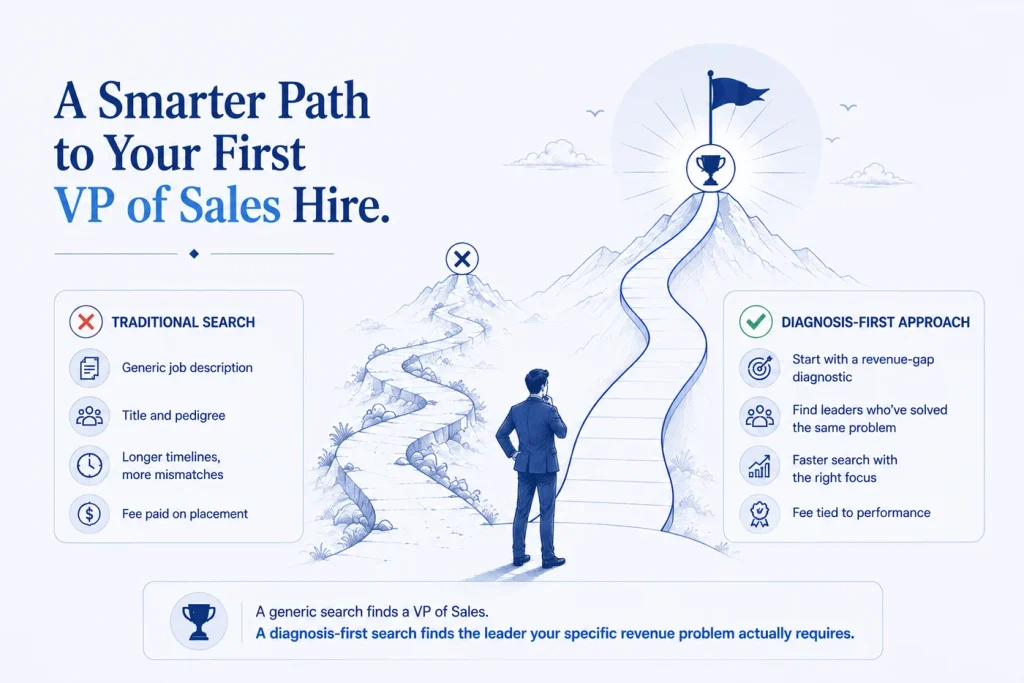
Start with a revenue-gap diagnosis before writing a single interview question. Define the leadership profile around the specific business problem identified, not a generic VP of Sales template pulled from a job board.
Source candidates with genuinely comparable experience: the same buyer type, a similar deal size, a similar stage of company growth, not simply an impressive-sounding former employer. Validate performance and leadership capability through structured, evidence-based evaluation rather than interview chemistry alone, and assess cultural fit deliberately, particularly the specific dynamic between this leader and a CEO who has been the primary sales driver until now.
Finally, align the recruiting model itself with the outcome you actually want. A recruiter paid the same fee regardless of whether the hire succeeds has no financial reason to say no to an impressive candidate who is wrong for your stage. A recruiter whose incentives are tied to the hire’s actual performance is evaluating candidates the same way you are: against the problem, not against the résumé.
Traditional VP of Sales Search vs. Diagnosis-First Approach
| Dimension | Traditional Search | Diagnosis-First Approach |
|---|---|---|
| Starting point | Generic job description | Specific revenue-gap diagnostic |
| Candidate filter | Title and pedigree | Comparable problem solved before |
| Timeline | Often exceeds 90 days with mismatches | Focused search built around a defined profile |
| Accountability | Vague growth expectations | Measurable outcomes tied to the diagnosed gap |
| Incentive alignment | Fee paid on placement | Fee tied to performance |
A generic search finds a VP of Sales. A diagnosis-first search finds the leader your specific revenue problem actually requires.
The founder who eventually replaces themselves in the sales process does not do it by finding someone equally good at their own playbook. They do it by identifying the actual gap in the business and finding a leader who has already closed that exact kind of gap somewhere else. When Vertex needed to move enterprise sales off a small number of relationship-driven accounts, the search was built around that specific transition, not around finding the most decorated VP of Sales candidate available.
What to check before you sign a search agreement:
- The revenue gap has been diagnosed and documented before any job description was written.
- The leadership profile is tied to a specific, measurable outcome, not general growth.
- Candidates are being evaluated against a comparable problem they have solved before.
- The recruiter’s commercial model rewards a successful hire, not just a completed placement.
- A plan exists for what changes operationally in the first 90 days after the hire starts.
If any of those five boxes is empty, the search is optimizing for speed or resume strength, not for the actual outcome the business needs.
Ready to Move From Founder-Led to Revenue-Led?
Every section above leads back to the same starting point: diagnose the revenue gap before you define the role, and define the role before you look at a single candidate. A VP of Sales hiring process that skips that sequence is how ninety days disappear and how founders end up back on sales calls they thought they had already delegated. How to hire a VP of Sales is ultimately a smaller question than it looks. The harder one is knowing exactly what you are hiring them to fix.
Diagnose the Revenue Gap Before You Hire
Define the specific capability your business needs from its first VP of Sales, before the search begins. Free. 20 minutes. Get an instant report.
TALSMART is a global revenue execution partner and specialist VP of Sales executive recruitment firm for B2B technology companies, operating across 100 + countries and 23 languages.
Frequently Asked Questions
When should a founder hire their first VP of Sales?
When revenue and pipeline are dependent on the founder personally, the sales process is not repeatable across a team, and the founder’s time is going into closing deals instead of the decisions only they can make. This trigger is about dependency and repeatability, not a specific revenue milestone.
What should a founder look for in their first VP of Sales?
Relevant technology sales experience, a track record of solving a comparable revenue problem, the ability to build a sales function rather than simply manage an existing one, genuine coaching and team-building capability, and a leadership style that can work closely with a CEO who has been the primary seller until now.
How long does it take to hire a VP of Sales?
A search built around a clearly diagnosed revenue gap and a specific capability profile typically moves faster than a generic search, because it is not evaluating candidates against a vague, shifting mental picture. Searches that skip the diagnostic step commonly stretch past 90 days while still producing a mismatched hire.
What are the biggest mistakes founders make when hiring a VP of Sales?
Writing the job description before diagnosing the actual revenue problem, hiring based on an impressive former employer rather than a comparable solved problem, prioritizing whoever can start soonest over whoever actually fits, and failing to validate performance and cultural fit with structured evaluation instead of interview chemistry.
Should a startup hire a VP of Sales or a sales leader first?
This depends on whether the company needs someone who can build a sales function from close to nothing or someone who can manage and scale a motion that already exists in some form. The title matters less than matching the leader’s actual skill set, building versus managing, to the company’s current stage.
How do you evaluate whether a VP of Sales can scale a SaaS sales organization?
Look for direct evidence they have built repeatable processes at a comparable stage before, validated through specific questions about what they built and decided, not general claims about revenue growth. Test their approach to your company’s specific gap directly in the interview, and evaluate how they coach underperforming reps, since that capability determines whether the team they build survives them.