

James had been CEO of a B2B tech company for six years. He had built a product his market genuinely needed. He had raised a Series B. And he had a VP Sales with an impressive background, a recognizable company name on the resume, and a confident answer for every interview question.
Eighteen months later, James was sitting across from his board explaining why the revenue target had been missed for the third consecutive quarter. The VP Sales had managed the team well. The team liked them. The CRM was clean. And the pipeline was exactly as empty as it had been on day one.
What James had hired was an experienced executive. What he needed was a revenue builder. The traditional executive search firm that placed the hire saw no difference between those two things. That was the problem.
Hiring a VP Sales through a traditional executive search firm is like hiring a Formula 1 driver because they have a driver’s license.
Every candidate can drive. That doesn’t mean they can win a race.
Every VP of Sales has managed a team. That doesn’t mean they can:
- Scale from $5M to $25M ARR
- Build a repeatable sales process
- Coach managers
- Forecast accurately
- Recruit top performers
- Lead through hypergrowth
Finding those capabilities requires far more than reading a resume.
The best executive search partner isn’t the one that fills the most executive roles. It’s the one that best understands the role you’re hiring for.
If you have placed a sales leader who arrived with a strong resume, interviewed with confidence, and then spent their first year doing what they had always done in a company that needed something fundamentally different, you already know this. The hire was not wrong. The hiring process was.
Sales Leadership Is a Revenue Role, Not Just a Leadership Role. A VP Finance manages capital allocation. A VP Engineering manages product delivery. Both are consequential. Neither produces revenue directly from their own execution. A VP Sales does. Every week. Every quarter. The accountability is different. The skills required to succeed are different. And the way the role should be evaluated is different.
The Revenue Execution System (Diagnose, Build, Execute, Lead) begins with a diagnosis of the specific revenue challenge the incoming leader must solve. Without that diagnosis, the search begins in the wrong place and often ends with the wrong person.
Before the Next Search, Diagnose the Revenue Problem First
The Revenue Gap Diagnostic maps exactly where your current sales system is breaking down. That diagnosis becomes the only brief worth building a search around. Free. 20 minutes. Get instant report.
Why Sales Leadership Hiring Is Different from Executive Hiring
Sales leadership is not a leadership role with a revenue number attached. It is a revenue role that requires leadership. A VP Finance manages capital allocation. A VP Engineering manages product delivery. Both are consequential. Neither produces revenue from their own execution. A VP Sales does. Every week. Every quarter. Finding someone who can do that consistently, in a B2B tech company at your specific stage, requires a fundamentally different evaluation than any standard executive search.
Sales leadership recruiters who specialize exclusively in B2B technology companies understand this distinction structurally. They do not start with a job description. They start with the specific revenue challenge the company is trying to solve. That starting point changes everything that follows.
Why Traditional Executive Search Often Falls Short for Sales Leadership Hiring

Firms like Spencer Stuart, Korn Ferry, and Heidrick and Struggles have built exceptional executive search processes across dozens of senior functions. For a Chief People Officer, a General Counsel, or a Chief Financial Officer, their approach works. The limitation is not their quality. It is their specificity. Sales leadership in B2B technology is a function those processes were never designed to assess.
Traditional executive search firms are built to find executives. They are not built to assess whether an executive can build a sales revenue engine in a specific market, at a specific stage of company growth, against a specific competitive environment. Those are different problems.
Managing Sales Teams Isn’t the Same as Building Revenue
A candidate who has managed a 200-person sales organization at a large enterprise technology company has done something genuinely difficult. They have also done something that is entirely different from what an early-stage or mid-market B2B tech company needs from their first or second VP Sales hire. Scaling a mature team and building a revenue function from scratch require opposite skill sets. A generalist search firm has no reliable way to distinguish between them.
Resumes Don’t Reveal Revenue Capability
A resume documents what a sales leader was responsible for. It does not document what they built, what they broke, what they inherited and improved, or what they inherited and merely maintained. The VP Sales who hit 110% of quota for three consecutive years at a company where the territory had been built by their predecessor, the product had category leadership, and the marketing engine was generating qualified pipeline is not the same as the VP Sales who built the pipeline from zero. Both resumes look compelling. Only one of them has the capability the company actually needs.
General Executive Search vs Sales Leadership Expertise
A generalist executive search firm assessing a VP Sales candidate is making a judgment about a domain they do not operate in. They are evaluating the candidate’s ability to describe sales leadership rather than their actual revenue-building capability. An experienced sales leader can tell a compelling story about a territory they did not build, a number they did not close, and a team they did not develop. A recruiter with no sales background has no frame of reference to challenge it. That gap is not a process problem. It is a structural one.
Active Candidates vs Passive Revenue Leaders
The highest-performing sales leaders in B2B tech are almost never actively looking for their next role. They are too busy succeeding in their current one. The active candidate market, the pool of executives responding to job postings and submitting applications, represents roughly 20% of available sales leadership talent. The best 80% are not visible to a search firm that relies on active candidate outreach. Reaching them requires relationships built over years inside the passive talent network.
Are You Evaluating Sales Leaders the Right Way?
Structured revenue capability assessment reveals what resumes and interviews cannot. Find out how specialist executive sales recruiters evaluate the candidates traditional search firms miss.
What Executive Sales Recruiters Assess That Traditional Search Firms Often Miss
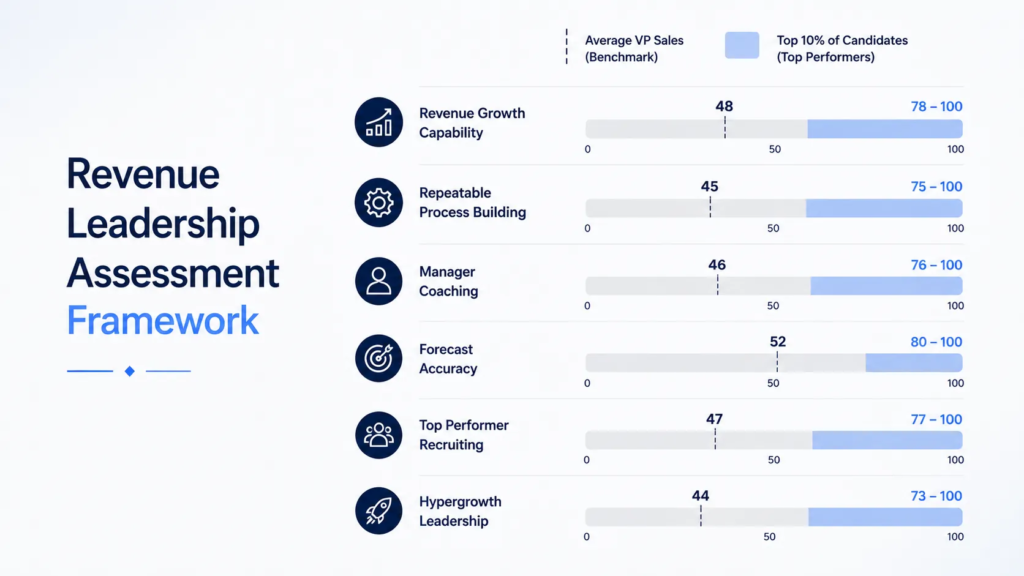
The difference between a strong sales leader interview and a strong sales leader is the gap that generalist search firms consistently fail to close. Executive sales recruiters close it through structured assessment of six specific capabilities that predict revenue leadership success.
Think of it this way. A hospital does not hire a surgeon based on how well they explain the procedure in an interview. They check their operating record, their complication rate, and whether they have performed the specific procedure your patient needs. Sales leadership assessment works the same way. The interview reveals how a candidate talks about revenue leadership. The assessment reveals whether they have actually produced it.
Revenue Growth Capability
Has this candidate grown revenue in conditions similar to yours? Not just managed a team that grew, but personally drove the strategy, the hiring, the process design, and the execution that produced the growth? The assessment looks for specific, verifiable examples with real numbers. A candidate who can answer this question in detail and a candidate who speaks in generalities are two entirely different profiles.
Building Repeatable Sales Processes
Tech sales training and individual rep performance only compound when the underlying sales process is built to scale. A sales leader who relies on individual talent rather than process produces results that collapse when top performers leave. The assessment asks: what repeatable process did you build, and what happened to performance when you were not in the building?
Coaching Sales Managers
Sales coaching capability at the management layer is where most sales leadership hires produce their greatest leverage or their greatest failure. A VP Sales who can coach individual reps is useful. A VP Sales who can coach sales managers to coach their own reps is the structural multiplier that makes a team compound rather than plateau. The assessment evaluates whether the candidate has developed this capability or has simply been a high-performing seller who was promoted.
Forecast Accuracy
Forecast accuracy is the metric that tells you whether a sales leader actually understands their pipeline or whether they are managing perception. A leader who consistently forecasts within five percent of actual outcome has built qualification discipline and visibility into deal progression across the team. A leader whose forecast accuracy varies by thirty percent quarter to quarter is working with assumptions rather than data. The assessment tracks this across multiple periods.
Recruiting Top Performers
A VP Sales who cannot attract talent compounds the team they inherit. A VP Sales who can attract talent builds a team that keeps improving. The assessment looks at the candidate’s track record of identifying, attracting, and retaining high-performing reps and managers in competitive hiring markets. In B2B tech, where tech sales vacancies have risen 65% to over 700,000 open roles nationally, this capability is not a nice-to-have. It is a survival requirement.
Leading Through Hypergrowth
Hypergrowth requires a specific leadership profile that most executives who have operated in stable or declining markets do not possess. The pace of decision-making, the tolerance for ambiguity, the ability to build processes while executing at full speed, and the resilience required to maintain team confidence when everything is changing simultaneously are capabilities that either exist or do not. They cannot be trained quickly.
Define the Leadership Profile Before the Search Begins
The Revenue Gap Diagnostic maps your current revenue challenge and produces the precise capability profile your next sales leader must have. Free. 20 minutes. Get Instant Report. No sales call required.
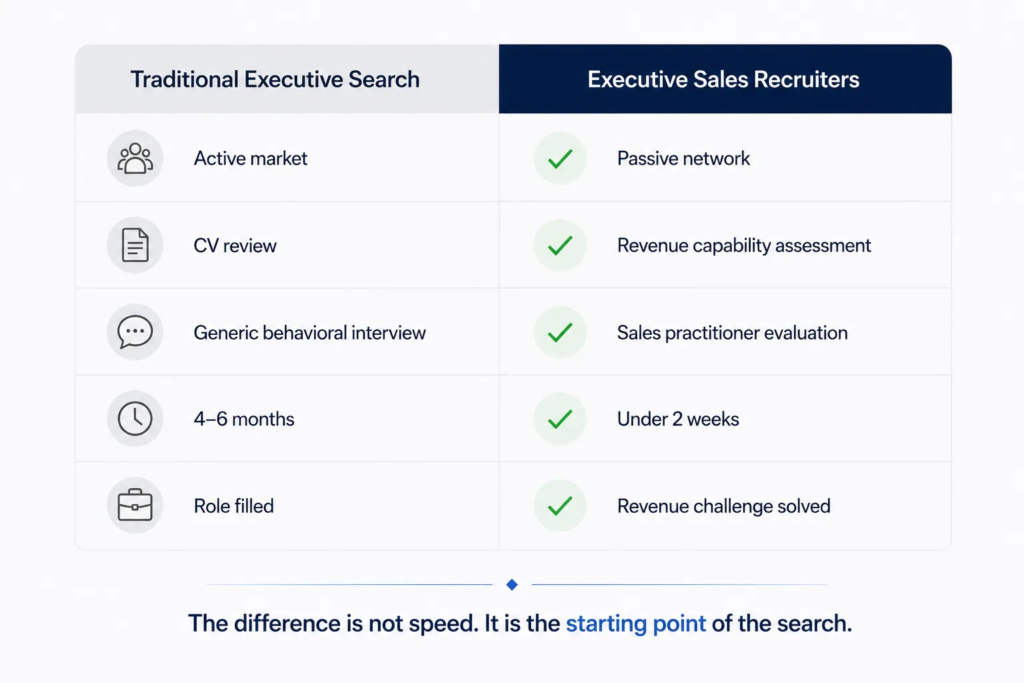
Executive Sales Recruiters vs Traditional Executive Search Firms
| Criteria | Traditional Executive Search Firms | Executive Sales Recruiters |
|---|---|---|
| Search approach | Broad executive market across all functions | Specialist search within sales leadership only |
| Candidate sourcing | Primarily active candidates on job boards | 80% passive candidates not visible in any active market |
| Sales leadership expertise | Generalist knowledge across multiple functions | Deep expertise in B2B tech sales leadership specifically |
| Revenue capability assessment | CV review and structured interview only | Structured sales competency assessment by practitioners |
| Revenue-gap diagnostics | Not typically offered | Diagnostic run before search to define the right profile |
| Leadership assessment | Generic behavioral interview frameworks | Assessment led by experienced B2B sales professionals |
| Passive candidate outreach | Limited to existing database contacts | Dedicated outreach into passive network built over years |
| Time to hire | 4 to 6 months on average | Under 2 weeks for vetted shortlist |
| Business outcomes | Role filled. Revenue impact uncertain. | Revenue leadership hire matched to specific growth challenge |
Traditional executive search firms fill executive roles. Executive sales recruiters predict revenue leadership success.
When Should B2B Tech Companies Choose Executive Sales Recruiters?
Not every executive search requires a specialist. The right choice depends on what the incoming leader is actually being hired to do. If the role is primarily about managing an established function, a generalist firm will deliver. If the role is about building or rebuilding a B2B tech revenue engine, the search process itself must be built differently.
When Traditional Executive Search Is the Right Choice
Traditional executive search firms work well for roles where functional expertise and organizational presence are the primary requirements: Chief People Officer, General Counsel, Chief Financial Officer. When the role is fundamentally about building or rebuilding a B2B tech revenue engine, a generalist firm has a structural disadvantage it cannot compensate for with effort.
When Executive Sales Recruiters Deliver Better Results
When the company is scaling rapidly. When the existing sales process is undefined or inconsistent. When win rates are declining and nobody knows exactly why. When the previous VP Sales left and took the team’s confidence with them. When the board is asking why the pipeline is not converting. When the company is entering a new market, a new product category, or a new buyer profile. In every one of these situations, the hire is not an executive placement. It is a revenue recovery or revenue acceleration decision. That requires a different kind of search.
Case Study: The Biggest Sales Hiring Crisis in Modern History
Tech sales vacancies have risen 65% to over 700,000 open roles nationally. The companies winning on talent are not the ones with the largest recruiting budgets. They are the ones who stopped treating sales hiring as a reactive event and built proactive talent pipelines that exist before the vacancy does. Specialist executive sales recruiters maintain those pipelines continuously. When a role opens, the shortlist is ready.
Watch the video:– https://youtu.be/Nj5gm-Yv6tI?si=ZRkM_k6qOzbrqDmg
Is Your Revenue Challenge Defined Before the Search Starts?
Most sales leadership hires fail because the brief was wrong before the search began. The Revenue Gap Diagnostic fixes that. Free. 20 minutes. Get Instant Report.
How TALSMART Helps B2B Tech Companies Hire Revenue-Building Sales Leaders

The goal of executive search is not to present impressive resumes. It is to predict revenue leadership success. Every element of the approach below is built around that objective.
Exclusive focus on B2B technology companies
Every search, every assessment, every coach in the evaluation process has been selected for their understanding of B2B tech sales execution. This is not a generalist firm that handles tech companies. It is a specialist practice that handles nothing else.
Specialist executive sales recruiters
The recruiters conducting your search have built sales teams, carried quotas, and managed pipelines. They know what good looks like because they have done it themselves.
Revenue-gap diagnostics before every search
Before approaching a single candidate, a diagnostic is run to identify exactly where your current revenue system is breaking down. That diagnostic defines the leadership profile required. Goldman Sachs used this approach to align their sales leadership hiring criteria with their actual stage-level execution gaps before making any hiring investment.
Expert assessments by experienced sales leaders and executive coaches
Candidates are evaluated by professionals who have personally built B2B tech revenue functions, including coaches with experience at Google and Oracle. The assessment reveals whether the candidate has solved the specific problem your company faces, not whether they can describe it compellingly.
Access to elite passive sales leadership talent
The network reaches candidates who have not applied for a role in years and who will not be visible to any active search. These are the candidates who are currently winning in their roles.
No upfront retainer
The practice operates as a true partner with real skin in the game. Own money and own time go in before a fee is earned. Payment is tied to the performance of the placed leader, not to the speed of the placement. When the search firm’s success depends on the hire’s commercial success, the quality of the search changes completely.
Elite sales leadership hiring in less than two weeks
Because passive talent outreach is ongoing rather than reactive, vetted shortlists are ready before the vacancy is formally declared.
Expert assessment and culture fit
Every candidate is assessed by professionals who have personally built B2B tech revenue functions, including executive coaches with experience at Google and Oracle. Assessment evaluates both revenue capability and culture fit simultaneously. The right commercial capability in the wrong culture produces an eighteen-month departure. Specialist executive sales recruiters assess both before making a recommendation.
Find Out Exactly What Revenue Capability Your Next Hire Must Have
The Revenue Gap Diagnostic maps your current sales system and produces the leadership capability profile your search should be built around. Free. 20 minutes. Get Instant Report. No sales call required.
Conclusion
Back to where this article started. James is still CEO. After the third consecutive miss, he changed the search process. Before the next VP Sales search began, he ran a diagnostic that mapped exactly where his revenue system was breaking down. That diagnostic told him something the interview process had never surfaced: he needed someone who had specifically built pipeline infrastructure from scratch in a technical sales environment, not someone who had managed a team that already had one.
The candidate who was placed had never been on a job board. A specialist search found them through passive outreach. Within two quarters, the company had its first repeatable sales process, its first accurate forecast, and its first quarter above target.
Back to the original question. Every VP of Sales you have ever hired has managed a team. The one who is still there and still growing is the one who could build the revenue engine your specific company needed, at the specific stage it was at, against the specific competitive environment it faced. That person was not found by matching a job description to a resume. They were found because someone asked the right diagnostic questions before the search began.
When Vertex needed to move from a founder-led sales motion to a scalable commercial organization, the brief was not VP Sales with enterprise experience. It was: who has made this specific transition before, in a B2B tech company at a comparable stage? That candidate was not browsing job boards. A specialist search found them anyway. Within two quarters, the team had its first repeatable sales process and its first predictable forecast.
That is the difference executive sales recruiters make. Not faster access to the same candidates. Access to different candidates. Evaluated against the right criteria. Matched to the specific revenue challenge rather than the generic job description.
The search firm that fills the most executive roles is not the best choice for a revenue-critical hire. The search firm that best understands the role you are actually hiring for is.
TALSMART is a global revenue execution partner and specialist executive sales recruiter for B2B technology companies, operating across 100 + countries and 23 languages.
Frequently Asked Questions
What is the difference between executive sales recruiters and traditional executive search firms?
Traditional executive search firms cover all executive functions across all industries. They evaluate candidates using generic assessment frameworks and primarily reach active candidates. Executive sales recruiters specialize exclusively in sales leadership for specific industries, typically technology. They assess revenue capability rather than executive presence, reach passive candidates through dedicated network relationships, and run diagnostics before the search to define the precise capability profile required.
Why is sales leadership hiring different from executive hiring?
Sales leadership is a revenue role, not just a leadership role. A VP Sales is directly accountable for producing revenue every week of every quarter. The skills required to scale a B2B tech sales organization from $5 million to $25 million ARR, build a repeatable sales process, coach managers, forecast accurately, recruit top performers, and lead through hypergrowth are fundamentally different from the skills required to manage a stable executive function. Generalist executive search firms are not equipped to assess the specific capabilities that determine whether a VP Sales hire will drive revenue or simply manage the team that exists.
How do executive sales recruiters assess sales leaders?
Specialist assessment evaluates six specific capabilities: revenue growth in comparable conditions, repeatable process building, coaching of sales managers, forecast accuracy over multiple periods, recruiting track record in competitive markets, and hypergrowth leadership experience. Assessment is conducted by professionals who have themselves carried quotas and built B2B tech revenue functions. This produces a fundamentally different evaluation than a structured interview conducted by a generalist recruiter.
What are revenue-gap diagnostics?
Revenue-gap diagnostics map exactly where a company’s current sales system is breaking down before the leadership search begins. Is the challenge pipeline volume, qualification discipline, discovery quality, win rate, deal cycle length, or team capability? Each of these requires a different leadership profile. Running the diagnostic before the search means the brief is built around the actual revenue problem rather than a generic job description. Without it, the search begins in the wrong place and often ends with the wrong person.
When should B2B tech companies choose executive sales recruiters?
Executive sales recruiters deliver superior outcomes when the company is scaling rapidly, when the existing sales process is undefined or inconsistent, when win rates are declining, when the previous VP Sales has left, when the board is questioning pipeline conversion, or when the company is entering a new market or product category. In these situations, the hire is a revenue recovery or acceleration decision, not an executive placement. That requires a search process built around revenue capability assessment, not executive profile matching.
How long does executive sales recruitment take?
Traditional executive search firms typically take four to six months from brief to placement. Specialist executive sales recruiters who maintain proactive passive talent pipelines deliver vetted shortlists in under two weeks for most technology sales leadership searches. The difference is not speed of execution during the search. It is that passive talent outreach happens continuously, not only when a vacancy exists.
Why are passive candidates important in executive recruitment?
The highest-performing sales leaders are almost never actively looking for their next role. They are performing in their current one. The active candidate market represents approximately 20% of available sales leadership talent. The 80% who are not looking include most of the candidates who have solved the specific revenue problems your company faces. Reaching them requires dedicated long-term relationship networks inside the passive talent market, not job postings or database searches.