
A CRO with the wrong brief will cost you more than no CRO at all.
That is the part nobody says when a board approves a senior revenue hire. The conversation is about who the candidate is. It is almost never about what problem they were actually hired to solve.
Simon’s company had just raised a Series C. The product was strong. The pipeline was active. What was missing was predictability. The board wanted a CRO who could build the architecture to take the company from $18 million to $60 million ARR in three years.
The candidate Simon hired had done exactly that. At a different company. With a different product. In a different market. Three previous CRO roles, one at a business that had gone public. References who used the word transformational without being asked. The board approved the offer before Simon had finished the reference calls.
Fourteen months later, the revenue number had moved by less than 8%. Headcount had doubled. The pipeline was busier than ever. And the architecture that would have made growth predictable had never been built. The CRO had managed the team they inherited. They had not rebuilt the system the company actually needed.
The CRO was not wrong. Simon’s brief was.
If you have made a senior revenue hire whose track record looked directly relevant and discovered after twelve months that the context behind it was nothing like yours, that is not a hiring failure. It is a diagnostic failure. The search found an impressive candidate. Nobody had defined the problem the candidate needed to solve.
Hiring a CRO from a resume alone is like appointing a surgeon based on the number of operations they have performed, without asking whether they have performed this specific procedure on this type of patient. The credential is real. The relevance is untested. And in surgery, as in CRO executive recruitment, the untested assumption is where the risk lives.
The Revenue Execution System (Diagnose, Build, Execute, Lead) is built around one structural truth: the Lead layer begins not with the hire but with the diagnosis. Before any candidate is approached, the revenue gap must be defined. That definition is what determines whether the CRO you hire is the right one for the problem you actually have.
Define the Revenue Gap Before the CRO Search Begins
The Revenue Gap Diagnostic maps exactly where your current commercial system is breaking down. That output becomes the only CRO brief worth building a search around. Free. 20 minutes.Get Instant Report.
Why Traditional CRO Recruitment Often Gets It Wrong
Almost every sales executive search firm will tell you they help companies hire CROs. That is true. The limitation is that finding CRO candidates and validating whether a specific candidate can scale revenue inside a specific company are completely different exercises. Most CRO executive recruitment processes are built for the first one.
A Strong CRO Resume Is Not Enough
Previous revenue results need context before they mean anything. The CRO who scaled a company from $30 million to $120 million ARR did so with a specific product, a specific market, a specific sales motion, and a specific team. None of those variables transfer automatically. The revenue number is real. What produced it may have nothing to do with the challenge you are hiring them to solve.
Company stage, product complexity, sales cycle length, buying committee structure, market maturity, and GTM model all determine whether a CRO’s track record is relevant to your situation. A candidate who succeeded in one configuration of those variables may struggle in another. The resume cannot tell you which one you are looking at.
Start With the Revenue Problem, Not the Candidate
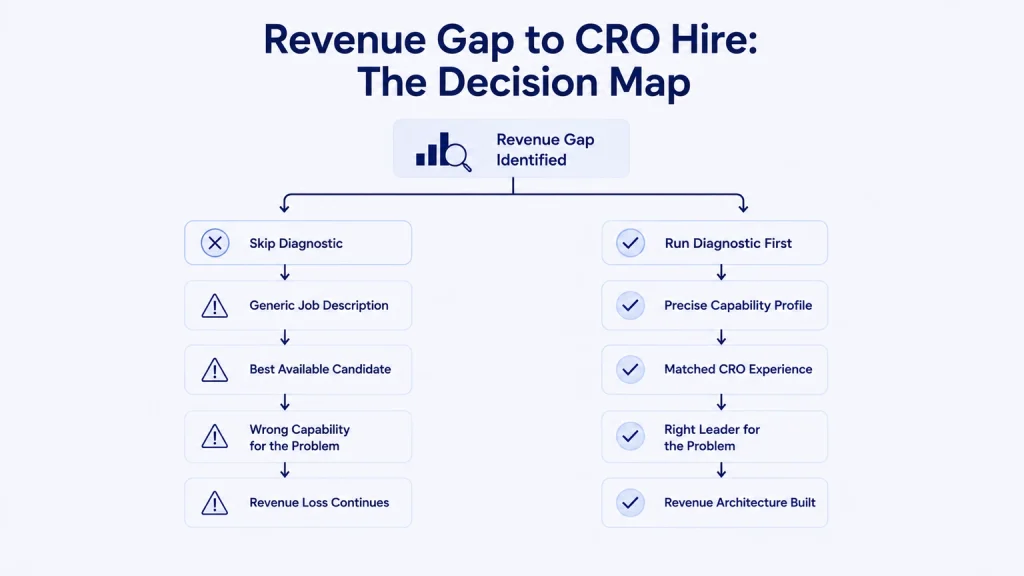
Sales leadership hiring at the CRO level produces better outcomes when the revenue problem is defined before the candidate search begins. Not a job description. A revenue gap diagnostic. Where is revenue leaking? What is the forecast accuracy and why? Which part of the commercial engine is producing the highest loss? Those answers produce the capability brief the search should be built around.
A CRO hired without this diagnosis is hired for the title. A CRO hired with it is hired for the specific problem. The first search fills the role. The second one fixes what was broken.
What to Evaluate Before Hiring a CRO
Five capability dimensions determine whether a CRO can actually scale revenue in a B2B technology company. Each needs to be assessed against the specific context of the hiring company, not against a generic CRO benchmark.
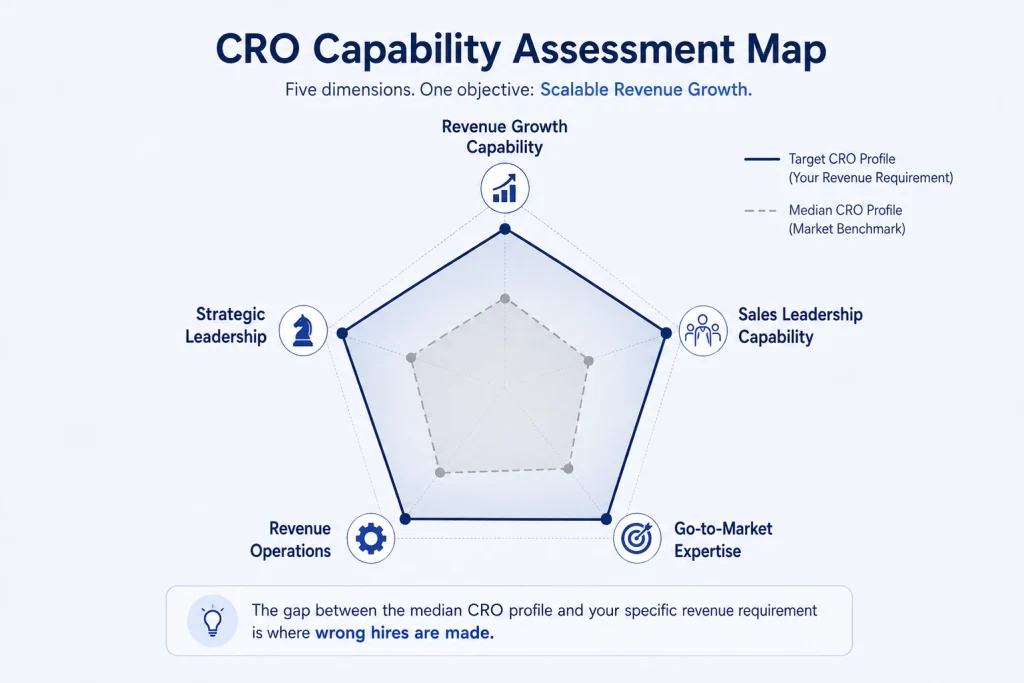
| Evaluation Dimension | What to Look For | Common Mistake |
|---|---|---|
| Revenue Growth Capability | Sustainable growth in comparable company stage and complexity | Hiring based on peak revenue number without context |
| Sales Leadership Capability | Coaching track record, team building, execution systems | Assuming quota attainment proves leadership capability |
| Go-to-Market Expertise | GTM design and adaptation across markets and channels | Overlooking whether GTM experience matches your model |
| Revenue Operations | Cross-functional alignment, forecasting, data-driven decisions | Treating RevOps as optional rather than foundational |
| Strategic Leadership | CEO-level communication, long-term vs short-term balance | Hiring for short-term execution at a long-term architecture role |
A strong CRO interview produces confidence. A strong CRO assessment produces evidence.
Revenue Growth Capability
Sustainable revenue growth is not the same as revenue growth. A CRO who hit a number during a market expansion period, with a well-funded marketing machine, in a category that was winning regardless of sales execution, has demonstrated something. What they have demonstrated is not necessarily scalable. The assessment looks for specific evidence of growth that the candidate created rather than inherited.
Sales Leadership Capability
A CRO who cannot build the revenue team the company needs is a CRO who will replace the people already there rather than develop them. Coaching track record, capability-building approach, and specific evidence of teams they developed are more predictive than quota attainment numbers from roles where the team was already assembled.
Sales coaching at the management layer is one of the CRO’s most structurally important contributions. The best CRO candidates build a coaching infrastructure that continues to run without their direct involvement. If their leadership model requires constant personal presence to sustain performance, they have not built a system. They have become a dependency.
Go-to-Market Expertise
The GTM model that the company needs the CRO to operate in should match, at least structurally, the GTM models the candidate has operated in before. Enterprise versus mid-market versus SMB motion. Product-led versus sales-led. Single product versus multi-product. Single market versus international. A CRO who has only operated in one configuration may have the instincts but not the scar tissue required to navigate a different one.
B2B tech sales strategy at the CRO level is not about choosing a methodology. It is about designing the commercial architecture that connects every revenue-generating function and adapts as the market changes. The candidate who can describe that architecture in specific terms, including where it has failed before and why, is a fundamentally different profile from one who describes results without describing the system that produced them.
Revenue Operations and Cross-Functional Leadership
A CRO who cannot connect sales, marketing, and customer success around a single revenue model will manage three functions rather than one revenue engine. The ability to align teams around shared pipeline definitions, shared qualification standards, shared customer success metrics, and shared forecast methodology is the structural capability that separates a CRO who compounds growth from one who manages it.
Strategic and Executive Leadership
The CRO reports to the CEO and presents to the board. The ability to translate company strategy into revenue execution, to hold the tension between short-term target pressure and long-term architecture investment, and to communicate commercial risk in terms the board can act on is as important as the commercial expertise that qualifies the candidate in the first place.
Already Have CRO Candidates? Assess Them Against Your Revenue Gap First.
The Revenue Gap Diagnostic produces the precise capability profile that every CRO candidate should be measured against. Free. 20 minutes. Get An Instant Report.
How to Assess a CRO Beyond the Resume
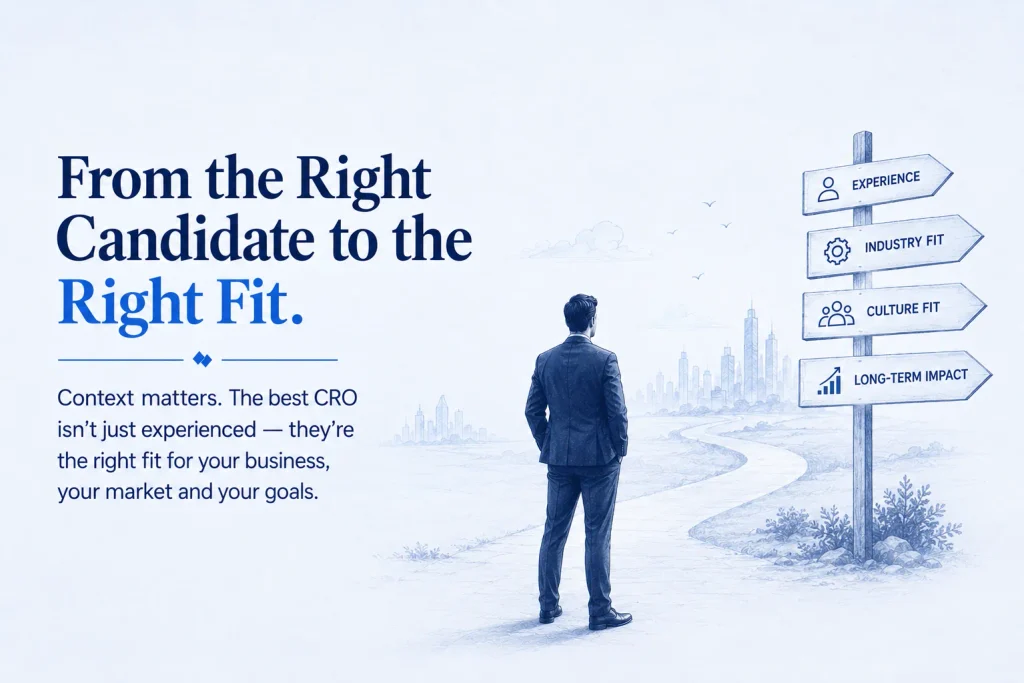
The interview is not the assessment. It is the audition. A CRO candidate who interviews well has demonstrated one thing: they can describe revenue leadership compellingly. Whether they can actually execute it in your specific environment is a different question, and it requires a different evaluation process. The four dimensions below produce evidence rather than impressions.
Assess the Candidate Against Your Revenue Gap
The revenue gap diagnostic output becomes the scoring rubric. For each identified gap, the question is whether the candidate has solved a structurally comparable problem before. Not the same company. Not the same number. The same type of revenue challenge, at a comparable stage, with comparable complexity. The match between the diagnostic output and the candidate’s specific experience is the primary signal.
Test Revenue Problem-Solving
Present the candidate with real revenue scenarios from the company’s current situation. Pipeline deterioration. Declining win rates. Poor forecast accuracy. GTM misalignment. Long sales cycles. The quality of the assessment is not in the answer they give. It is in the diagnostic questions they ask before they answer. A CRO who asks about stage-level conversion data, team capability benchmarks, and GTM model before recommending a solution is demonstrating the diagnostic instinct that revenue leadership requires. One who recommends a solution without asking is demonstrating something else.
Evaluate GTM Complexity
Map the specific GTM complexity the incoming CRO will face. Enterprise versus mid-market buyers. Multiple products across different markets. Technical buying committees. Procurement-heavy purchasing cycles. Channel complexity. The candidate’s assessment should cover not just whether they have operated in comparable complexity, but how they would adapt their approach to yours specifically. General GTM fluency is different from specific GTM judgment.
Assess Leadership and Cultural Fit
Cultural fit at the CRO level is not about personality or style preference. It is about whether the candidate’s leadership approach matches the stage the company is in. A CRO who has operated in a 500-person enterprise with dedicated RevOps, marketing operations, and sales enablement functions may be the wrong fit for a 40-person company where the CRO needs to build those capabilities from scratch while still being involved in major deals personally. The question is not whether they are good. It is whether they are right for this specific configuration.
The CRO Hiring Process: From Revenue Gap to Final Candidate
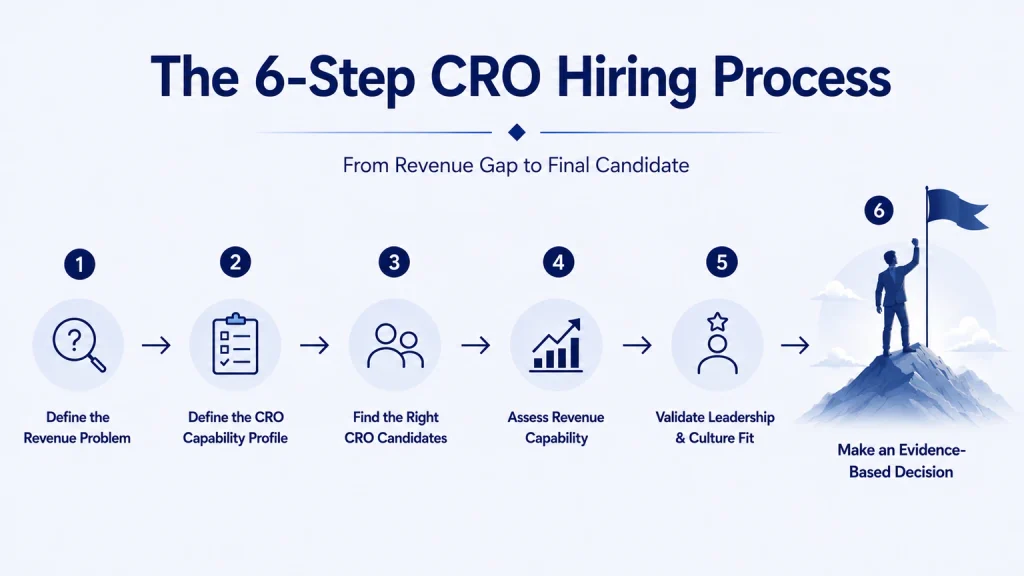
Most CRO searches start with a job description and end with the best available candidate at the time the search closes. That is the sequence that produces the wrong hire. A process built around the revenue gap produces a categorically different outcome at every stage because it is answering a different question throughout. Not who is the best CRO available, but who is the right CRO for this specific revenue problem.
Each step below depends on the one before it. Skipping any step does not save time. It shifts the cost of the shortcut forward into the eighteen months after the hire is made.
Step 1: Define the Revenue Problem
Where is revenue currently being lost? What needs to change in the next 12 to 18 months? What should the CRO accomplish that the current structure cannot? Run the revenue gap diagnostic before writing a single line of the job description. The answers define the profile.
Step 2: Define the CRO Capability Profile
Translate the diagnostic output into specific capability requirements. Revenue growth experience at the relevant company stage and complexity. Sales leadership track record with evidence of team development. GTM experience that matches the model. Industry and market knowledge sufficient to build credibility with the buying committee. Leadership behavior that matches the company’s current culture.
Step 3: Find the Right CRO Candidates
Revenue leadership search at the CRO level requires access beyond active candidates. The CROs most likely to solve the company’s specific problem are almost never in active search. They are running revenue at another company. Reaching them requires long-term relationship networks inside the technology revenue leadership community, not database searches and job postings. Prioritise relevant revenue experience. Evaluate the context behind every result before the interview stage.
Step 4: Assess Revenue Capability
Revenue capability assessment covers technical sales leadership, GTM design, forecasting methodology, and problem-solving approach on live scenarios. Tech sales training and capability development experience is part of this assessment. A CRO who cannot articulate how they would diagnose and rebuild the team they are inheriting is a CRO who will manage the team, not develop it.
Step 5: Validate Leadership and Culture Fit
Leadership behavior assessment looks at how the candidate runs their current or most recent revenue function. How do they coach? How do they handle missed quarters? How do they communicate risk to a board? How do they make decisions when the data is incomplete? References from people who have worked for them, not with them, produce the most accurate picture.
Step 6: Make an Evidence-Based Hiring Decision
Compare every candidate against the defined capability profile, not against each other. The best candidate in the shortlist is not always the right one for the specific problem. The evidence-based decision asks one question above all others: whose specific experience most directly addresses the revenue gap the diagnostic identified? That is the hire worth making.
Sales training and coaching infrastructure is one of the clearest proxies for whether a CRO will develop the team or simply manage it. Candidates who can describe the specific coaching systems they have built, not just the coaching culture they have created, are demonstrating a structural capability that compounds over time.
What Makes CRO Executive Recruitment Different at TALSMART?
Any firm can source CRO candidates. What most firms cannot do is assess whether a specific candidate can solve a specific company’s revenue problem. That assessment requires someone who has built what they are evaluating. It requires revenue expertise alongside recruitment expertise. The four points below explain where that difference is structural rather than incremental.
Recruitment Is Not the Differentiator
Finding CRO candidates is not the hard part. Every executive search firm can find candidates. The differentiator is the capability to assess whether a specific candidate can solve a specific company’s revenue problem. That assessment requires revenue expertise, not just recruitment expertise. The evaluators need to have built what they are assessing.
Built for Technology Companies
The practice works exclusively with B2B technology companies. Every assessment framework, every evaluator, and every candidate relationship is built around the specific demands of technology revenue leadership. This is not a generalist practice that handles tech as one sector among many. It is a specialist practice that understands the commercial complexity of technology GTM environments at every stage of scale.
Revenue-Gap Diagnostics and Expert Assessment
The search begins with a revenue gap diagnostic, not a job description. The diagnostic output becomes the capability brief. Every candidate is assessed against that brief by coaches who have personally built B2B technology revenue functions, including professionals with experience at organizations like Google and Oracle. Assessment covers commercial capability and culture fit simultaneously, because the right capability in the wrong culture produces a departure within eighteen months.
A Model With Skin in the Game
Elite CRO candidates are identified within two weeks. No retainer is charged upfront. Own money and own time go into the search before a fee is earned. Payment is tied to the commercial performance of the placed leader. When the search firm’s success depends on the hire’s success, the quality of the assessment changes.
Executive sales recruiters who operate on this model have a structural reason to be precise about capability assessment. Every shortcut in the evaluation is a shortcut that comes back to them, not just to the client.
CRO Executive Recruitment Checklist
Before making a final CRO hiring decision, each question below should have a specific, evidence-based answer. General confidence in a candidate is not sufficient. Specific answers are.
| Can the candidate diagnose our specific revenue problem? |
| Have they scaled a comparable revenue model at a comparable stage? |
| Do they understand our GTM complexity? |
| Can they build and lead the revenue organisation we need? |
| Can they align sales, marketing, and customer success? |
| Have we tested their revenue problem-solving approach on live scenarios? |
| Have we assessed leadership behavior and cultural fit? |
| Does their capability match the specific gap we need to solve? |
Find a CRO Who Can Actually Scale Revenue
The Revenue Gap Diagnostic defines the specific revenue problem. The capability profile follows from the diagnostic. The search is built around the profile. Free. 20 minutes. Get An Instant Report. No sales call required.
Hire the CRO Who Can Solve Your Revenue Problem
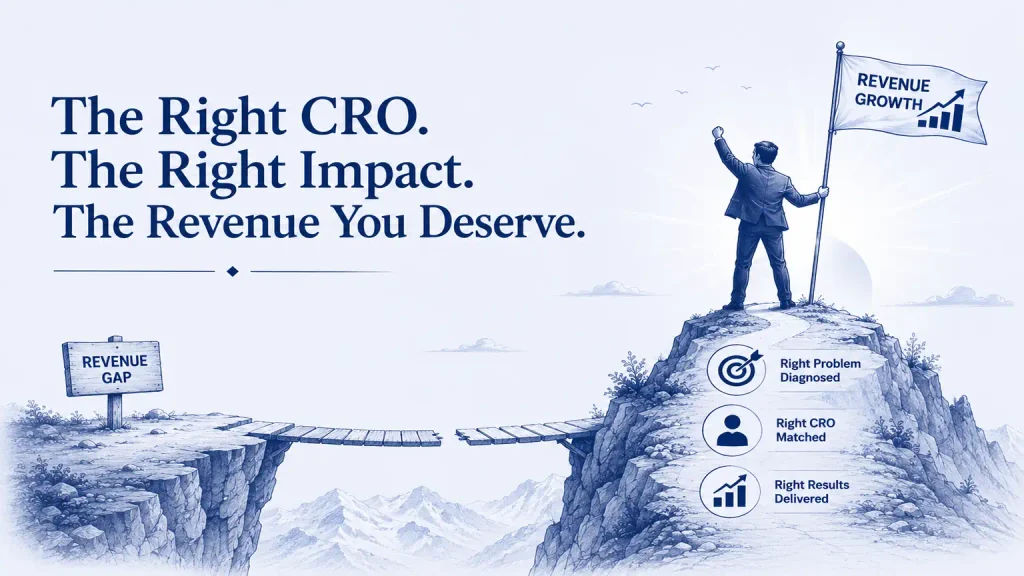
Simon ran the revenue gap diagnostic before the second CRO search. The output showed that the structural problem was not pipeline volume. It was qualification discipline and forecast accuracy at the individual stage level. The incoming CRO needed to have rebuilt those two capabilities before, in a comparable B2B technology environment.
The candidate who was placed had never been featured in a case study. Their previous company was not a household name. But they had solved exactly that problem, at a comparable stage, with a comparable team, and the Free Sales Audit Tools helped validate the diagnostic evidence. Within nine months, forecast accuracy had improved from 58% to 81%. Within fourteen months, the company had its highest-revenue quarter on record.
The resume had nothing to do with it. The diagnostic did.
Don’t ask only who has been a CRO.
Ask who can solve your revenue problem and build the system required to scale it.
TALSMART is a global revenue execution partner and specialist CRO executive recruitment firm for B2B technology companies, operating across 100 plus countries and 23 languages.
Frequently Asked Questions
What should companies look for when hiring a CRO?
Start with the revenue problem the company needs the CRO to solve. Define the capability profile from the diagnostic output. Look for relevant experience at comparable company stages, in comparable GTM models, with specific evidence of revenue architecture built rather than inherited. Assess leadership and cultural fit against the company’s current stage, not its aspirational future state.
How do you assess a CRO candidate beyond their resume?
Test revenue problem-solving on live scenarios from the company’s actual commercial situation. Assess the quality of the diagnostic questions the candidate asks before recommending solutions. Evaluate GTM complexity experience against the specific model the company operates. Reference people who have worked for the candidate, not with them. Measure every candidate against the revenue gap diagnostic output, not against each other.
What is the difference between CRO recruitment and CRO executive search?
Traditional CRO executive search finds candidates who match a job description. CRO executive recruitment built around a revenue gap diagnostic finds candidates who match a specific revenue capability requirement. The first process produces a shortlist of qualified candidates. The second produces a recommendation of the candidate most likely to solve the company’s actual revenue problem.
How long does CRO executive recruitment take?
Traditional CRO executive search typically takes four to six months. Specialist CRO recruitment with continuous passive talent outreach delivers vetted shortlists in under two weeks. The difference is not speed of execution during the search. It is that passive outreach and relationship building run continuously rather than starting when the vacancy is declared.
How do you evaluate CRO leadership and cultural fit?
Assess leadership behavior against the specific stage the company is in rather than against a generic CRO leadership profile. Interview people who have worked for the candidate in comparable environments. Evaluate the coaching and capability-building methodology the candidate has actually implemented, not just described. Assess cross-functional collaboration track record in organizations with comparable complexity.
How can you determine whether a CRO can actually scale revenue?
Look for specific evidence of revenue architecture built in comparable conditions. What qualification process did they design? What forecasting methodology did they implement? How did team performance change under their leadership? What happened to revenue predictability during and after their tenure? The answers to these specific questions are more predictive than any title or headline revenue number.