
You have a CRM. You have sales content. You have a training programme that ran last quarter. And yet your reps still enter deals unprepared, lose pipeline to silence, and revert to old habits the moment the coach leaves the room.
Sales enablement in B2B tech is one of the most misunderstood investments a revenue leader can make. The term gets applied to content libraries, onboarding decks, and CRM dashboards. None of those things, on their own, constitute a strategy. A sales enablement strategy is the architecture that connects your B2B tech sales strategy to the behaviours your reps actually exhibit in the field, on every deal, every quarter.
If your reps are not executing the way you trained them to, the problem is not the training. It is the absence of a system designed to make that execution the path of least resistance.
What Sales Enablement Strategy Actually Means
Sales enablement strategy is the deliberate design of how your organization equips, trains, coaches, and measures its sales team across the entire B2B sales process. It is not a content management system. It is not a sales playbook that lives on a shared drive.
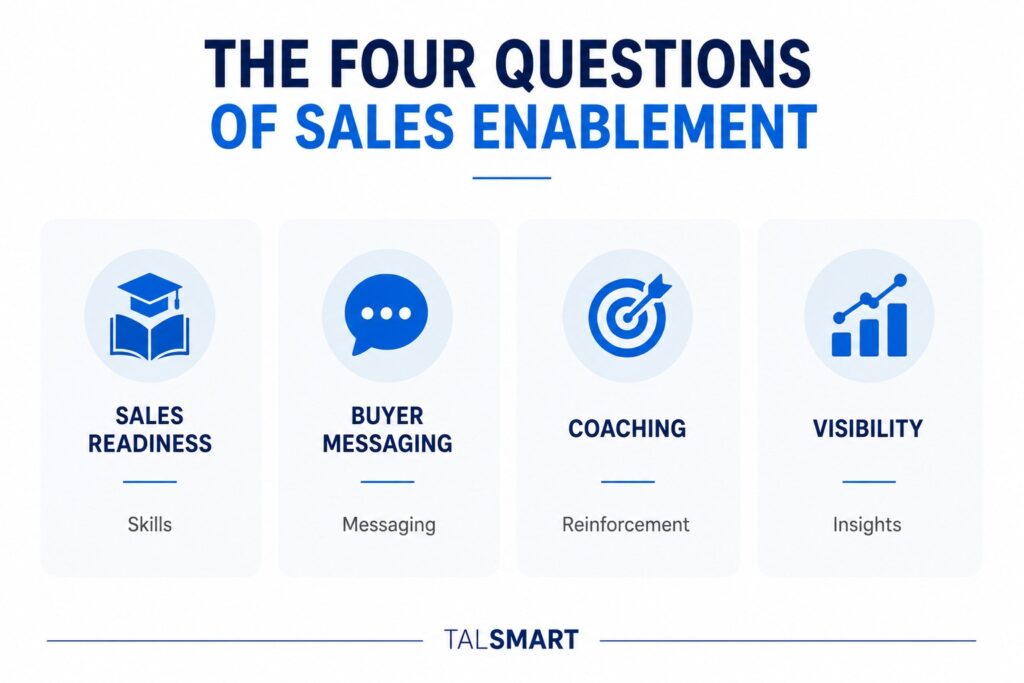
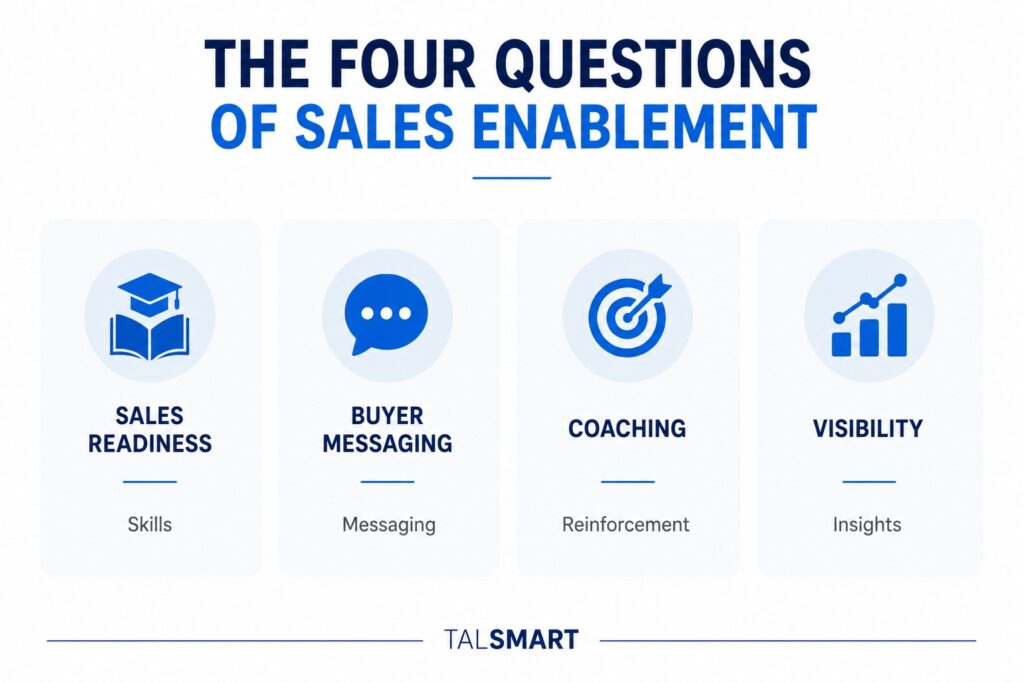
A real sales enablement strategy answers four questions that most revenue organizations leave to chance:
- Do reps have the right skills and knowledge at each stage of the deal, or are we assuming they do?
- Does the content and messaging they use match how buyers in enterprise tech actually make decisions?
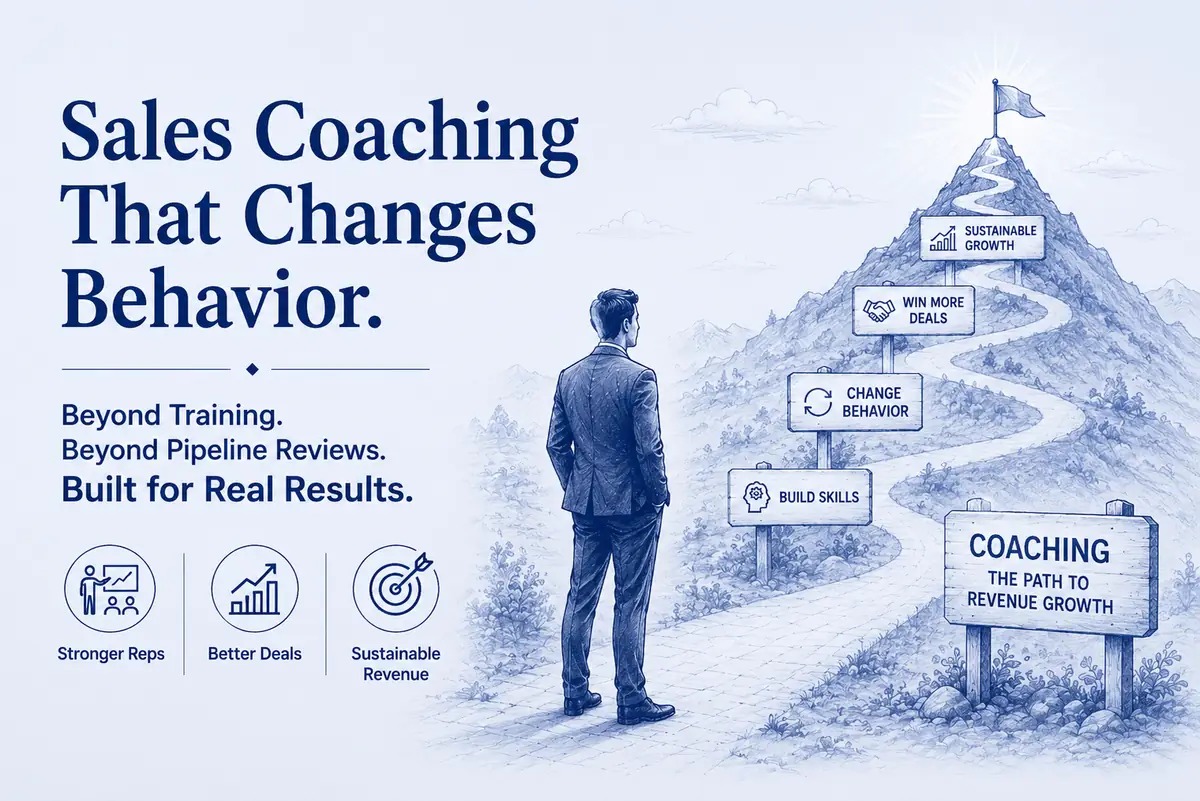
- Is there a coaching mechanism that reinforces skill in the field, not just in training sessions?
- Do we have pipeline visibility and sales analytics that tell us where execution is breaking down before it costs us the quarter?
Sales enablement is not what happens before the rep gets on the call. It is the system that determines how they perform on every call, in every deal, across every stage of a complex enterprise sales cycle.
The Three Layers of a Sales Enablement Framework That Works
Most B2B tech companies build their sales enablement framework in isolation from their execution reality. They invest in tools without a training strategy. They run training without a coaching infrastructure. They measure activity metrics without revenue intelligence that ties behaviour to outcome.
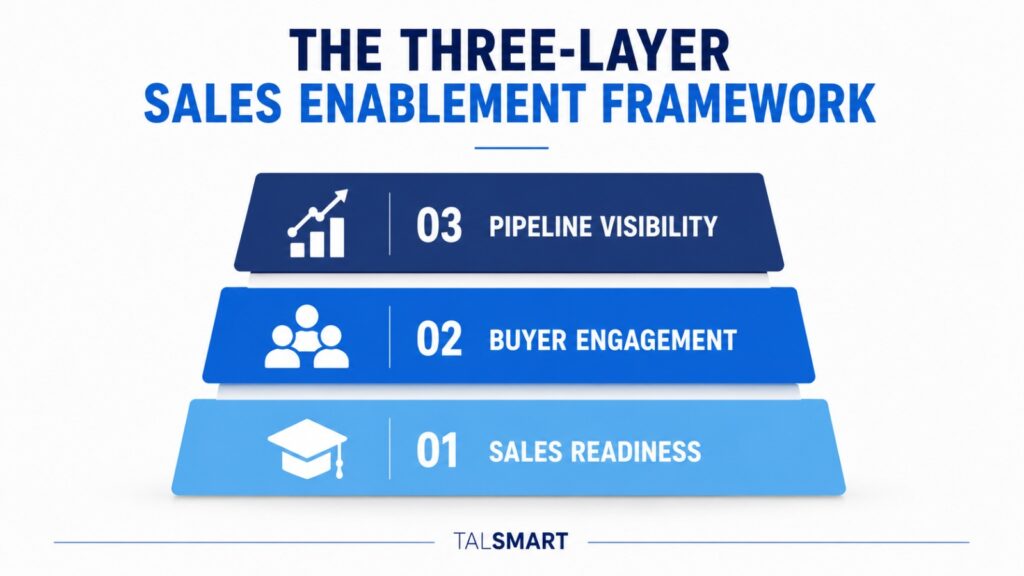
The framework that actually compounds across quarters operates in three connected layers.
Layer 1: Sales Readiness
Sales readiness is the foundation. It is the answer to: can your reps execute at the level the deal requires, before they are in the deal?
This layer covers structured sales training programs built specifically for enterprise sales in B2B tech, not adapted from generic methodology. It covers sales onboarding that gets new reps to first meaningful conversation faster, using a diagnostic baseline rather than assumptions about what they already know. And it covers sales content management: making sure the right message, case study, or competitive response is available to the rep at the exact stage where it matters, not buried in a folder nobody opens.
Worth knowing
TALSMART’s Tech Sales Mastery Program builds sales readiness stage by stage.
Built exclusively for B2B tech. Cinematic. Neuroscience-based. Top-rated on Udemy. From $20.
Layer 2: Buyer Engagement
Your reps can be fully trained and still lose deals they should win. Not because of skill gaps, but because they are not connecting the right insight to the right stakeholder at the right moment.
Buyer engagement in enterprise tech is complex. Sales automation can handle sequencing. Revenue intelligence tools can surface intent signals. But none of that replaces the consultative selling capability that makes a buyer feel genuinely understood rather than managed through a process.
The sales enablement best practices that drive buyer engagement at this layer are specific: coaching reps to read buying signals rather than chase activity metrics, equipping them with multi-stakeholder messaging that lands differently with a CFO than it does with a technical evaluator, and building a feedback loop between what buyers respond to and what the team is trained to do.
Do you know where your reps’ buyer engagement is breaking down?
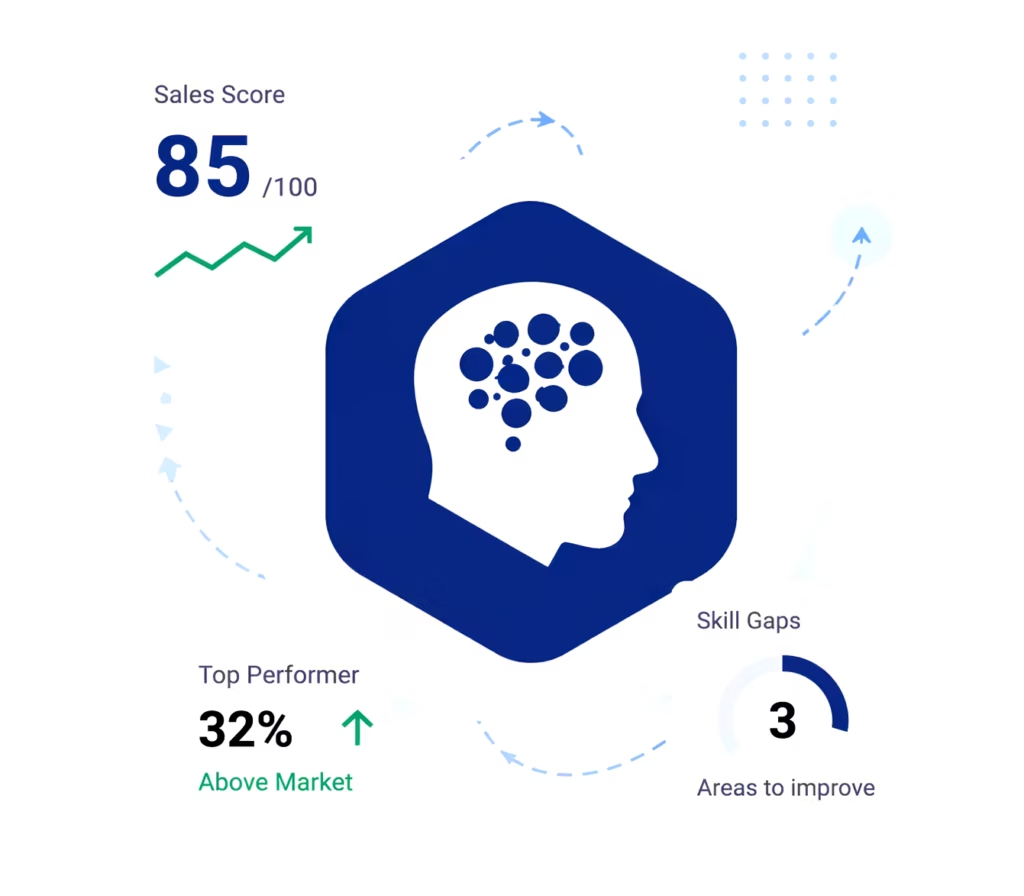
The Revenue-Gap Diagnostic benchmarks your team across five B2B tech sales stages against the top 4% of performers globally. Free. 20 minutes. Get Instant Report.
Layer 3: Pipeline Visibility and Revenue Alignment
This is the layer most companies build first and most poorly. They install a CRM, declare the enablement problem solved, and wonder why forecast accuracy does not improve.
Pipeline visibility is only useful when it is connected to execution insight. Sales analytics that tell you a deal has been in stage three for forty-two days are not enablement. Sales analytics that tell you why it stalled, which objections were not handled, and what coaching intervention would move it forward: that is revenue intelligence working as it should.
Revenue alignment, the connection between marketing, sales, and customer success around a shared view of the buyer journey and a shared definition of what good execution looks like, is what makes this layer compound rather than report. Without it, revenue operations data becomes a post-mortem rather than a management tool.
Sales Enablement KPIs That Measure the Right Things
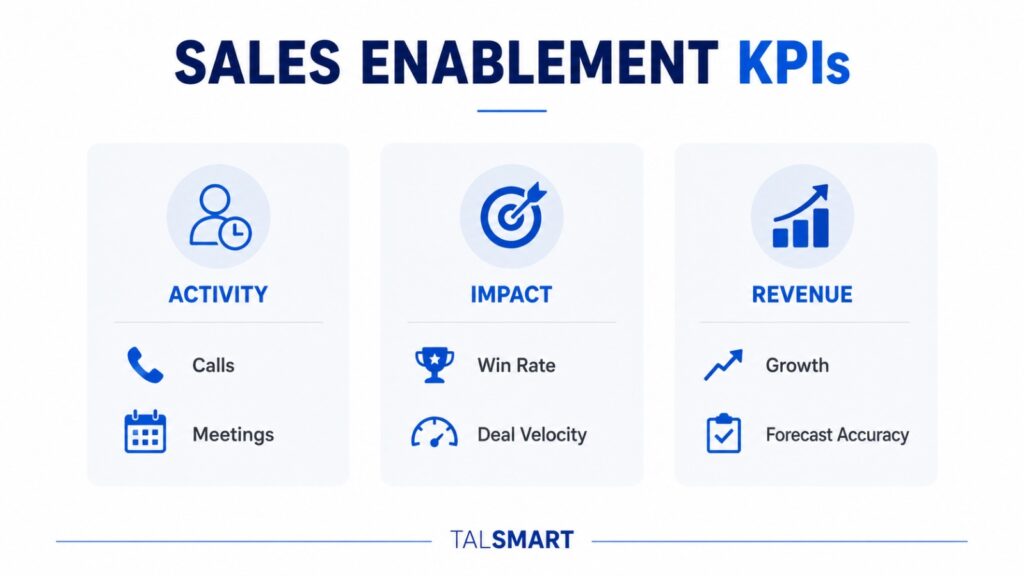
The most commonly tracked sales enablement KPIs measure activity. The ones that measure impact are less common and far more useful.
Activity metrics tell you what reps are doing. Impact metrics tell you whether what they are doing is working. For a sales enablement strategy in B2B tech, the KPIs that matter are:
- Quota attainment by rep and segment, tracked against their starting diagnostic baseline to measure growth rather than raw performance.
- Time to first meaningful conversation for new reps, which reveals whether onboarding is building sales readiness or just completing a checklist.
- Deal velocity at each stage of the B2B sales process, which surfaces where pipeline stalls and which coaching interventions produce measurable movement.
- Content engagement by deal stage, which tells you whether your sales content management is actually influencing buyer decisions or being ignored.
- Training behaviour retention at 30, 60, and 90 days, which is the single most revealing KPI for whether enablement is a system or an event.
70 percent of reps revert to pre-training behaviour within 90 days when coaching is not embedded in their workflow. That number shows up eventually in quota attainment. The KPIs above let you catch it before it does.
The Thing Most B2B Tech Companies Miss
Most revenue leaders know their sales enablement strategy is not working. They can feel it in forecast calls, in pipeline reviews, in the gap between what reps were trained to do and what they actually do under pressure.
What they often cannot see is that the problem is structural, not individual. It is not that the reps are not good enough. It is that the enablement system was designed as a collection of tools and programmes rather than as a compounding architecture.
The sales training programs that sit inside a real enablement strategy are not separate events. The sales analytics that measure it are not separate reports. The sales coaching that reinforces it is not a separate initiative. They are layers of one system, designed so that each one makes the others more effective.
That is the difference between a B2B sales enablement framework that compounds quarter over quarter and one that restarts every January.
Build the System, Not Just the Stack
Before investing in another tool or programme, know exactly where your team’s execution is breaking down. The Revenue-Gap Diagnostic benchmarks your reps across all five stages of the B2B sales process against the top 4% of performers globally.
Frequently Asked Questions
What is a sales enablement strategy?
A sales enablement strategy is the system that equips sales reps with the content, skills, coaching, and context they need to advance deals at every stage of the buyer journey. It is not a content library or a single tool. It is the architecture that connects what reps know to what they actually do in front of buyers, and measures whether that connection is producing commercial results.
How is sales enablement different from sales training?
Sales training programs build skills. Sales enablement is the broader system that makes those skills usable in the field. Training teaches a rep how to handle an objection. Enablement ensures the right objection framework reaches the rep at the moment that objection surfaces in a live deal. Both matter, but enablement without training has no content, and training without enablement rarely sticks past 30 days.
What KPIs should I track for sales enablement?
The most useful sales enablement KPIs are pipeline velocity by stage, content utilization mapped to deal stage, quota attainment split by rep tenure, coaching coverage ratio, and win rate on coached versus uncoached deals. These metrics tell you where the B2B sales process is stalling, whether enablement assets are being used, and whether coaching is producing measurable commercial outcomes.
How do I build a sales enablement strategy for a B2B tech company?
Start with a clear skill gap analysis before selecting any tools or building any content. Understand where deals are actually breaking down across your sales stages, then build enablement resources that address those specific gaps. Connect your content management, pipeline visibility, sales analytics, and coaching infrastructure into a single system. Measure utilization and outcomes from the first quarter, not the first year.
What tools do I need for sales enablement?
The core tool set covers four functions: pipeline visibility so managers can see deal health in real time, sales content management so reps can find the right asset at the right deal stage, sales analytics for coaching decisions grounded in data, and a learning management system for ongoing skills development. The goal is not more tools. It is connecting what you have so they produce a coherent picture of revenue performance.
What is revenue enablement, and how is it different from sales enablement?
Revenue enablement expands the scope of sales enablement to include the full revenue organization, not just the sales team. It aligns sales, marketing, and customer success around shared pipeline visibility, buyer engagement data, and revenue intelligence. For most B2B tech companies, revenue enablement is the mature form of what begins as a sales-only initiative, and it becomes especially relevant when revenue operations span multiple functions.
TALSMART is a global revenue execution partner for B2B tech companies, operating across 100 + countries and 23 languages. The Revenue Execution System is built exclusively for the complexity of enterprise technology sales.