
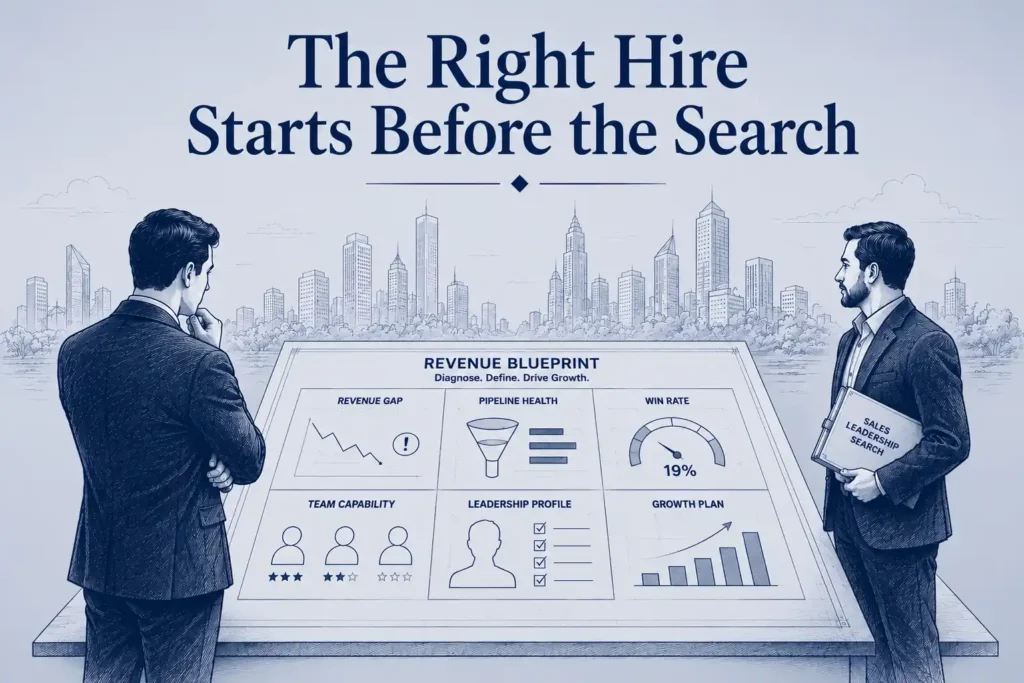
David hired three VP Sales in four years. Each one came with an impressive resume. Each one had managed large teams at recognizable technology companies. Each one passed the interview with confidence. And each one, by month eighteen, had left the company with the same revenue problem that existed before they arrived.
After the third departure, the CEO asked a question nobody had thought to ask at the start: what revenue problem were we actually trying to solve when we hired them?
Nobody had a clear answer.
If this pattern feels familiar, the issue is almost certainly not the quality of your hiring. It is the definition of success that was never agreed upon before the search began.
Hiring a sales leader without first diagnosing your revenue challenge is like calling a surgeon before knowing what is wrong with the patient. The surgeon may be exceptional. But without a diagnosis, there is no way to know whether you need a cardiologist, an orthopedic specialist, or a neurologist. You will always get someone competent. You will rarely get the right person.
The goal of a sales leadership recruiter is not to present impressive resumes. It is to predict revenue leadership success. Those are two entirely different briefs. And most executive search processes are built around the first one, not the second.
The Revenue Execution System (Diagnose, Build, Execute, Lead) starts with this premise. Before anyone is hired, the revenue gap must be diagnosed. That diagnosis defines the leadership profile. Without it, every search begins in the wrong place.
Your Sales Leadership Recruiter Is Hiring for a Position Instead of a Revenue Problem
Most sales leadership hiring begins with a job description. A title. A list of requirements. A set of qualifications. The search firm receives the brief and begins looking for candidates who match those inputs.
The problem is that a job description describes what the company expects the person to do. It rarely describes what the company needs the person to fix. And in high-growth B2B tech, those two things are often not the same.
A company that needs to scale from $10 million to $50 million in three years needs a sales leader who has built pipeline infrastructure from scratch. This is executive sales recruitment at its most specific: matching a revenue growth strategy to the leader most equipped to execute it. A company that has strong pipeline volume but a 19% win rate needs a sales leader who can identify and close stage-level execution gaps. A company entering a new vertical needs someone who has opened markets without an established brand. These are three completely different roles, and none of them is captured by the title VP Sales.
When the search begins without this clarity, every candidate is evaluated against the wrong standard. The hire is made based on who interviewed best. And the revenue problem that prompted the search is still waiting twelve months later.
What Revenue Problem Does Your Next Sales Leader Need to Solve?
The Revenue Gap Diagnostic maps exactly where your current sales system is breaking down before the search begins. Free. 20 minutes. Get Instant Report.
Why Most Sales Leadership Recruiters Fail to Find Revenue-Building Leaders
They’re Searching in the Same Talent Pool as Everyone Else
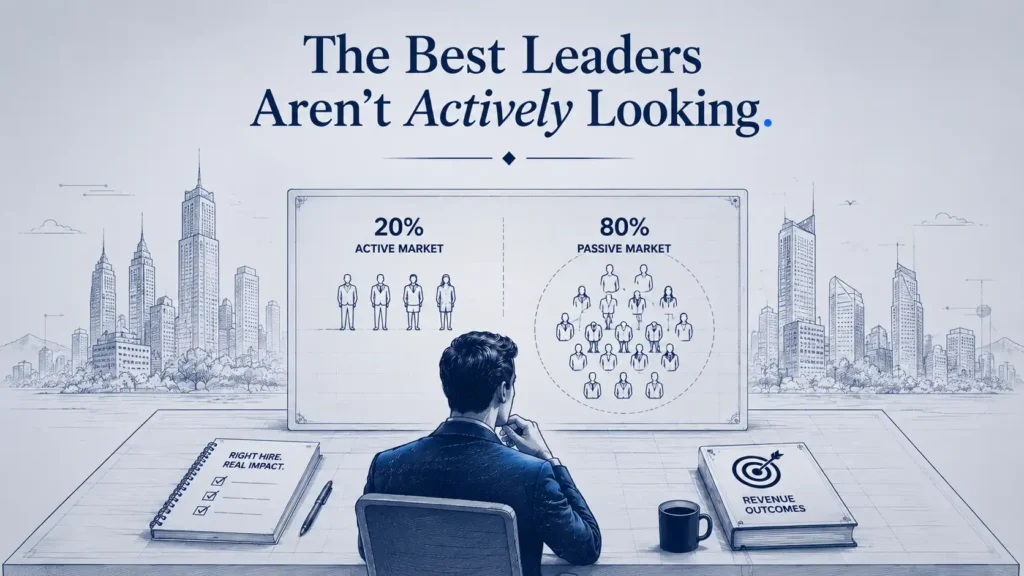
The active candidate market represents approximately 20% of available sales leadership talent. The remaining 80% are not on job boards, not responding to LinkedIn messages, and not registered with general executive search firms. They are running sales teams, hitting targets, and not looking. Sales leadership recruiters who search only the active market are not reaching most of the people worth considering.
The Best Sales Leaders Rarely Apply for Executive Roles
The sales leaders most capable of transforming a revenue function are typically the least likely to be browsing job postings. They are occupied. They are not in pain. They are not actively searching. Reaching them requires deliberate outreach, a compelling case for the opportunity, and a recruiter who has built genuine relationships inside the passive market over years, not weeks.
Leadership Titles Don’t Always Predict Revenue Growth
A candidate who has held VP Sales at three technology companies has three years of experience repeated three times, or three genuinely different revenue-building achievements. The title is the same. The capability is not. Without structured sales leadership assessment beyond CV review and interview performance, there is no reliable way to distinguish between the two. Technology sales leadership experience is a necessary condition for the role, not a sufficient one.
Recruiters Without Sales Experience Can’t Assess Sales Leaders Properly
Sales coaching is built on the ability to recognise what good execution looks like in a live deal. A recruiter who has never carried a quota, never built a pipeline from zero, and never closed an enterprise deal is evaluating candidates on the basis of what they say rather than whether what they say is credible. An experienced sales leader can tell a compelling story about a territory they did not build, a number they did not close, and a team they did not develop. A recruiter with no sales background has no frame of reference to challenge it. The result is a hire who interviews brilliantly and underdelivers in the field.
Tech sales training in a B2B technology environment requires a fundamentally different competency to teach than general sales methodology. The same distinction applies in evaluation. Assessing whether a candidate truly understands multi-stakeholder enterprise deals, procurement dynamics, and stage-specific execution gaps requires an evaluator who has personally navigated those situations, not one who has only read about them.
Too Many Executive Searches Reduce Hiring Quality
A search firm managing thirty open positions simultaneously cannot give any single search the attention it requires. Recruiter burnout is real, and it has a direct cost to hiring quality. Candidate outreach becomes templated. Assessment becomes surface-level. Follow-up conversations are deprioritized when the next brief is already waiting. The pressure to close searches produces candidates who are good enough rather than candidates who are right. Sales leadership recruiters who specialize exclusively in technology companies, and who manage fewer simultaneous searches, consistently produce better long-term hiring outcomes.
Is Your Revenue Challenge Clearly Defined Before the Search Begins?
The Revenue Gap Diagnostic identifies exactly where your current sales system is breaking down, giving any incoming sales leader a precise brief to work from. Free. 20 minutes. Get Instant Report.
Case Study: Proactive Recruitment Reduces Time-to-Hire by 60%
A technology company working with a specialist sales leadership recruiter shifted from reactive hiring to an always-on recruitment discipline. Rather than opening a search when a role became vacant, they committed to interviewing at least one sales leadership candidate every week of the year. (Center for Sales Strategy) When their VP Sales resigned with three weeks notice, a vetted shortlist already existed. The replacement was in role within two weeks. The same search, run reactively through a generalist firm, had previously taken four to five months. The key variable was not the quality of the candidates. It was that the passive talent outreach had already been done.
Read The Full case study:- https://talsmart.com/masterclass/sales-recruitment-tips-how-to-build-an-it-sales-team-that-sticks/
Watch the video:– https://youtu.be/y2y80utK6CU
What Specialist Sales Leadership Recruiters Evaluate Before Recommending a Candidate
Understanding the Revenue Challenge Before Starting the Search
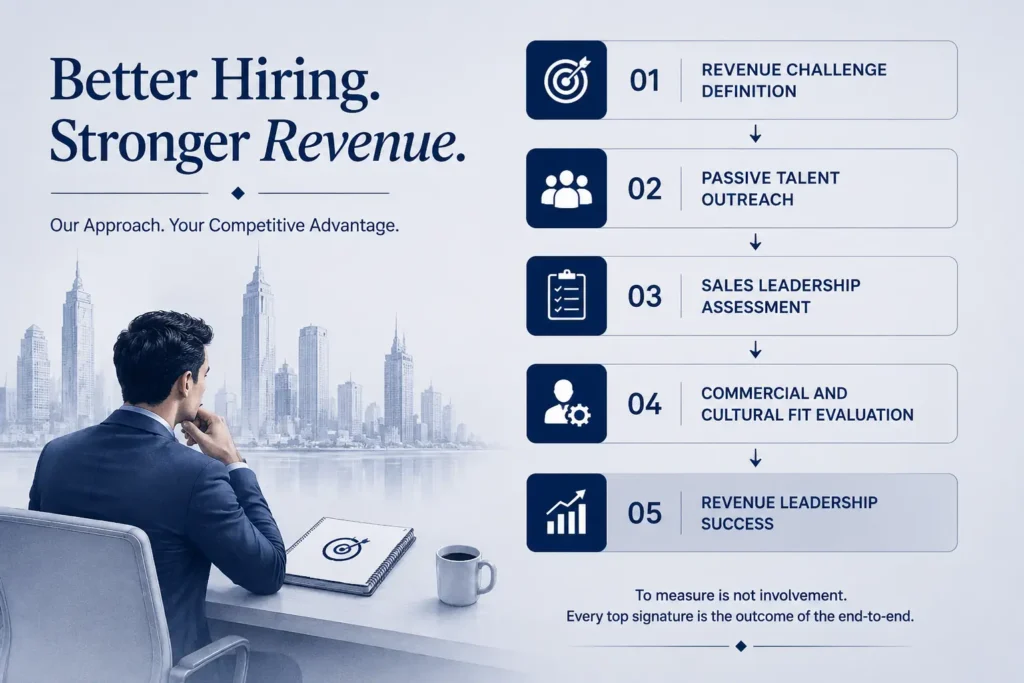
Before writing a job description or approaching a single candidate, a specialist sales leadership recruiter maps the revenue problem the incoming leader will need to solve. Is the challenge pipeline volume, pipeline quality, win rate, deal cycle length, or team capability? Each of these requires a different leadership profile. Defining the problem first makes the search specific rather than general.
Building Access to Passive Sales Leadership Talent
Specialist sales leadership recruiters maintain active relationships with senior sales professionals who are not looking but who would consider the right opportunity. This network is built over years and cannot be replicated quickly. It is the primary reason specialist firms surface candidates that generalist executive search firms never see.
Measuring Sales Competencies Beyond CVs and Interviews
Revenue-gap diagnostics applied to leadership candidates reveal how a candidate thinks about pipeline architecture, qualification standards, team development, and performance management before they are placed. A candidate who can explain their approach to stage-specific execution, and can demonstrate it with specific numbers from their track record, is a fundamentally different profile from one who can only describe what they managed at a high level.
This is where structured assessment, led by professionals who have built and run B2B tech sales teams, replaces the interview as the primary evaluation tool.
Evaluating Candidates Through Experienced Sales Professionals
Assessment led by experienced B2B sales professionals and executive coaches who have themselves carried quotas, built territories, and managed enterprise deals produces a categorically different evaluation. Candidates are assessed on the credibility and specificity of their commercial track record, not on their ability to present well in a structured interview. The evaluator knows what good looks like because they have done it themselves.
Balancing Commercial Capability with Cultural Fit
A sales leader who has the right capability in the wrong culture will underperform. A sales leader who fits the culture but lacks the specific commercial capability the company needs will also underperform. Assessment must evaluate both dimensions simultaneously. Cultural fit without commercial validation is a social hire. Commercial capability without cultural alignment is a high performer who leaves within eighteen months.
Revenue Leadership Evaluation Framework
The framework below converts a reactive executive search into a structured, predictable process. Each element must be completed before the next begins. Skipping any step is where hiring errors are made.
Revenue Challenge x Leadership Capability x Sales Competency Assessment x Commercial and Cultural Fit = Successful Sales Leadership Hire
Every element must be present. A hire built on fewer than four is a risk, not a decision.
| What Generic Recruiters Do | What Specialist Sales Leadership Recruiters Do |
|---|---|
| Search active candidates only. | Reach 80% of the market through passive outreach. |
| Evaluate based on CV and interview. | Assess using structured sales competency frameworks. |
| Match job title to job description. | Define the revenue problem before writing the brief. |
| Assessed by HR or generalist recruiters. | Evaluated by professionals who have carried a sales quota. |
| Fill the vacancy in months. | Deliver vetted candidates in under two weeks. |
| Charge a retainer upfront. | No retainer. Payment tied to performance. |
Source: TALSMART Sales Leadership Recruitment practice. Benchmarked against generalist executive search outcomes across B2B tech hiring.
Why TALSMART’s Sales Leadership Recruitment Approach Delivers Better Hiring Outcomes

Focusing Exclusively on Sales Leadership Recruitment for Technology Companies
Generalist executive search firms cover every function across every industry. The benefit is breadth. The cost is depth. The practice works exclusively with technology companies hiring sales leadership. Every relationship, every assessment framework, and every evaluator is built around this single context. The result is a recruiter who knows what revenue leadership success looks like in B2B tech specifically, not in general.
Access to Passive Sales Leadership Talent Beyond the Active Market
The best sales leaders are not looking. They are performing. Sales leadership recruiters who reach only the active market are selecting from a pool that the best candidates never enter. The outreach methodology reaches passive candidates through direct relationship networks built specifically inside the technology sales leadership community. This is not a broader LinkedIn search. It is a different market altogether.
Revenue-Gap Diagnostics That Define the Right Leadership Profile
Before any search begins, the Revenue Execution System (Diagnose, Build, Execute, Lead) is used to identify where the current sales system is producing gaps. That diagnostic output becomes the hiring brief. The incoming leader is evaluated against the specific capability needed to close the identified gap, not against a generic VP Sales profile.
Sales Leadership Assessments Led by Experienced B2B Sales Professionals and Executive Coaches
Every candidate is assessed by professionals who have themselves built B2B tech revenue functions, including coaches with experience at Google and Oracle. This is not a competency framework applied by a recruiter. It is an evaluation conducted by practitioners who know the difference between a candidate who has managed a sales team and a candidate who has built one from a broken starting point.
Delivering a Faster and More Predictable Hiring Process
Because passive talent outreach is ongoing rather than reactive, Vetted shortlists are delivered in under two weeks for most technology sales leadership searches. The search does not begin when the role opens. The candidate pipeline exists before the vacancy is declared.
Aligning Recruitment Success with Business Outcomes
There is no retainer. This is a true partnership with skin in the game, investing time and resources before a fee is earned. Payment is tied to the performance of the placed leader. This alignment of incentives produces a fundamentally different quality of search. The recruiter’s success depends on the candidate’s commercial success, not on the speed of the placement.
Long-Term Hiring Partnerships Focused on Revenue Growth
The technology companies that hire the best sales leaders consistently are not the ones who run the best reactive searches. They treat sales organisation scaling as a leadership capability problem, not a hiring event. They are the ones who treat sales leadership hiring as an ongoing discipline rather than an emergency response. A long-term hiring partnership built around continuous passive talent outreach, regular competency benchmarking, and a pre-built pipeline of qualified candidates is what converts executive hiring from a crisis into a capability.
Define Your Revenue Challenge Before the Next Search Begins
The Revenue Gap Diagnostic maps where your current sales system is breaking down and produces the precise capability brief that should drive your next sales leadership hire. Free. 20 minutes. Get Instant Report. No sales call required.
David eventually found the right VP Sales. The process that produced the hire was different from everything that came before it. It started with a diagnostic that mapped where his revenue system was actually breaking down. It used that diagnostic to define the precise leadership profile needed. And the candidate who was placed was someone who had never applied for a job in the previous eight years. She was not looking. The recruiter found her anyway.
By month six, the pipeline conversion rate had improved by nine points. By month twelve, the team had its best revenue quarter on record.
The resume that landed her the role would not have stood out in any active search. What stood out was what the structured assessment revealed: she had solved this exact problem before.
TALSMART is a global revenue execution partner and specialist sales leadership recruitment firm for B2B technology companies, operating across 100 + countries and 23 languages.
Frequently Asked Questions
Why do sales leadership recruiters struggle to find the right candidate?
The most common reason is that the search begins with a job description rather than a revenue diagnosis. Without defining the specific commercial challenge the incoming leader must solve, every candidate is evaluated against a generic standard. A recruiter searching for a VP Sales without knowing whether the company needs a pipeline builder, a win-rate improver, or a market-entry specialist will present candidates who match the title but not the need.
Why do the best sales leaders rarely apply for executive roles?
The highest-performing sales leaders are already running successful teams. They are not browsing job boards or responding to generic outreach. Reaching them requires a recruiter with genuine relationships inside the passive talent market and a compelling case for why a specific opportunity is worth considering. Most generalist executive search firms never access this segment of the market.
How do you assess whether a sales leader can drive revenue growth?
Structured sales leadership assessment evaluates candidates on the specificity and credibility of their commercial track record, their understanding of stage-specific execution across the five deal stages, their approach to team capability development, and their ability to build pipeline infrastructure rather than simply manage one that already exists. Assessment led by practitioners who have carried a quota produces fundamentally different results than assessment conducted by generalist recruiters.
What should companies evaluate beyond sales leadership experience?
Commercial capability and cultural fit must both be assessed simultaneously. A sales leader who has the right experience in the wrong culture will underperform. The right cultural alignment question is not whether the candidate will be liked, but whether their leadership style matches the stage of growth the company is in. A leader who excels at scaling a large team may be the wrong fit for a company that needs someone to build the first ten reps.
Why do sales leadership hires fail in high-growth tech companies?
The most common cause is a mismatch between the capability hired and the revenue problem that existed. The company knew it needed a sales leader. It did not define what kind. The hire was made based on impressive credentials, a strong interview, and confidence built on a track record in a different context. Without a diagnostic that maps the specific revenue gap before the search, the right person for the wrong problem is the most likely outcome.
What makes a specialist sales leadership recruiter different from a traditional executive search firm?
A specialist sales leadership recruiter works exclusively in one function within one industry. They have pre-built relationships with passive candidates who will never appear in an active search. They evaluate candidates through structured sales assessments led by practitioners rather than generalist interview processes. And they define the revenue problem before the search brief, rather than matching a job description to a candidate profile.
How does passive candidate outreach improve executive hiring success?
The active candidate market represents approximately 20% of available sales leadership talent. The 80% who are not looking include most of the highest performers. Passive outreach conducted through genuine long-term relationships, rather than reactive cold messaging when a role opens, surfaces candidates the active market never surfaces. The technology companies that consistently hire the best sales leaders treat passive talent outreach as an ongoing practice, not a search activity.