
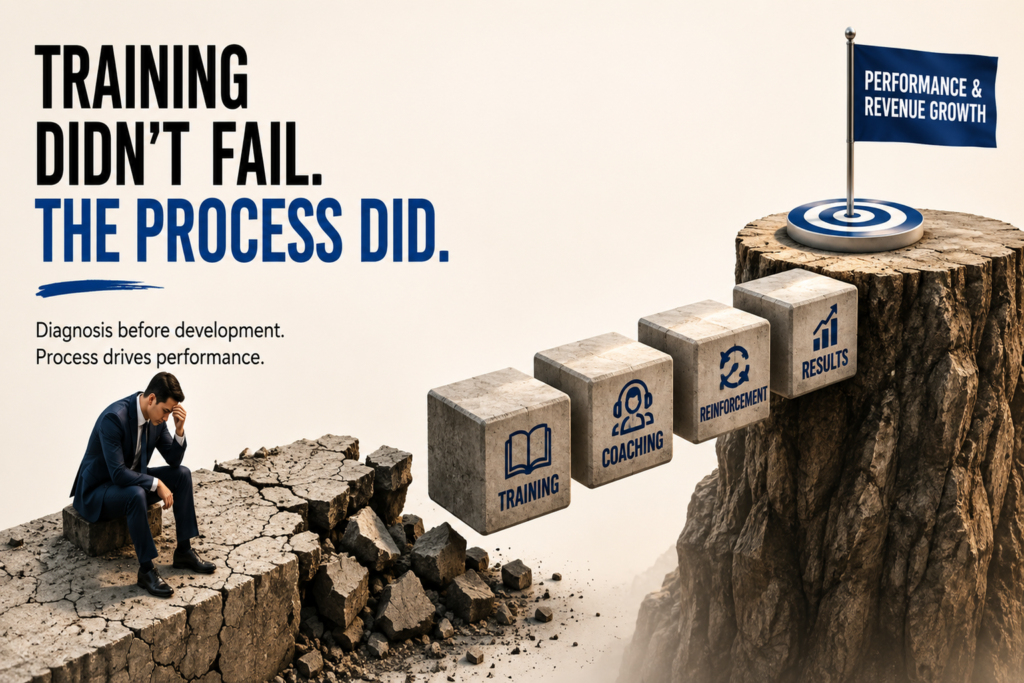
Mark, the VP of Sales at a fast-growing software company, walked into the quarterly board meeting feeling optimistic.
Three months earlier, he’d invested $60,000 in sales training for his 18-person team.
- The trainer was excellent.
- The sessions were interactive.
- The reps were engaged.
- The feedback forms averaged 4.9 out of 5.
For a few weeks, the office buzzed with new ideas. Reps talked about qualification frameworks, discovery questions, and objection-handling techniques. Managers felt energized. Leadership believed they had solved their sales performance problem.
Then the CEO asked a simple question.
“So… what changed?”
- The room fell silent.
- The pipeline hadn’t grown.
- Win rates were almost identical.
- Deals were still taking six months to close.
- Forecast accuracy hadn’t improved.
The company had spent thousands of dollars, taken every salesperson away from customers for two days, and yet the revenue graph looked almost exactly the same.
- Sound familiar?
- The problem wasn’t the training.
- The problem was what happened before the training ever began.
Think about what happens when a personal trainer gives every client the exact same workout program without measuring their fitness level first. Rep A needs cardio. Rep B needs strength. Rep C has a mobility problem that makes half the exercises counterproductive. The trainer runs the same six-week program with all three and wonders, at week six, why only one person improved. The program was not wrong. The sequence was. Assessment should have come before prescription. The same training that helped Rep B actively slowed down Rep A and injured Rep C.
Sales training works the same way. A rep whose conversion rate is collapsing at the negotiation stage does not need a prospecting workshop. A rep who cannot generate qualified pipeline does not need a discovery training program. Running both of them through the same training event produces one improved rep and two frustrated ones who now believe training does not work. The training did not fail. The organization prescribed it before it was diagnosed.
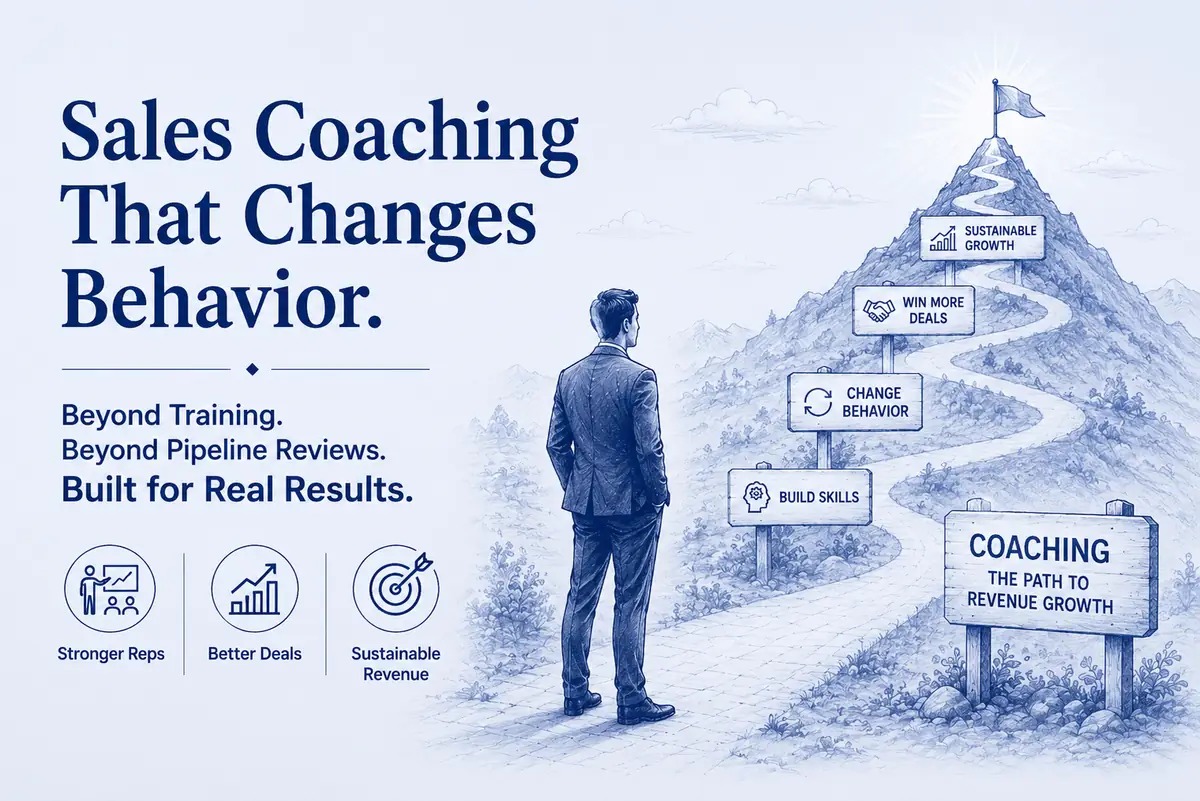
Assessment diagnoses. Training teaches. Coaching improves. Reinforcement sustains. Performance produces ROI. This article gives you the formulas to measure sales training ROI accurately, the five stages where it is won or lost, and a framework that replaces the guess-and-invest cycle with a system that compounds.
Already Suspecting Your Training Budget Isn’t Returning?
Run a stage-level diagnostic on your team before your next training investment. Free. 20 minutes. Get Instant Report. No sales call required.
Great Sales Training Doesn’t Guarantee Great Sales Performance
The highest-rated sales training programs in the world do not transfer to field performance automatically. Eighty-seven percent of training content is forgotten within thirty days without reinforcement. (CSO Insights) A rep who scores ninety percent in a post-training assessment and returns to a coaching environment that does not connect what was learned to active deals will revert within a quarter. Training knowledge retention requires a system around it. The content alone is not the system.
Tech sales training that sticks is not distinguished by delivery method or production quality. It is distinguished by specificity. Training that targets the exact stage where a rep’s capability is weakest, reinforced by a manager who coaches on that stage in live deal reviews, produces measurable improvement. Generic training delivered to the full team at once produces temporary awareness.
The Biggest Myth About Sales Training ROI
The myth is that training ROI is measured by what reps learn. It is not. It is measured by what changes in the field. A rep who can describe a qualification framework in a role-play scenario but cannot apply it to a real deal has not produced ROI. A rep who qualifies more tightly, advances fewer unqualified deals, and closes at a higher rate has. The measurement error is measuring input (completion rates, quiz scores) instead of output (win rate change, pipeline velocity, deal cycle compression).
The Hidden Cost of Training the Wrong Skill
Training events fail because they are designed as events. A one-day workshop that introduces qualification methodology produces one day of heightened awareness. Without a coaching infrastructure that connects what was taught to what a rep is doing on their next active deal, the methodology fades before it becomes a habit. The system around training, specifically the manager’s coaching behavior in pipeline reviews, is what determines whether the training ever reaches the field.
Generic training also carries a cost that most ROI calculations ignore: the training tax. Every day a rep spends in a classroom is a day they are not in front of buyers. A team of fifteen reps in a two-day generic training event loses thirty rep-days of selling capacity. When that training addresses stages where many of those reps already perform adequately, the opportunity cost doubles the waste. Stage-targeted training reduces time off the floor because it addresses one specific gap per rep, not five stages for everyone. The same investment produces more field time and more precise development simultaneously.
The Missing Link Between Sales Training and Sales Performance
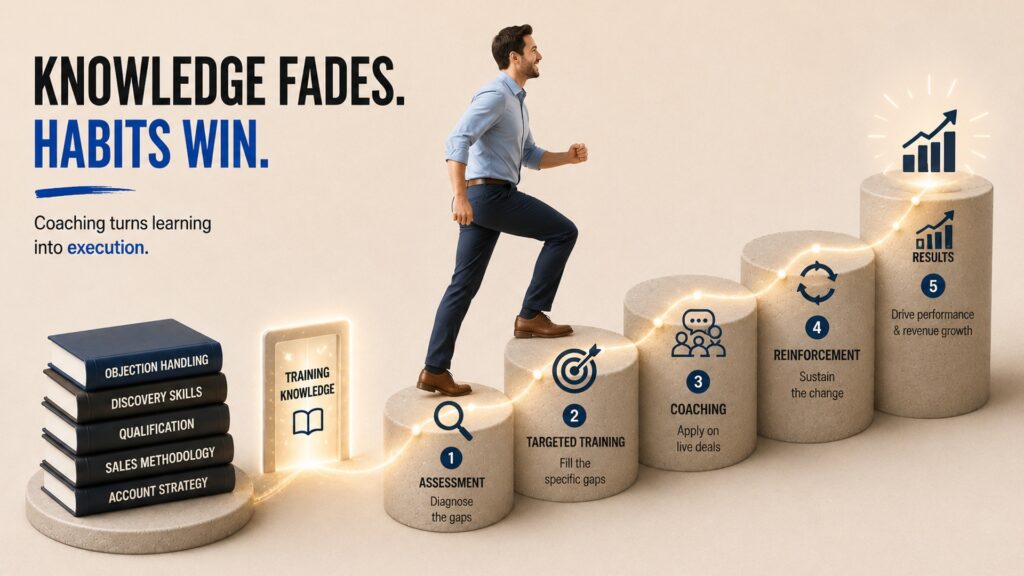
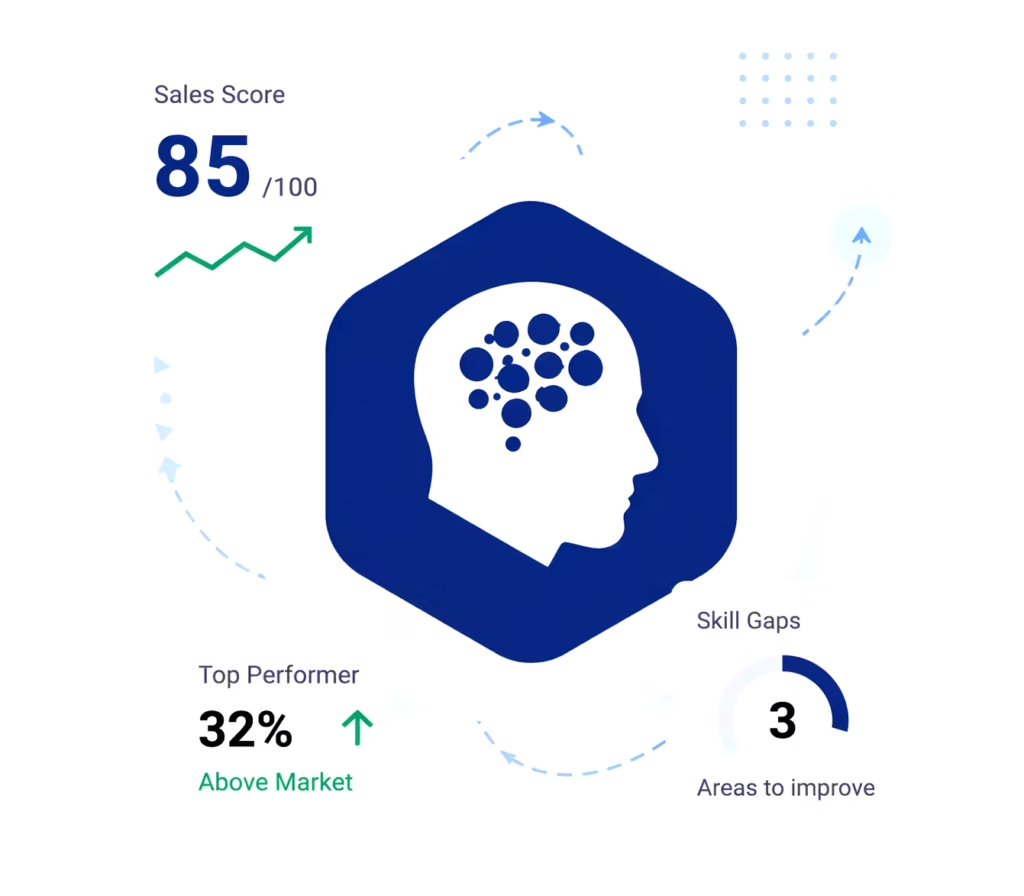
The missing link is stage-specific assessment. Assessment is not the same as a post-training quiz. It is a structured diagnostic that maps each rep’s execution capability across all five deal stages before training is designed. When the assessment reveals that a rep’s prospecting score is forty-one percent and their discovery score is eighty-two percent, the training budget goes to the prospecting gap, not to a program that covers all five stages equally.
MEDDIC, SPIN, and Sandler have all made genuine contributions to how reps structure conversations. They are worth studying. The limitation is not the methodology. It is that none of them were built for the specific complexity of B2B tech sales. A methodology organizes the conversation. It does not build stage-specific capability across every rep on the team.
Sales coaching embedded in live deals, applied to the exact stage where each rep is weak, is what converts methodology into consistent field behavior. Without that layer, even the best framework fades after the first quarter. And without a prior diagnostic to identify which stage each rep needs coaching on, even experienced managers default to general feedback rather than targeted development.
A strong B2B tech sales strategy does not begin with training. It begins with diagnosis. Assessment establishes the baseline. Training fills the specific gap. Coaching applies the training to live deals. Reinforcement sustains the improvement. Performance produces the ROI.
Skip assessment and every step that follows is guesswork. An effective sales enablement strategy and a structured sales process improvement program both depend on this sequence. Revenue growth is only predictable when the diagnosis precedes the investment. Buyer engagement improves at every stage when reps have the specific competency that stage requires, not the generic knowledge a team-wide training event provides.
The Five Sales Stages Where Training ROI Is Actually Won or Lost
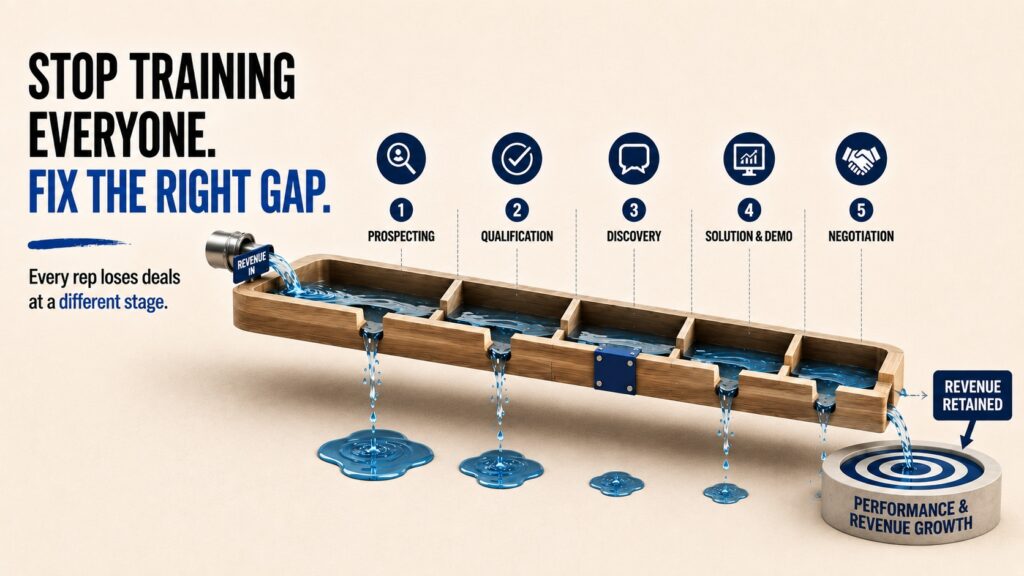
Think of your sales process as a bucket with five holes. Revenue flows into the bucket at the top through prospecting. At each stage, revenue leaks out through the specific hole that corresponds to the gap in that rep’s capability at that stage. Pouring more training into the top of the bucket does not stop the leak. It just fills the bucket faster before it empties. The only intervention that increases what reaches the bottom is plugging each hole at the stage where it sits.
| Stage | Common Failure | Revenue Lost | How to Fix It |
|---|---|---|---|
| Prospecting | Accounts targeted without intent signals and low-intent leads. | Wasted qualification capacity and slow pipeline growth. | Conduct deep business and market research. Target accounts showing active buying intent signals before investing outreach capacity. |
| Qualification | Deals advance on champion enthusiasm alone. | 3 to 4 months wasted per unqualified deal. | Score every active deal against buying committee coverage and decision process documentation before it advances. |
| Discovery | Single-stakeholder conversations and generic proposals. | Committee rejections, rework, and delayed sales cycles. | Run structured discovery conversations across all stakeholder groups, not just the primary champion. |
| Solution & Demo | Generic demos with no urgency created. | Deals stall between proposal and decision. | Align solution value to each stakeholder’s specific pain before presenting, not after. |
| Negotiation & Close | No structured response to price pressure. | Margin erosion and extended procurement timelines. | Map objections by buyer profile and deal type before the negotiation call, not during it. Finalize your BATNA. |
Source: Revenue Gap Diagnostic. Benchmarked across 4,200 plus professionals in 100+ countries.
The diagnostic test for each stage is straightforward. If your reps are generating pipeline volume but conversion falls apart by stage two, your system is broken at qualification. If deals move through qualification but stall after the first presentation, your system is failing at discovery. If your proposal win rate is below twenty-five percent, your discovery conversations are not reaching the full buying committee. If margin erosion happens on nearly every deal, your reps are entering negotiation without a structured value case already built. Each of these is a stage failure. None of them is a talent failure. And none of them responds to generic training.
Before investing another dollar in sales training, use these free smart tools to help your sales team learn and practice practical skills and improve exactly where each rep’s capability is breaking down. Each tool addresses a specific stage in the deal cycle where training ROI is most frequently lost.
Prospect Research Tool
TALSMART’s Prospect Research Tool identifies accounts with genuine buying intent before reps invest outreach capacity. It surfaces trigger events, stakeholder signals, and competitive context so prospecting targets accounts that are ready to engage rather than accounts that match a static ICP profile. Reps use it before building their outreach sequence. Managers use it to review pipeline entry quality before deals enter the qualification stage.
Free Tool: Prospect Research Tool
Diagnose your prospecting stage. Identify accounts with genuine buying signals before wasting qualification capacity on low-intent pipelines.
Lead Quality Analysis Tool
The Lead Quality Analysis Tool assesses each active opportunity against the criteria that predict whether it can actually close: buying committee coverage, documented decision process, procurement risk, and timeline credibility. Reps use it before pipeline reviews to understand which deals are real and which are advancing on assumption. Managers use it to direct coaching toward the opportunities where it changes the outcome.
Free Tool: Lead Quality Analysis Tool
Diagnose your qualification stage. Score every active deal against the criteria that predict close before coaching time is invested in deals that were never going to close.
Objection Intelligence System
The Objection Intelligence System maps the specific objections that arise at the solution and negotiation stages for a rep’s deal type and buyer profile, and provides structured evidence-based responses. Reps use it as deal preparation before a proposal meeting or negotiation call. Managers use it in coaching sessions to test whether reps are prepared for the objections their specific deals are likely to face before those objections derail the close.
Free Tool: Objection Intelligence System
Diagnose your negotiation stage. Map the objections your buyer profiles raise and prepare structured responses before they surface under deal pressure.
Stop Measuring Sales Training ROI by Attendance and Completion Rates
Completion rates measure whether reps sat in the room. They tell you nothing about whether anything changed in the field. A team with one hundred percent training completion and a declining win rate has a measurement problem, not a participation problem. Sales training ROI must be measured at the outcome level: win rate, deal velocity, pipeline conversion, and average deal size, before and after the intervention. Sales team performance is the only metric that validates training spend. Attendance is not a performance metric.
The most valuable measurement shift is from lagging to leading indicators. Only twenty-five percent of sales organizations directly measure leading indicator selling behaviors, even though these predict revenue outcomes weeks or months before the lagging metrics confirm them. (Forbes, 2026) For B2B tech teams, leading indicators are stage-specific:
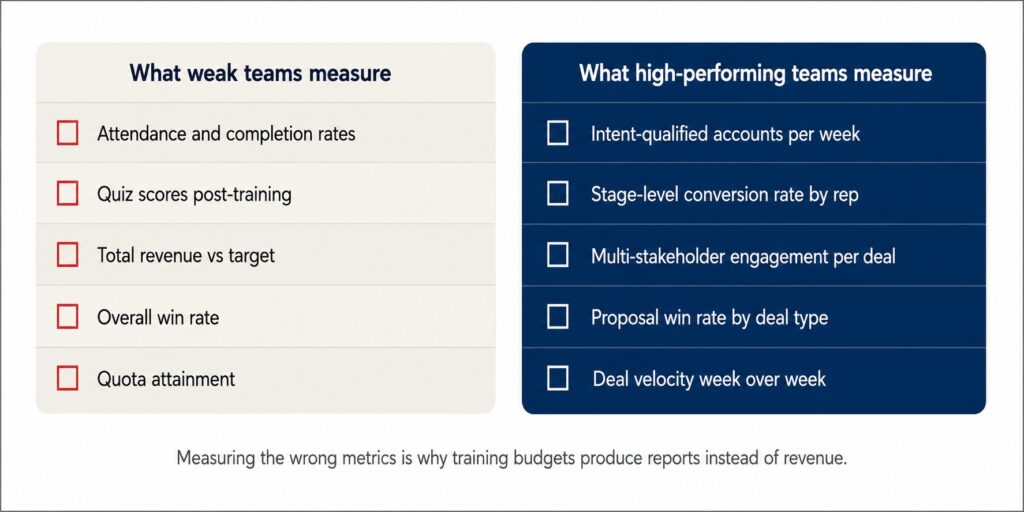
Measuring leading indicators by stage converts pipeline reviews from status updates into coaching conversations. The rep who cannot answer these questions for their active deals reveals exactly which stage needs the next coaching investment.
Sales Training ROI (%) = [(Revenue Impact – Total Training Cost) / Total Training Cost] x 100
Revenue Impact = (Win Rate Improvement x Qualified Pipeline Value) + (Deal Cycle Reduction x Number of Deals x Average Deal Size)
Example:
Training Cost: $50,000
Win Rate: improved from 20% to 26% on $20M pipeline = $1,200,000 additional revenue
These metrics require a baseline measurement taken before training begins and a comparison measurement ninety days after. Without a pre-training baseline, ROI cannot be calculated. This is why assessment must precede training: not just to target the content but to establish the reference point against which improvement is measured.
Another ROI dimension: turnover reduction.
Turnover ROI from Training = (Turnover Rate Before Training – Turnover Rate After Training)
x Team Size x Average Rep Replacement Cost
Example:
Before training: 45% turnover on 20-rep team = 9 departures
After effective training: 34% turnover = 6-7 departures
Reps saved: 2-3 per year
Replacement cost per rep: $75,000
Turnover ROI: $150,000 to $225,000 annually, compounding
A Better Framework for Improving Sales Training ROI
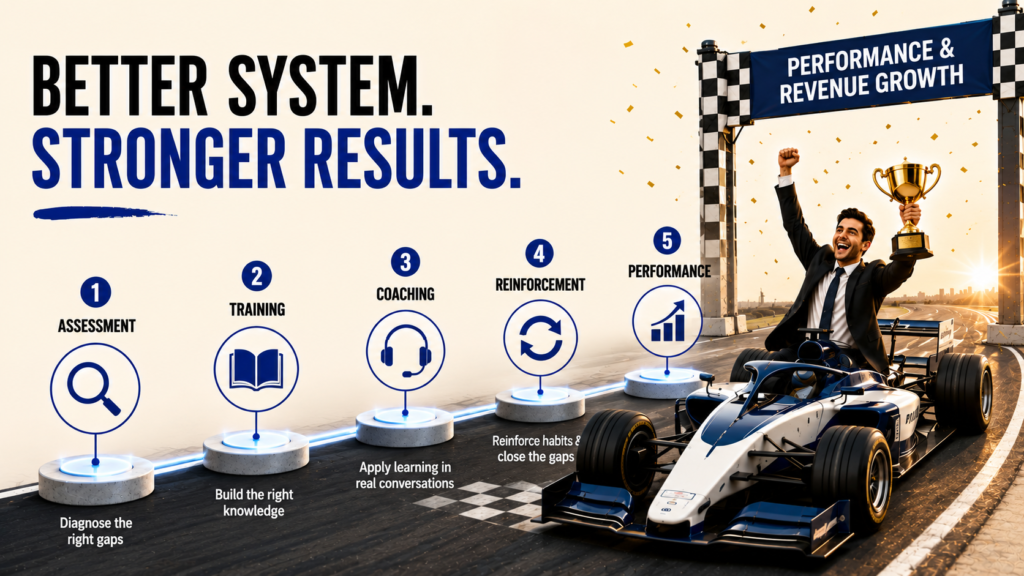
The sequence that converts training investment into measurable revenue improvement has five steps. Each step depends on the output of the previous one. Without assessment, training is generic. Without coaching, training fades. Without reinforcement, coaching stays retrospective. Without performance measurement at the stage level, improvement is invisible.
| Step | What It Does | Output |
|---|---|---|
| Assessment | Stage-specific skill gap diagnosis identifies exactly where each rep breaks down. | Individual bottleneck profile per rep across all five stages. |
| Training | Targeted tech sales training aligned to the diagnosed gap, not generic content. | Reps learn the capability they actually lack through self-directed learning videos with practical tech case studies. |
| Coaching | Sales coaching applied to live deals at the specific stage where the gap sits. | Methodology meets stage-specific skills, converting workshop knowledge into field behavior. |
| Reinforcement | Continuous learning embedded in pipeline reviews, not one-off events. | Skills compound instead of fading within thirty days. |
| Performance | Revenue metrics tracked at the stage level, not just quota attainment. | Predictable improvement in win rates, deal velocity, and margins. |
The Revenue Execution System (Diagnose, Build, Execute, Lead) connects every step of this framework to a structured process that runs across all five deal stages. Globant reduced its average deal cycle by thirty-four percent in six months by implementing stage-specific coaching as the reinforcement mechanism after targeted training. (Revenue Gap Diagnostic)
Find Out Which Stage Is Costing Your Team the Most Revenue
The Revenue Gap Diagnostic benchmarks your reps across all five B2B tech sales stages against the top 4% of performers globally. Free. 20 minutes. Get Instant Report. No sales call required.
How High Performing B2B Tech Companies Maximise Sales Training ROI
Goldman Sachs’s sales leadership ran a stage-specific assessment across their B2B team before committing a single dollar to training. The assessment returned something they had not seen before: a precise map showing that their strongest reps by quota attainment had significant gaps at the discovery stage. The training that followed was not a team-wide program. It was targeted development for the exact stage where even high performers were losing deals they should have won. (Revenue Gap Diagnostic)
Vertex used assessment as a hiring benchmark rather than an interview substitute. Stage-level competency scoring identified which candidates had the specific capabilities their deal complexity required. New hire ramp time compressed measurably because training could be targeted to each rep’s specific gap from day one rather than starting from a generic onboarding curriculum. This approach is increasingly used by sales leadership recruiters who want to place candidates against a measurable competency standard rather than relying on interview performance alone. ( Revenue Gap Diagnostic)
Across 4,200 plus sales professionals in 100+ countries, the common thread in every high-performing B2B tech sales team is not training volume. It is diagnostic precision. Sales coaching directed at stage-level gaps in live deals, reinforced consistently by managers who know which stage each rep needs to develop, produces compound improvement. A revenue enablement strategy built this way creates a learning culture where coaching strategy is embedded in daily pipeline activity, not reserved for quarterly training events.
Here is what changes when the system is in place.
Remember the VP of Sales from the beginning?
They didn’t buy another training programme.
They ran a stage-by-stage assessment.
It revealed something surprising.
Sales hunters failed to research the eight critical business factors and compelling change events outlined in the Prospect Research and Lead Quality Analysis tools.
Their best closers weren’t losing deals in negotiation. They were losing them in discovery.
One targeted coaching programme later:
Win rates increased
Deal cycles shortened
Managers coached with confidence
Training finally produced measurable ROI
Tech Sales Mastery Program
The Tech Sales Mastery Program builds stage-specific capability across all five B2B tech deal stages. Neuroscience based. Stage by stage. Built to address the exact gaps the Revenue Gap Diagnostic identifies.
Top rated on Udemy. From $20.
TALSMART is a global revenue execution partner for B2B technology companies, operating across 100 + countries and 23 languages.
Frequently Asked Questions
What is Sales Training ROI?
Sales Training ROI is the measurable revenue return on sales training investment, expressed as a percentage. The formula is: Sales Training ROI (%) = [(Revenue Impact minus Training Cost) / Training Cost] x 100. Revenue Impact is calculated from win rate improvement applied to qualified pipeline value plus any improvement in deal cycle speed applied to active deal volume. ROI is only measurable when a pre-training baseline of win rate, deal velocity, and pipeline conversion has been established before any training begins.
Why do most sales training programs fail to deliver ROI?
Because training is applied before diagnosis. When the stage where capability breaks down is unknown, training covers all stages generically. Generic training produces temporary awareness across the team, not measurable improvement at the specific stage where deals are being lost. The second most common cause is the absence of a coaching infrastructure to reinforce what was trained. Eighty-seven percent of training content is forgotten within thirty days without reinforcement. (CSO Insights) The training was not the problem. The system around the training was absent.
How do you measure Sales Training ROI?
Measure at the outcome level, not the activity level. Completion rates and quiz scores are inputs. The outputs are win rate, deal cycle length, pipeline conversion rate, and average deal size. Establish a baseline before training begins. Measure the same metrics ninety days after training with coaching and reinforcement in place. The difference in revenue outcome divided by training cost gives the ROI. Without a pre-training baseline, ROI cannot be calculated honestly.
What improves Sales Training ROI the most?
Stage-specific assessment before training is the single highest-leverage intervention. When training is targeted to the exact stage where each rep’s capability is weakest, the same training budget produces three to four times more impact than generic content delivered to the full team. The second most important factor is manager coaching behavior after training. A manager who consistently reinforces stage-level standards in live pipeline reviews converts training into field behavior. A manager who does not reverse the investment within one quarter.
Why doesn’t sales training change sales performance?
Because training transfers knowledge and performance requires behavior change. Knowledge and behavior are different things. A rep who understands a qualification framework conceptually will not automatically apply it under deal pressure when their existing habits, which are faster and more comfortable, are competing. Behavior change requires deliberate practice in real deal situations with specific coaching feedback. Training creates knowledge. Coaching on live deals at the specific stage where the rep has the gap creates the behavior.
How do sales assessments improve Sales Training ROI?
Stage-specific assessments improve sales training ROI in three ways. First, they eliminate the waste from generic training by directing investment to the exact stage where each rep needs it. Second, they establish the pre-training baseline that makes ROI calculation possible. Third, they give managers the specific data to coach precisely rather than generally, which is what converts training from a temporary awareness event into a sustainable improvement in field performance. Without assessment, every subsequent training investment is guesswork with a budget attached.