
Sarah was the VP of Sales at a fast-growing B2B tech company. Her team of fourteen reps had been selling remotely for two years. They knew the product. They knew the methodology. And they were losing deals they used to close.
The pattern was always the same. A great first virtual call. A promising follow-up. Then silence. Buyers who had seemed engaged went dark. Deals that looked qualified in the pipeline died at proposal. Win rates had dropped from 28 percent to 19 percent in eighteen months.
Sarah brought in a consultant to observe three of her best reps on live virtual calls. What the consultant found was not a motivation problem or a product problem. Every rep was running the same face-to-face playbook they had always used, just through a camera. The energy they used to project across a conference table was disappearing into a two-inch thumbnail. The room-reading they had relied on for years did not exist on a screen.
- The CEO asked a simple question in the next board meeting.
- “So what changed when we went remote?”
- The answer nobody wanted to give: everything changed. And the team had not changed with it.
- Sound familiar?
Virtual selling did not break your team’s ability to sell. It exposed a gap in how precisely they execute each stage of the deal. The room used to hide that gap. The screen does not.
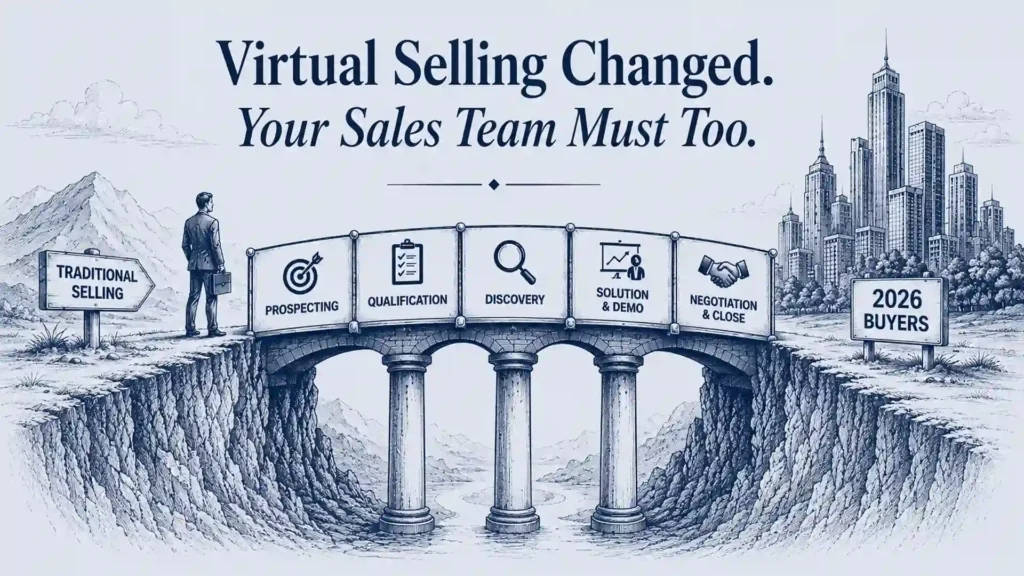
The five deal stages are the same. Prospecting, Qualification, Discovery, Solution and Demo, Negotiation and Close. What changes is the precision required at every single stage. The solution is a practice ecosystem: stage-specific skills built deliberately, coached on live deals, and measured at the stage level. This article shows you exactly what that looks like.
Virtual Selling Isn’t a Different Sales Process. It’s a Different Selling Environment
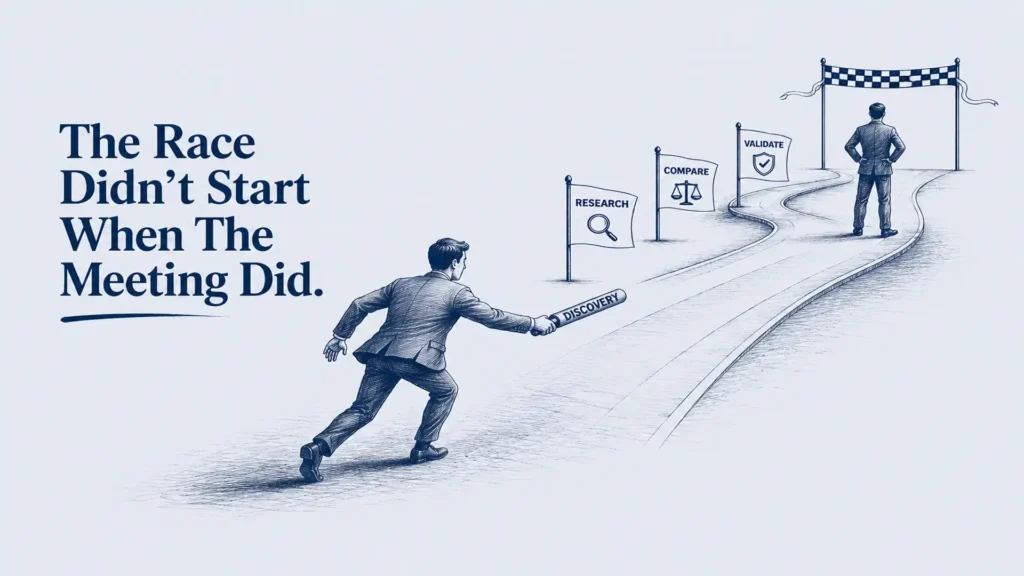
Win rates are declining. And one culprit is virtual selling. Not because selling remotely is harder. Because it is a different buying environment altogether, and most sales teams are still running a 2019 playbook on 2026 buyers.
Win rates in B2B tech have declined from 29% in 2022 to 20 to 21% in 2025. (Hyperbound, 2025) Part of that is economic. But a significant part is structural. The way buyers buy has changed. The way most sales teams sell has not.
What is actually different today:
- Buyers increasingly use AI before speaking with vendors. By the time your rep is on a first call, the buyer has already built a comparison framework, researched your competitors, and formed a preliminary view on whether your solution is worth their committee’s time. A rep who opens with a standard discovery script is starting three steps behind.
- Sales reps use AI for research, call summaries, and follow-ups. The administrative burden has shifted. But the skill gap has not. AI can summarize a call. It cannot ask the question that surfaces a buying committee’s real objection.
- Asynchronous communication has become a normal part of enterprise sales. A deal that used to take ten synchronous meetings now involves multiple async touchpoints: emails, video messages, shared documents. Every one of those is a moment where a rep either advances the deal or loses momentum. Most reps have had no training on how to create urgency in writing.
- Buyers expect personalized business impact, not generic demos. A screen-share presentation covering every feature of your platform is not a virtual demo. It is a webinar. Buyers disengage within minutes if the narrative is not built around their specific situation, their specific stakeholders, and their specific gap.
Technology Amplifies Great Salespeople. It Doesn’t Rescue Weak Sales Execution
The biggest mistake sales leaders make when transitioning to virtual is deploying more technology to compensate for execution gaps. A better CRM does not improve discovery. A video messaging tool does not teach a rep how to handle a procurement objection. Sales enablement tools extend great execution. They do not replace it. The foundation is always stage-specific skill. Without that, more technology produces more activity at the same conversion rate.
| Sales Stage | Critical Virtual Skills |
|---|---|
| Prospecting | Master personalized outreach, create engaging video messages, and leverage AI-powered research to connect with high-intent prospects. |
| Qualification | Build trust remotely while recognizing digital buying signals that indicate genuine purchase intent. |
| Discovery | Practice active listening to uncover business needs and strengthen conversations through effective objection handling. |
| Solution & Demo | Deliver compelling storytelling, strengthen executive communication, and maintain high levels of audience engagement. |
| Negotiation | Drive consensus building across stakeholders while preventing margin erosion through value-based negotiation. |
Is Your Team Built to Win Deals Remotely?
The Revenue Gap Diagnostic benchmarks your reps across all five B2B tech sales stages. Find out exactly which stage is costing you deals. Free. 20 minutes. Get Instant Report.
Sales Methodologies Don’t Solve Virtual Selling Challenges
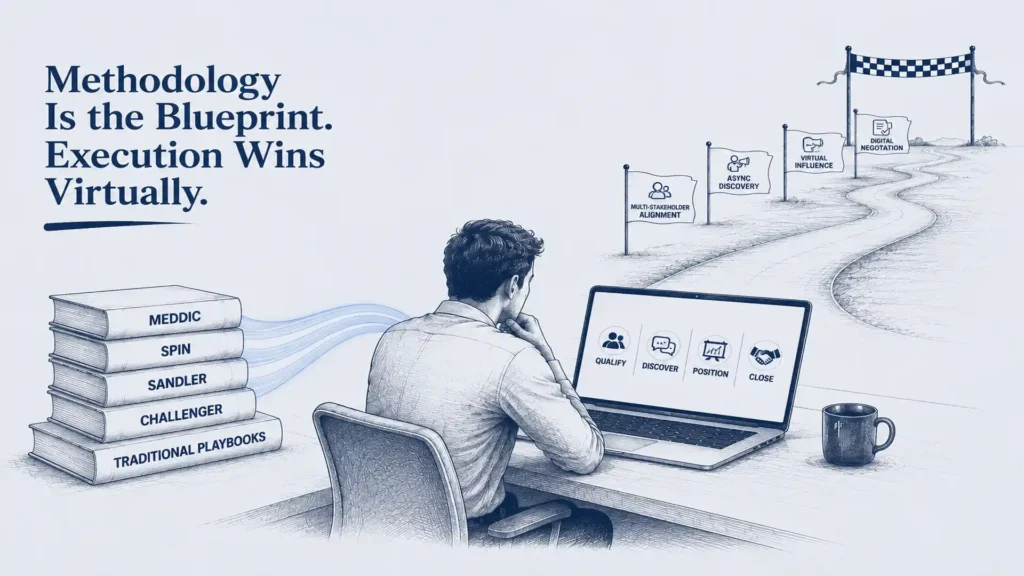
MEDDIC, SPIN, Sandler, and Challenger all provide genuine value. They give reps a framework for structuring the sales conversation, qualifying rigorously, and positioning solutions against the buyer’s stated priorities. They are worth using.
The limitation is straightforward. Every one of these methodologies was built for an environment where the rep can read a room, hold eye contact, and gauge energy across a table. In a virtual environment, none of those cues exist.
MEDDIC tells a rep to identify the economic buyer. It does not tell them how to build committee consensus across seven stakeholders who will never be in the same video call together. SPIN improves questioning sequences. It does not address how to run parallel async discovery threads with a CFO, a CTO, and a procurement lead who each have different calendars and different communication preferences. Sandler manages buyer psychology. It does not prepare a rep for a negotiation conducted primarily through email exchanges and redline documents.
The methodology is the architecture. Virtual selling requires rebuilding the execution layer inside every stage of that architecture.
A rep who knows MEDDIC but cannot run a compelling virtual qualification conversation will not close enterprise B2B tech deals in 2026. A B2B tech sales strategy that depends on methodology alone, without addressing the virtual execution layer, produces reps who know the framework and cannot apply it under the conditions they actually sell in.
Virtual Selling Success Depends on Mastering Every Sales Stage
Remote B2B tech sales teams that consistently close at or above target share one characteristic. They do not treat virtual selling as a channel adjustment. They treat it as a distinct execution environment where every stage of the deal demands a specific, learnable skill that can be practiced, measured, and improved.
The teams that struggle are the ones that hired for in-person selling ability and assumed the transition would happen naturally over time. It does not. A rep who was excellent at reading a room is not automatically excellent at reading engagement through a screen. A manager who coached effectively by walking the floor and listening in on calls cannot do that remotely without deliberate structure.
The good news: every virtual selling skill is learnable. Every stage gap is diagnosable. And the path from where your team is now to where it needs to be is shorter than most sales leaders assume, once the right stage is identified and the right intervention is applied.
The Five Sales Stages Every Remote Sales Team Must Master
Virtual selling doesn’t change the five sales stages. It changes how each stage must be executed.
Prospecting in a Digital-First World
Prospecting is a process, not personal rejection. That reframe matters because virtual prospecting produces more silence than in-person prospecting ever did.
The mindset shift: prospecting is about opening doors, not closing deals. And it is a filtering process. The goal is to find serious prospects versus casual inquiries.
So what are you actually trying to uncover? Three things:
- The Pain: What is keeping their business up at night?
- The Past: What have they tried before, and did it work?
- The Dream: What does success look like for them?
By using the field-tested 3D model and finding out what elements have changed in your prospect’s business, you align your pitch to a problem they already have, rather than simply selling something new. Sales coaching built around this model transforms prospecting from guessing to targeted engagement.
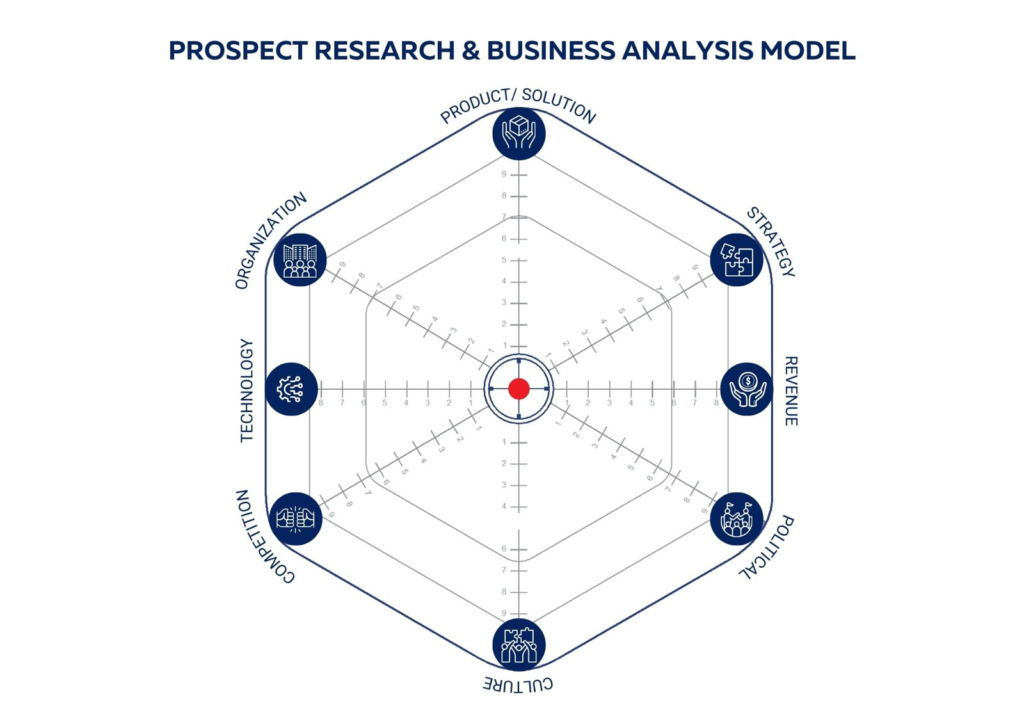
Free Tool: Prospect Research Tool
Map buying intent signals and trigger events for each target account before any outreach. Arrive at the first conversation already aligned to the buyer’s real situation.
Qualifying Buyers Reading Digital Buying Signals
Sales qualification is not just a checklist. It aligns your selling process with the buyer’s journey. Poor qualification leads to significant financial losses and can damage your company’s reputation.
Let’s look at a big-ticket sales example, a $1 million lead. If you misqualify this lead, whether intentionally or just to appear busy, that means more internal meetings, more presentations, and more teammates involved, all adding up fast. In reality, you’re not just losing time; you’re burning $40K to $50K in resources with nothing to show for it. The bottom line? Misqualified leads aren’t just a setback, they’re an expensive mistake that could’ve been avoided with proper qualification upfront.
We qualify leads in two phases. Phase 1 is all about engaging the lead by asking the right questions based on qualifying elements. This is where we use the BANT-PR technique to dig deep into budget, authority, need, timeline, plus pain, resources, and the relationship. Phase 2 is the evaluation, or rather, the re-evaluation of the lead using the Lead Quality Analysis 3D Model. This helps us fine-tune the lead score and recheck whether it’s still a good fit before we move forward. By mastering both phases, we ensure we’re focusing on the leads that truly matter!
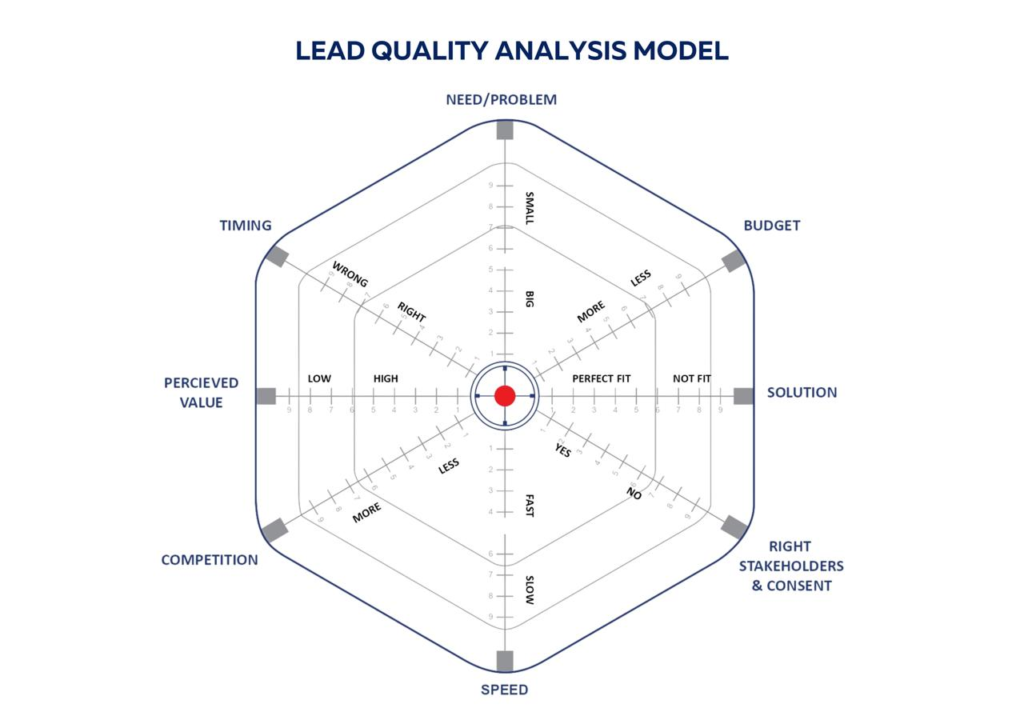
Free Tool: Lead Quality Analysis Tool
Score every active opportunity against buying committee coverage and procurement risk. Know which deals are real before your next pipeline review.
Mastering Discovery Calls Virtually: Active Listening, Objection Handling
Discovery calls are crucial for uncovering real obstacles, handling objections, and validating opportunities. By asking the right questions, sales professionals can differentiate between genuine decision-makers and potential roadblocks.
Sales revenue is won and lost in the discovery phase. It is the catalyst that creates velocity in the sales process.
Tech sales training that addresses virtual discovery must go beyond questioning frameworks. It must address how to handle the silence after a probing question on video, how to read engagement through a screen, and how to structure async follow-ups that keep multiple stakeholders moving forward.
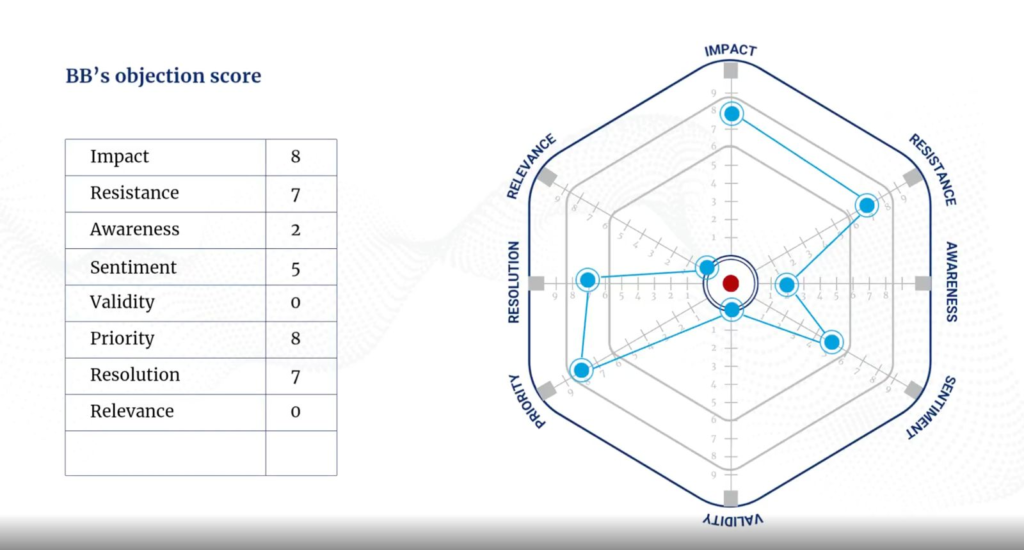
Free Tool: Objection Intelligence System
Practice and map the specific objections your buyer profiles raise at discovery and solution stages. Arrive at every virtual conversation prepared, not improvising.
Delivering Emotionally Resonant Demos That Build Confidence
Emotion Sells, Logic Seals.
Effective solution storytelling begins with emotional resonance, framing the customer’s pain and aspiration, then transitions into logical justification with your solution’s tangible impact.
Win Themes + Relevance = Attention.
A compelling Win-Theme aligned with the customer’s goals, backed by relevant stories and outcomes, keeps the client engaged and positions you as a trusted advisor, not just another vendor.
There are two ways to win hearts and minds: logically or emotionally. Great demos do both.
At the very beginning, it’s critical to prioritize challenges and business goals. This is where the demo starts, with you winning the client’s trust through a relevant win story. A reference story helps establish credibility and aligns the demo with their goals. Stakeholders are attentive here because you’re directly addressing their needs.
Now here’s where you sharpen your sword: using the Value-Gap Analysis model.
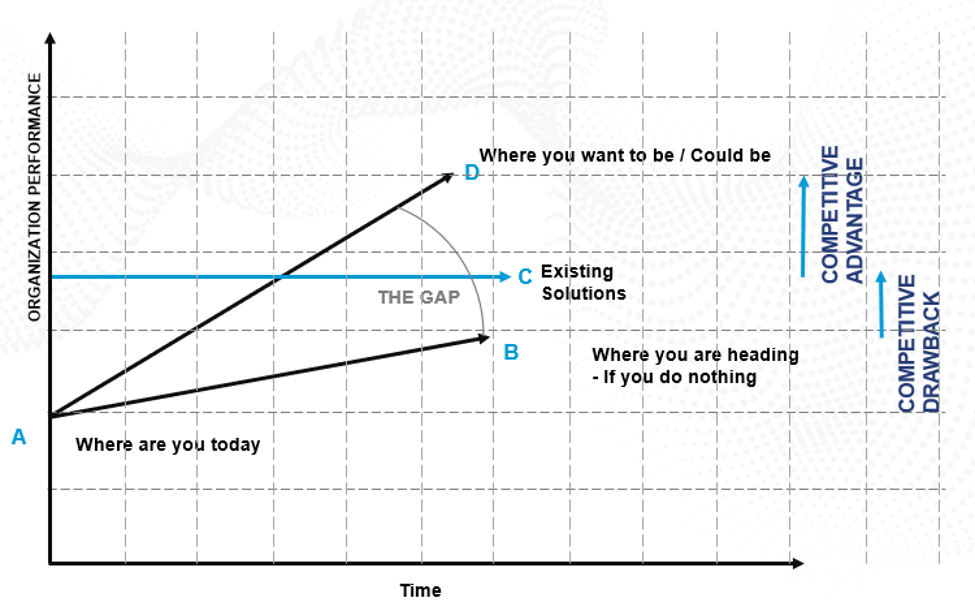
It’s a practical tool to ensure your competitive advantage isn’t just present but powerfully articulated to your customer.
Think of the vertical axis as Organization Performance, how well the customer is doing or could be doing. The horizontal axis represents Time, illustrating progress or lack thereof over time.
Notice point A. This is your customer’s current state. If they do nothing, they’re heading toward point B, a stagnant or slow-growth trajectory. Point C represents Existing Solutions, where your competitors can take them. Even if you have a superior solution and try to take your customer to point D, creating new value, if the customer is only aware of the path to C offered by your competitor, they might choose that, thinking it’s the best they can get.
Your ultimate goal is to take your customer to point D. This represents a new level of value, a significantly higher performance outcome. The space between B and D is THE GAP. C to D is your competitive advantage. B to C is your competitive drawback.
Practice: Answer these 8 Questions before your Next Virtual Demo
1. What best describes your prospect’s current performance level?
2. What is their single biggest operational pain right now?
3. If this prospect does absolutely nothing, what is the most likely outcome in 12 months? (This is point B)
4. What emotional pressure is the team feeling right now?
5. What solutions is your prospect currently aware of or actively comparing? (This shows you point C)
6. Why is their current approach falling short of what they truly need?
7. What outcome matters most to your prospect’s primary decision-maker?
8. What makes your solution uniquely able to get them to point D?
Negotiating and Closing Deals Remotely by Stopping Margin Erosion
Most salespeople are trained to sell, not negotiate. Every year buyers are becoming more sophisticated, researching and comparing with AI. Savvy companies have been sending their buyers to negotiating classes for years, because they realize the savings gained go straight to the Bottom Line!
This is why, as markets mature, and competition increases, sales and market share may hold, but profit margins erode.
Sale and Negotiation are 2 different things.
| Sales | Negotiation |
|---|---|
| Revenue | Profit |
| What you get | What you keep |
| Creating value | Defending or raising the price |
If you try to negotiate before you’ve sold the value, you lose leverage instantly.
It is extremely important for your target price to align closely with the buyer’s worst-case scenario or BATNA, which stands for Best Alternative to a Negotiated Agreement. This represents what they will do if they don’t reach a deal with you.
The BATNA Model: Negotiate to Win Without Losing Leverage.
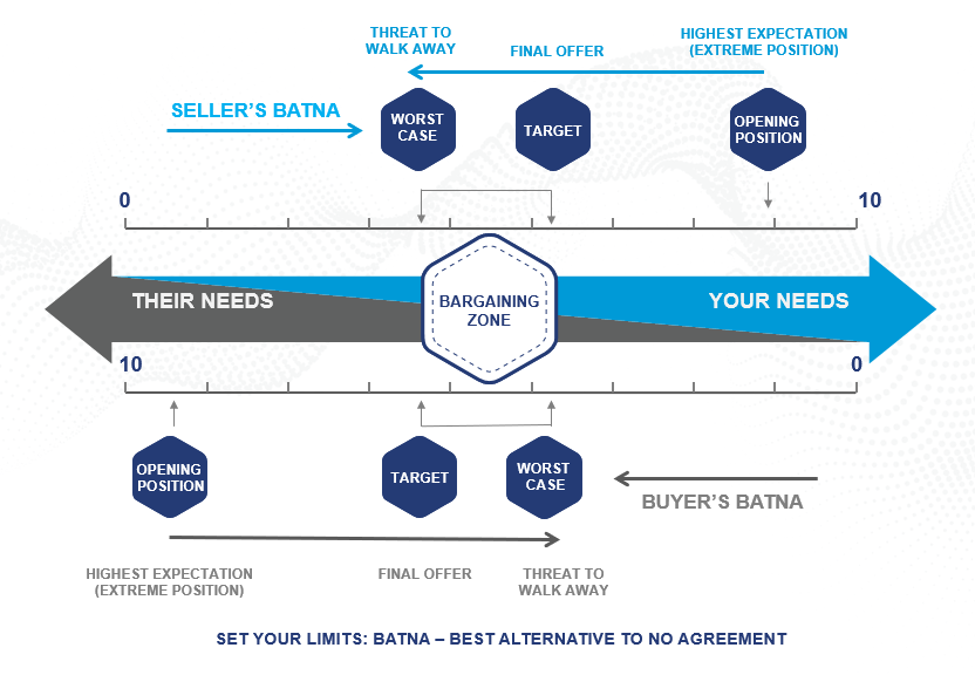
The Negotiation Scale (0 to 10).
The horizontal line represents the full range of possible deal outcomes, from least favorable at 0 to most favorable at 10. The left side leans toward their needs. The right side leans toward yours.
Opening Position (Highest Expectation).
- This is an extreme but justifiable ask.
- It sets the anchor and creates room to negotiate.
- It is not where you expect to finish, but where you begin.
Target.
- This is the deal you want to close.
- Most negotiation tactics aim to land as close to this point as possible.
- A good agreement usually falls near the target for both sides.
Worst Case (Walk-Away Point).
- The minimum you are willing to accept.
- Going beyond this point means the deal no longer makes sense.
- This is directly tied to your BATNA.
Bargaining Zone (ZOPA).
- Your acceptable range overlaps with theirs.
- A mutually beneficial deal can happen.
- No overlap = no deal.
In short, this model teaches you to negotiate to win, but never at the cost of a bad deal. It also teaches you to prepare by knowing your buyer’s BATNA from your market, customer, and competitor research.
In negotiation: a strong BATNA means you can negotiate more confidently or walk away. A weak BATNA means you are more likely to accept a bad deal.
Simply put: BATNA is what gives you the power to say NO.
How Sales Managers Should Coach Virtual Sales Teams
Coaching a virtual team is not the same as coaching one in the same building. Every coaching conversation must be intentional and connected to specific deal evidence.
Before each pipeline review, identify one deal where execution at a specific stage is below benchmark. Build the coaching conversation around that deal. The rep leaves with one specific behavior to change on their next virtual conversation.
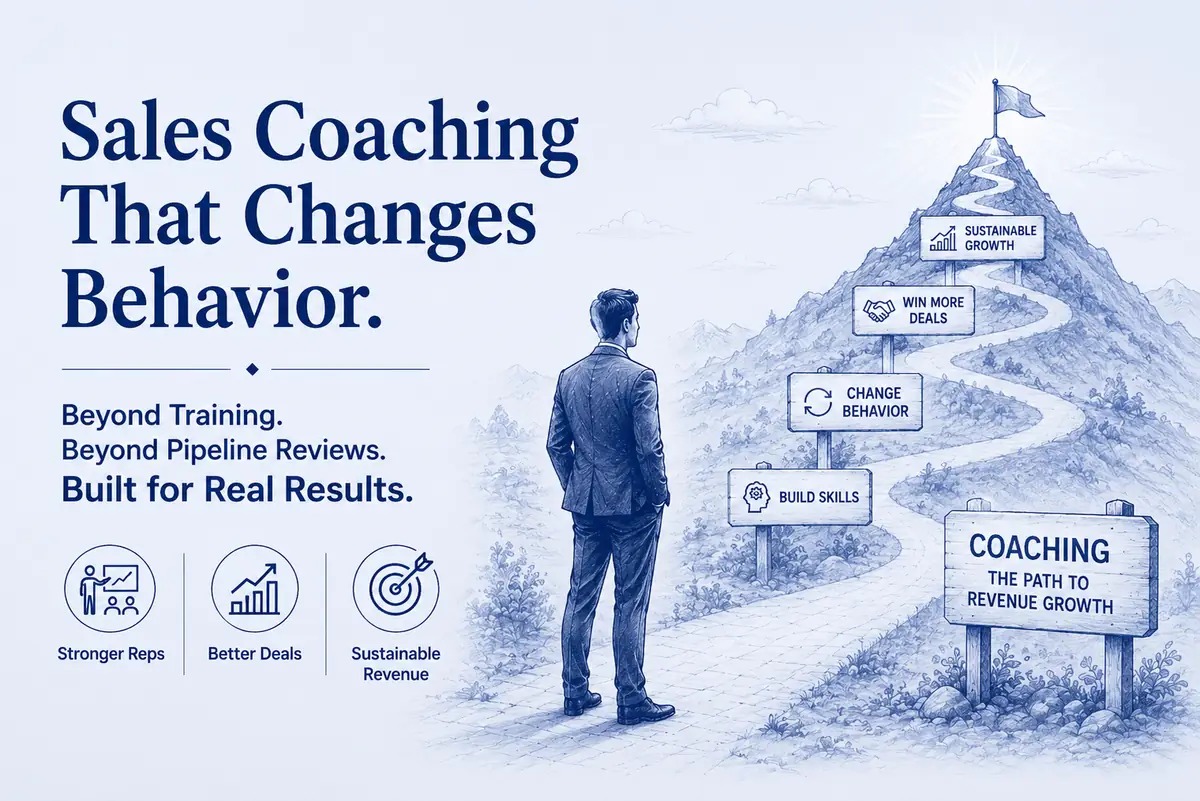
Sales coaching that is general and retrospective produces awareness. Coaching connected to a live deal at the stage where the rep has a gap produces behavior change. Improve sales performance by building coaching cadences that connect directly to stage-level data.
The Right Technology Supports Virtual Selling. It Doesn’t Replace Selling Skills
AI-powered call analysis, intent data, video messaging, and digital sales rooms can surface insights and reduce admin burden. None of them close a deal.
Sales leadership recruiters increasingly look for candidates who combine tech fluency with stage-specific selling capability. The technology is the amplifier. The capabTech Sales Trainingility is the signal. Without strong execution at each stage, more technology produces more activity at the same conversion rate.
A Better Framework for Building High-Performing Remote Sales Teams
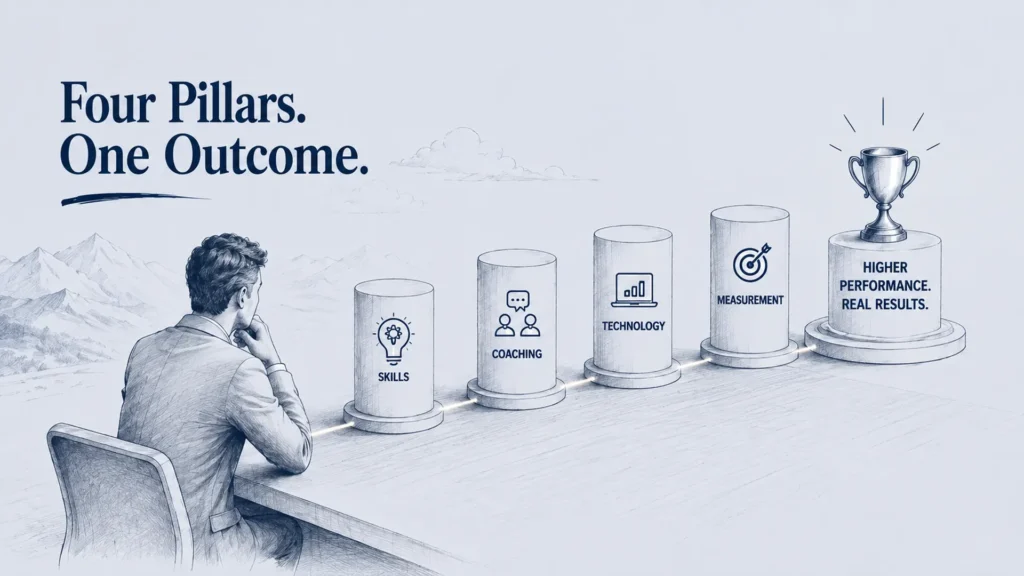
Most virtual selling improvement efforts focus on one element. They invest in a new tool, run a training program, or ask managers to coach more. The teams that produce consistent results operate differently. They treat virtual sales performance as a system with four interdependent elements. All four must work together.
| Element | What It Means in Virtual Selling | What Breaks Without It |
|---|---|---|
| Skills | Stage-specific execution capability built deliberately for a remote environment, not assumed from in-person experience. | Reps are competent in a room but invisible on a screen. Deal loss accumulates silently at specific stages. |
| Coaching | Manager-led reinforcement on live virtual deals, connected to the stage where each rep has a gap. | Skills improve in training and disappear in the field. No one applies what was learned to a real conversation. |
| Technology | Tools that extend great execution: intent data, video messaging, CRM, and digital sales rooms, used purposefully. | Effort is high, coordination is low. Buyers disengage between touchpoints because async communication lacks structure. |
| Measurement | Stage-level KPIs tracked weekly by rep, not team-wide quotas reviewed at quarter-end. | Managers cannot see where a rep is breaking down until deals are already lost. Coaching arrives too late to change the outcome. |
Skills x Coaching x Technology x Measurement = Virtual Sales Performance
This is a multiplier. Remove any element and the product is zero.
Tech Sales Mastery Program
Builds stage-specific virtual selling capability across all five B2B tech deal stages. Virtual prospecting, remote discovery, executive demo delivery, and virtual negotiation.
Neuroscience based. Stage by stage. Top rated on Udemy. From $20.
How Leading B2B Tech Companies Build High-Performing Virtual Sales Teams
Globant did not invest in a new sales technology platform when their virtual win rates declined. They ran a stage-level assessment first. The diagnostic showed that their remote team had strong prospecting volume but was losing deals at discovery because reps were not surfacing multi-stakeholder pain before building proposals. Targeted discovery coaching on live deals compressed their average deal cycle by 34% in six months. (Revenue Gap Diagnostic)
Goldman Sachs’s sales leadership ran the same diagnostic before launching a virtual selling initiative. The gap was not prospecting or demo delivery. It was a negotiation. Reps were reaching late-stage deals and giving margin away because they had not mapped the buyer’s BATNA before the first commercial conversation. Targeted negotiation capability development, applied to live deals, shifted their win-at-target-price rate within two quarters. (Revenue Gap Diagnostic)
Performing Virtual Sales Teams
What separates the companies above from teams that cycle through the same performance gaps every quarter is not the technology they use, the methodology they follow, or the training budget they allocate. It is the sequence they follow before spending a single dollar.
Every high-performing virtual sales team in B2B tech starts with a diagnosis. They map which stage each rep is breaking down at, before assigning training, before deploying a new tool, before changing the methodology. That diagnosis is what makes every subsequent investment land in the right place.
The teams that consistently improve sales performance in a virtual environment share four practices. They build stage-specific virtual execution skills deliberately, not by assuming reps will adapt over time. They coach on live virtual deals at the exact stage where each rep has a gap. They use technology to extend capability that already exists. And they measure performance at the stage level weekly, so managers can intervene before a quarter is lost.
Sarah ran the Revenue Gap Diagnostic across her fourteen-rep team. The results showed three distinct gap profiles: five reps with a qualification problem, four with a discovery problem, and three with a negotiation problem. Two were already above benchmark across all five stages. The coaching plans that followed were different for every group. Six months later, win rates were back above 25%.
The environment changed. Her team changed with it. That is the whole story.
Find Out Which Stage Is Limiting Your Virtual Team
The Revenue Gap Diagnostic benchmarks every rep across all five stages against the top 4% of B2B tech performers globally. Free. 20 minutes. Get Instant Report. No sales call required.
Frequently Asked Questions
What is virtual selling?
Virtual selling is managing the full B2B sales process remotely, using video calls, async communication, and digital sales tools rather than in-person meetings. It is not a modified version of traditional selling. It is a distinct execution environment that requires stage-specific skills built deliberately for remote buyer engagement.
How is virtual selling different from traditional sales?
The five deal stages are identical. What changes is the precision required at every stage. In a physical environment, a rep can read a room, intercept disengagement, and recover momentum in real time. On a screen, none of those cues exist. A rep must substitute physical presence with structured virtual execution at every stage.
What skills are most important for virtual selling in 2026?
Stage-specific skills. At Prospecting: AI-powered intent targeting and personalized video outreach. At Qualification: reading digital buying signals and building committee maps remotely. At Discovery: active listening through video and structured objection handling. At Demo: virtual storytelling and value-gap articulation. At Negotiation: BATNA preparation and margin defense without physical leverage.
Why do virtual sales teams struggle to close deals?
The most common cause is accumulated execution gaps across multiple stages. Weak virtual prospecting fills the pipeline with wrong accounts. Weak remote qualification advances unqualified deals. Weak virtual discovery produces proposals that do not resonate with the full committee. Each gap compounds the one that follows. The solution is a stage-level diagnostic before any training investment.
How should managers coach remote sales teams?
Sales coaching for virtual teams works when it is connected to a specific deal at a specific stage. Before each pipeline review, the manager identifies where execution is below benchmark. The coaching conversation targets that stage on that deal. The rep leaves with one specific behavior to change. General coaching produces awareness. Deal-specific coaching produces results.
Can sales methodologies improve virtual selling performance?
MEDDIC, SPIN, and Sandler provide a valuable framework for B2B tech deals and are worth using. Their limitation in virtual selling is that they were designed for in-person cues and pacing. They do not address how to run multi-stakeholder async discovery, maintain buyer engagement across a six-week digital cycle, or negotiate margin over email. The methodology is the architecture. Virtual execution capability is the skill that runs inside it.
TALSMART is a global revenue execution partner for B2B technology companies, operating across 100 + countries and 23 languages.