

Tom ran the best sales training his company had ever seen. Two days off-site. A nationally recognized trainer. Role-play exercises that actually felt real. Feedback forms that averaged 4.8 out of 5. His team walked back in on Monday energised, talking about qualification frameworks and discovery questions in the corridors.
Six weeks later, nothing had changed. The pipeline looked identical. Win rates were the same. The reps who had been struggling before the training were still struggling in the same places.
Tom blamed the trainer. The trainer blamed the reps. The reps blamed the product.
Nobody blamed the sequence
If you have run a training event that felt transformational in the room and produced no measurable change in the field, the problem is almost certainly not the content. It is everything that did not happen before and after it.
Sales training is not the problem. How companies use it is. Eighty-seven percent of training content is forgotten within thirty days without reinforcement. (CSO Insights) That statistic is not an indictment of trainers or of learning. It is a description of what happens when a learning event is treated as a destination rather than a starting point.
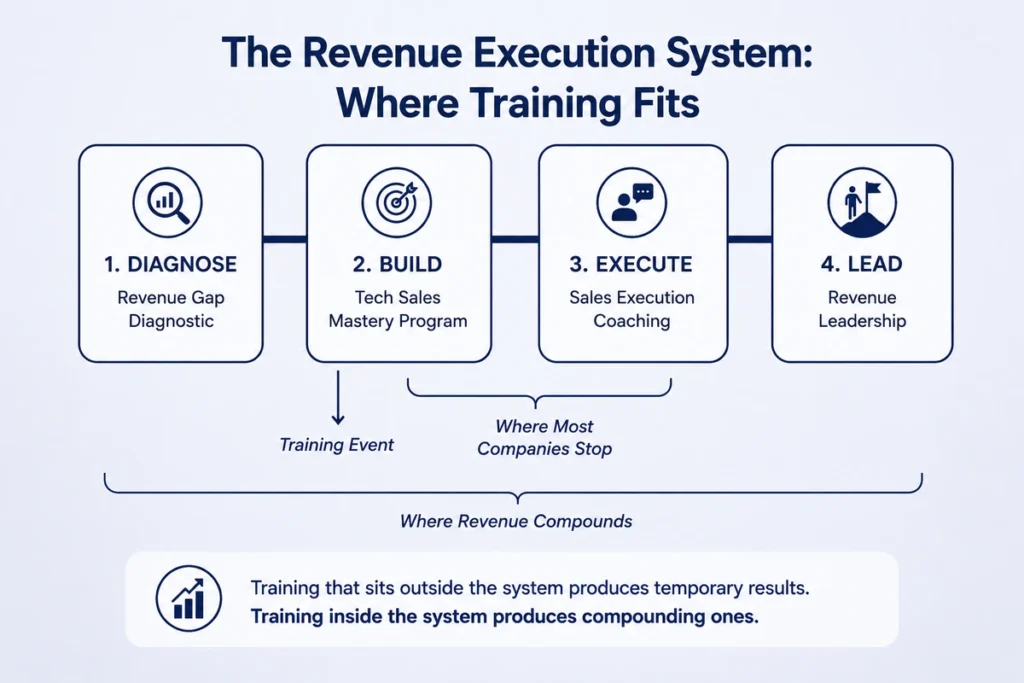
The Revenue Execution System (Diagnose, Build, Execute, Lead) is built around one structural truth: training belongs to the Build layer, not to the whole system. When companies deploy training without first diagnosing where revenue is leaking, and without the sales execution coaching infrastructure to reinforce it afterward, they are running the most expensive layer of the system in complete isolation.
Find Out Where Your Team Is Losing Revenue Before Investing in Training
The Revenue Gap Diagnostic identifies exactly which sales stage is breaking down for each rep. Free. 20 minutes. Get An Instant Report.
The Science Behind Why Sales Training Is Forgotten
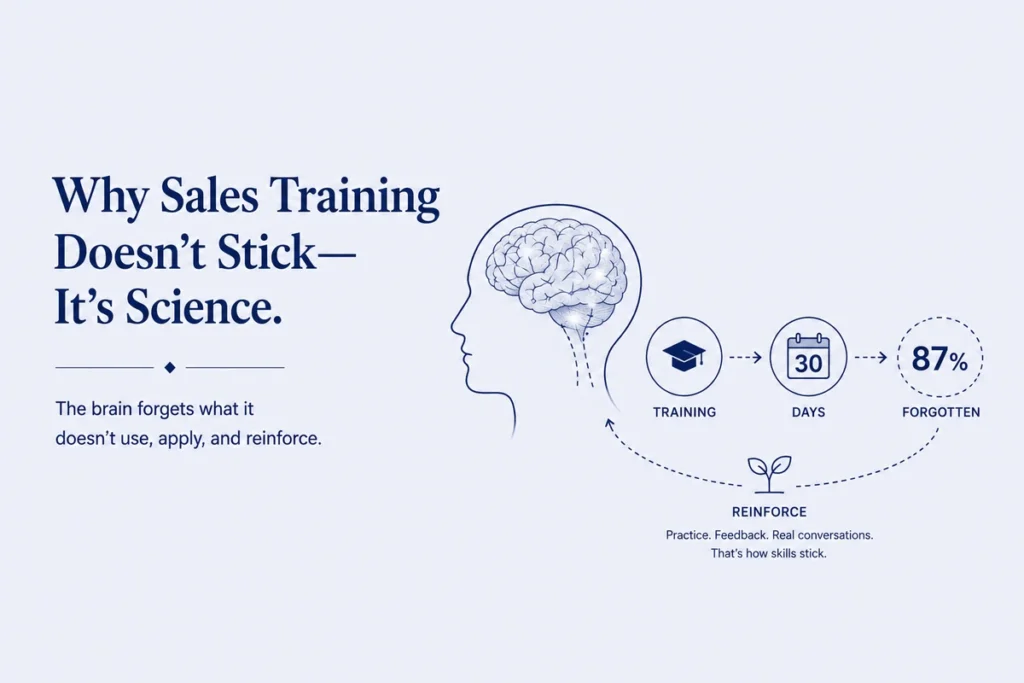
The 87% figure is not a mystery. It is neuroscience. The brain does not store information because it was presented compellingly. It stores information because it was retrieved repeatedly, applied under real conditions, and reinforced through feedback. A two-day training event, however well designed, does not meet any of those conditions.
Why Learning Doesn’t Automatically Become Behavior
Knowing how to run a qualification conversation and running one well under pressure are two entirely different cognitive events. The first is declarative knowledge. The second is procedural skill. Declarative knowledge is acquired quickly and forgotten quickly. Procedural skill is built slowly through repeated practice and retained because it becomes automatic.
A rep who learns a discovery framework in a workshop can describe it back accurately at the end of the day. Under the pressure of a live deal with a skeptical economic buyer asking pointed questions, that same rep reverts to whatever they have done hundreds of times before. Not because they forgot the training. Because they have not yet built the neural pathway that makes the new behavior the automatic one.
Why Reinforcement Makes Sales Skills Stick
Sales training and coaching serve two different functions in a revenue system. Training transfers knowledge. Coaching converts that knowledge into field behavior. Neither works without the other. Training without coaching produces reps who can describe the right approach in a workshop but revert to old habits on a live call. Coaching without training produces feedback that has no framework to anchor to.
Coaching embedded in live pipeline activity is how declarative knowledge becomes procedural skill. Not a debrief after the deal has closed. Not a quarterly training refresh. Coaching that happens inside an active opportunity, at the specific stage where the rep’s capability is weakest, applied while there is still time to change the outcome.
Sales coaching of this kind, connected to real deals rather than role-play scenarios, is what creates lasting behavior change. The mechanism is not motivation. It is repetition under real conditions with real feedback. That is how habits form.
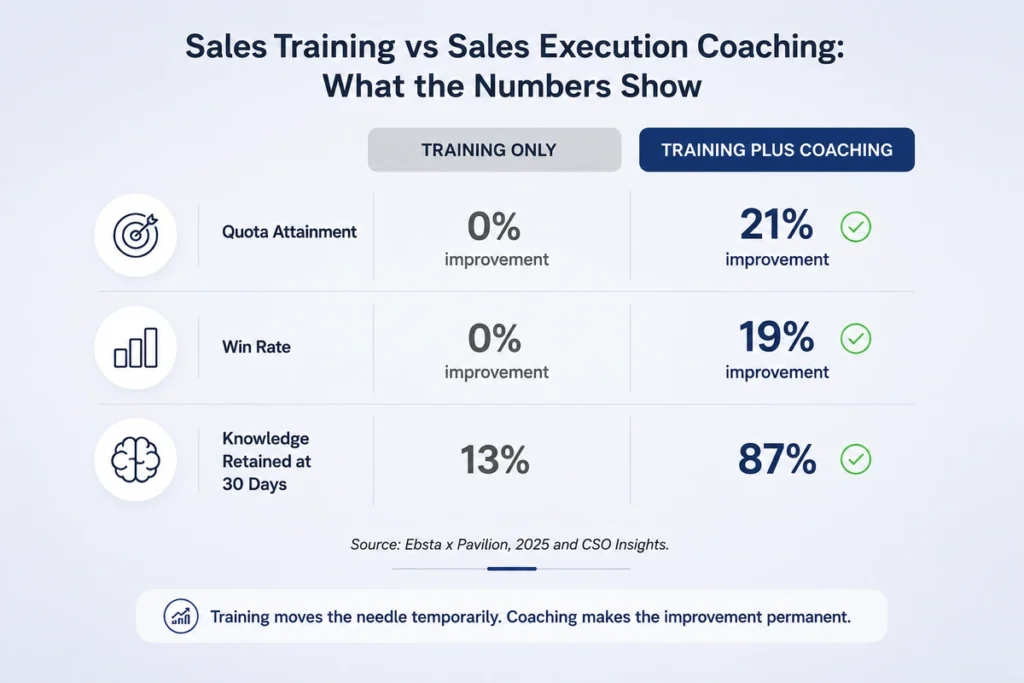
Teams that apply structured coaching within active pipeline reviews show a 21% improvement in quota attainment and a 19% improvement in win rates compared to teams that rely on training alone. (Ebsta x Pavilion, 2025) The training did not produce those results. The coaching infrastructure around it did.
The Biggest Mistake Sales Leaders Make: Training Before Diagnosis
| Sales Stage | Symptom When Broken | What Training Usually Addresses | What’s Actually Needed |
|---|---|---|---|
| Prospecting | Low pipeline volume | More outreach activity | Intent signal targeting and message relevance |
| Qualification | Deals advance that never close | Qualification checklists | Multi-stakeholder mapping and buying committee coverage |
| Discovery | Generic proposals, low win rates | Better questioning techniques | Stakeholder-specific problem framing across all buyers |
| Solution and Demo | Interest but no urgency created | Presentation delivery skills | Value gap articulation tied to each stakeholder’s priorities |
| Negotiation and Close | Margin erosion, late-stage stalls | Closing techniques | Structured negotiation with BATNA preparation before the conversation |
Source: Revenue Gap Diagnostic benchmark data, 4,200+ professionals across 100 + countries.
Case Study: Best Sales Training Techniques: What Forbes Business Leaders Say Actually Works
The best sales training techniques are refined by leaders who have built high-performing sales teams in competitive environments, not invented in a classroom. Forbes compiled advice from top business leaders and the patterns are consistent: the most effective training is not generic, not group-only, and not a one-time event. Pairing new reps with top performers, analyzing real sales calls, and building hybrid continuous learning programs all outperform the single training event. Explore the practical guide to sales training techniques that actually work for IT sales managers and sales directors.
Watch the video: https://youtu.be/ykh272OUx1k?si=A_xzSUQFfQGNjKOh
What Actually Works: A Revenue Execution System
Globant did not improve its sales performance by buying a better training program. It identified where deals were stalling, invested targeted capability development at that specific stage, and reinforced the new skills through coaching embedded in live pipeline reviews. Deal cycle compressed by 34% in six months. (Revenue Gap Diagnostic) The training content was not the variable. The system around it was.
Diagnose the Revenue Gap
Identify which stage is producing the highest revenue loss for which reps. Not a general assessment of the team’s performance. A stage-level capability map for each individual. The output tells you where to invest and in what sequence.
Build Targeted Capabilities
Once the gap is identified, the Tech Sales Mastery Program builds stage-specific capability at exactly that point. Not a full methodology refresh for the whole team. Targeted skill development for the reps who need it at the stage where they need it. Neuroscience-based. Stage by stage. Available on Udemy from $20.
Sales leadership hiring decisions benefit directly from this diagnostic approach. When a new sales leader inherits a team, knowing which reps have which capability gaps at which stages converts a months-long observation period into an immediate development plan.
Reinforce Through Sales Execution Coaching
Training tells reps what good looks like. Sales execution coaching makes them do it under pressure, on live deals, until it becomes instinct. This is the layer that converts the 87% who would otherwise forget into the minority who compound their improvement quarter after quarter.
Executive sales recruiters who specialize in B2B tech increasingly screen for sales leaders who understand this distinction. A VP Sales who cannot build a coaching infrastructure is a VP Sales who will train their team repeatedly and see the same results.
Measure the Impact
Leading indicators, not lagging ones. Stage-level conversion rates by rep, week over week. Pipeline velocity. Multi-stakeholder engagement per deal. These metrics surface capability gaps while there is still time to intervene in active opportunities. Win rate and quota attainment tell you what happened. Stage-level metrics tell you why, and what to do next quarter.
Stop Buying Sales Training. Start Building Sales Capability.
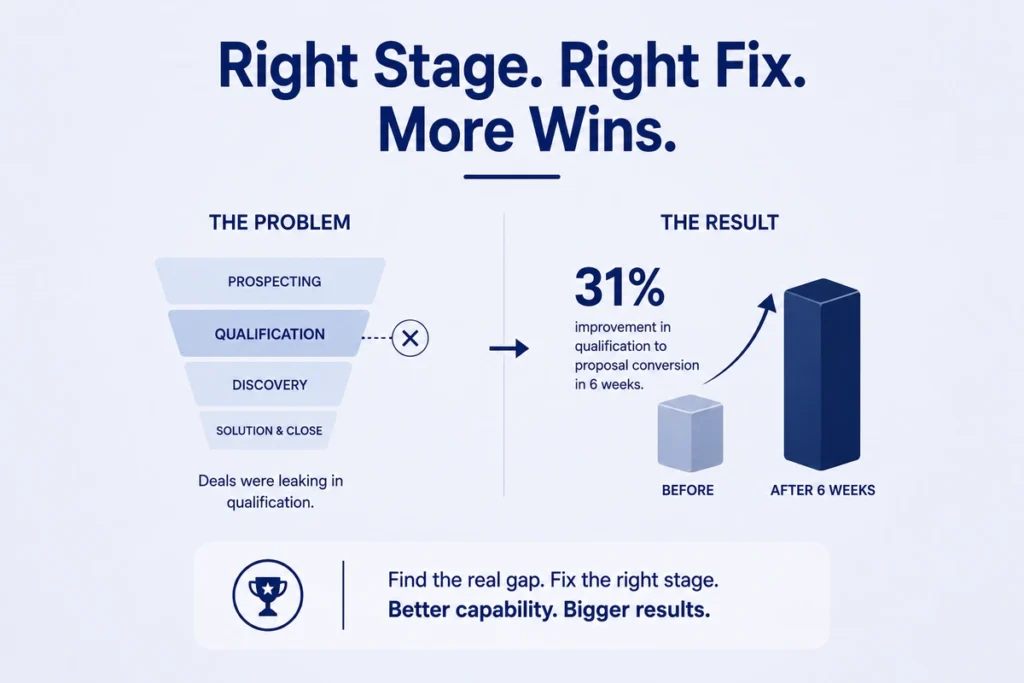
Tom eventually found out where his team was losing revenue. It was not where he thought. The training he had purchased addressed prospecting and discovery. The actual breakdown was at qualification. Deals were advancing into the pipeline that were never going to close because nobody had mapped the buying committee or the procurement risk. The team was losing in stage two and recovering in stage four, which is not recoverable.
After a stage-level diagnostic and six weeks of targeted qualification capability development, reinforced through weekly coaching on active deals, his qualification-to-proposal conversion rate improved by 31%. The training budget was smaller than the one he had spent on the event that produced no results. The difference was that he knew what he was fixing before he started.
Sales leadership recruiters who place VP Sales and CRO candidates in B2B tech companies are seeing this distinction play out at the hiring level. The leaders who produce consistent results are not the ones who have the best training budgets. They are the ones who know how to turn a training investment into a system that compounds.
The cost of a bad sales leadership hire in tech companies runs into millions when compounding revenue loss, team turnover, and pipeline deterioration are counted together. Getting the training sequence wrong is a contributing factor in almost every case. The wrong training invested in the wrong stage at the wrong time does not produce neutral results. It delays fixing the actual problem while consuming a budget that could have been targeted precisely.
Start With the Diagnosis. Not the Training.
The Revenue Gap Diagnostic identifies exactly where your team is losing revenue, by stage and by rep. Free. 20 minutes. Get An Instant Report. No sales call required.
Final Thought
Sales training is an event. Revenue execution is a system.
Tom’s team did not fail because the training was bad. They failed because the training was the whole plan. The event ended. The habits never formed. The pipeline stayed exactly where it was.
The leaders who build sales teams that consistently improve do not start with training. They start by identifying where revenue is actually leaking. Then they develop the specific capability that plugs that leak. Then they reinforce that capability through coaching on real deals until the new behavior becomes the automatic one.
The difference between sales training and coaching is not a matter of preference or budget. It is the difference between telling someone how to swim and having them in the water with a coach beside them. Both are necessary. The sequence is what makes them compound rather than cancel each other out.
That sequence is available to any sales leader willing to run the diagnosis before writing the training brief. The Revenue Gap Diagnostic takes twenty minutes. The PDF lands within three hours. What you do with it is the decision that determines whether the next training investment compounds or evaporates.
TALSMART is a global revenue execution partner for B2B technology companies, operating across 100 + countries and 23 languages.
Frequently Asked Questions
Why is 87% of sales training forgotten within 30 days?
Without reinforcement, declarative knowledge decays rapidly. The brain does not retain information presented once in a group setting under low-stakes conditions. It retains information retrieved repeatedly under real conditions with real feedback. Training that is not reinforced through coaching in live deal situations is not converted into procedural skill, and procedural skill is what determines field performance.
What is sales execution coaching and why does it work?
Sales execution coaching is coaching that happens inside active pipeline opportunities rather than in retrospective review. It identifies the specific capability gap a rep has at the specific stage where their deal is currently stalling and applies targeted feedback while the deal is still open. Teams that use this approach show 21% higher quota attainment and 19% higher win rates than teams that rely on training alone. (Ebsta x Pavilion, 2025).
How do you diagnose a sales training need before investing?
A revenue gap diagnostic maps each rep’s capability against benchmark performance at each of the five sales stages. It identifies which stage is producing the highest revenue loss for which reps and produces a specific capability brief that drives the training investment. Without this diagnostic, training decisions are made based on assumptions about what the team needs rather than evidence of where the system is actually breaking down.
Can one sales training program fix all five sales stages?
No. Each of the five sales stages requires a distinct capability profile. A rep whose conversion rate collapses at the discovery stage does not have the same problem as a rep who loses deals at negotiation. Generic training that covers all five stages addresses none of them with enough depth to produce behavioral change. Targeted capability development, applied at the specific stage where each rep has a gap, produces measurable improvement. Generic training produces measurable completions.
How does the Revenue Execution System improve on traditional sales training?
The Revenue Execution System treats training as one layer in a four-layer structure: diagnose the revenue gap, build the specific capability identified, reinforce through sales execution coaching in live deals, and lead with the infrastructure that sustains performance over time. Most sales training approaches address only the Build layer in isolation. The system connects all four layers so that investment in any one layer produces results rather than temporary improvement that fades without the others in place.