
You have invested in sales training before. The kickoff was energetic. Reps left motivated. And then, within sixty days, almost nothing changed.
That is not a rep failure. It is a decision failure. The question is whether the training is designed for the realities of B2B technology or software sales and integrated into a structured Revenue Execution System or it is vanilla training which is used for all the industries. Tech and Software Sales executives often struggle to learn from vanilla sales training because generic frameworks lack contextual relevance to their specific industry, products, and buyers. These one-size-fits-all programs typically fail to address real-world technical buyer resistance, suffer from poor knowledge retention, and lack the necessary reinforcement to change deeply ingrained habits. Above all, it just wastes the budget. It validates inaction. It teaches reps that training is something that happens to them rather than something that changes how they operate.
If this feels familiar, you are not alone. Most teams choosing a training program are working on assumption-driven training decisions, made without knowing exactly where the team is breaking down.
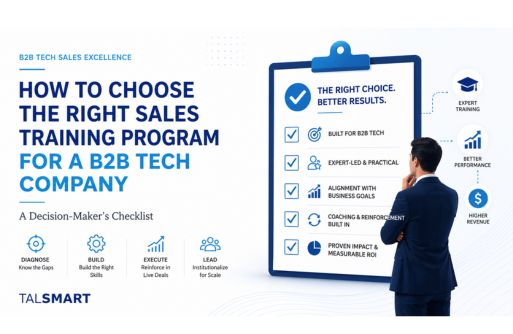
Knowing how to choose a sales training program is less about comparing brochures and more about asking the right questions in the right order, which is exactly what this checklist gives you.
Our purpose is to help every salesperson dream BIG and companies BIGGER because tech evolves every few years, but sales capability doesn’t. We exist to close this expensive gap.
The sales teams must convert innovation into revenue before technology becomes irrelevant.
The Revenue Execution System: Where This Decision Actually Sits
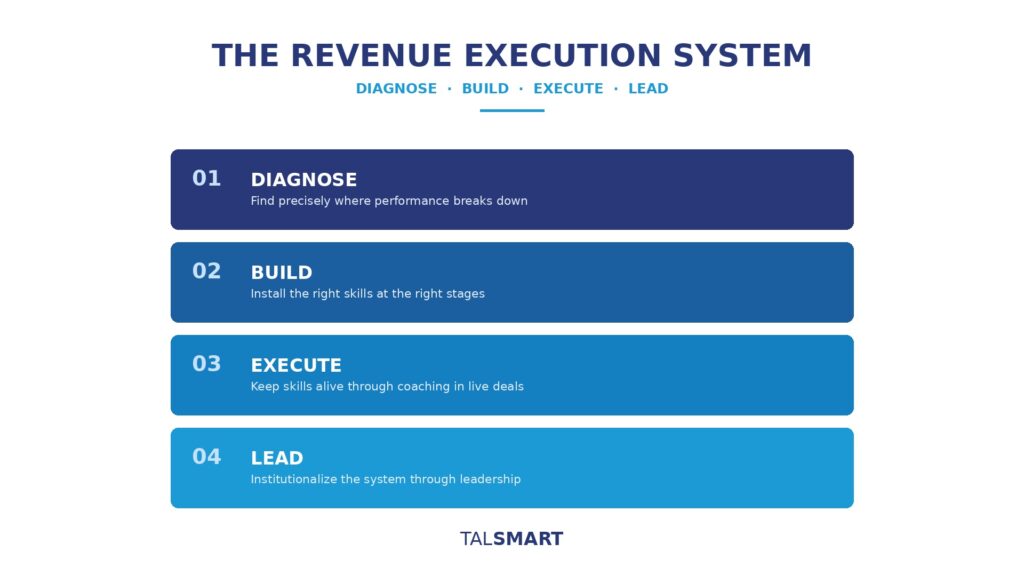
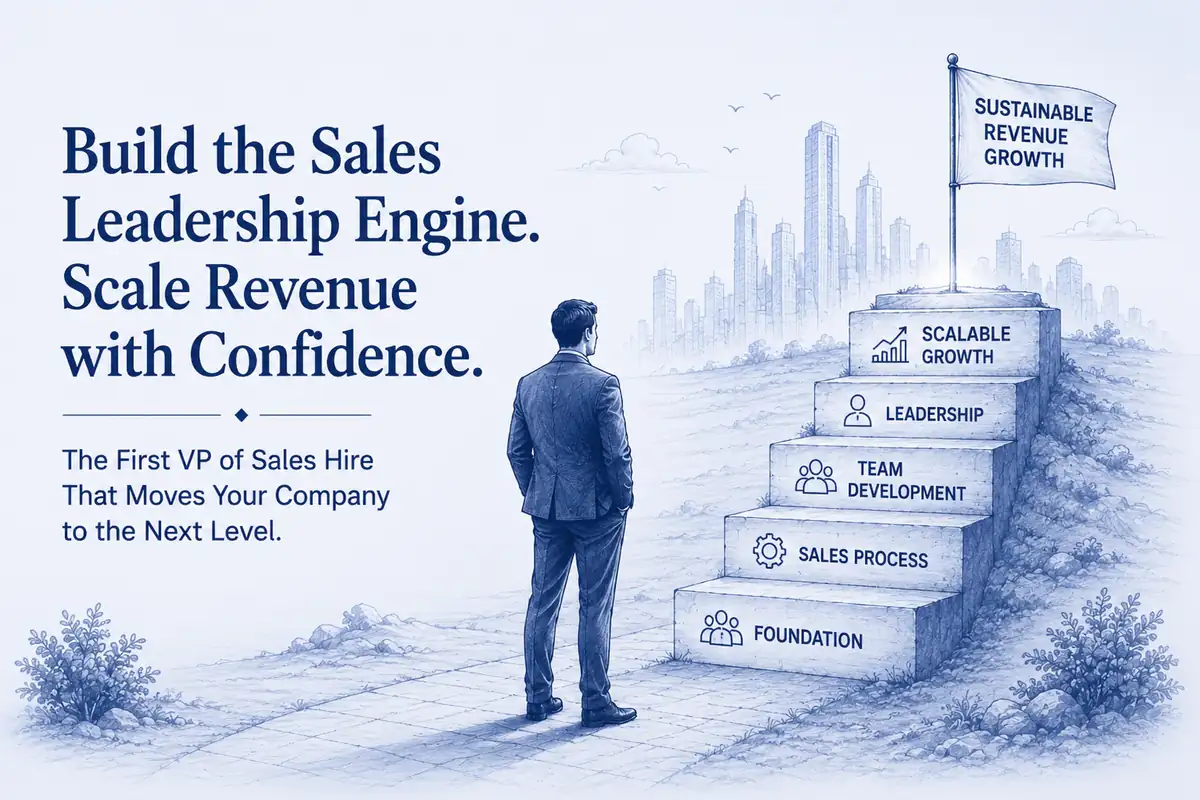
TALSMART’s Revenue Execution System exists for exactly this moment, the moment a sales leader is staring at a shortlist of training vendors with no clear way to compare them. The system has four layers. Diagnose, where you find out precisely where performance is breaking down. Build, where the right skills are installed at the right stages. Execute, where coaching keeps those skills alive in live deals. Lead, where the right leadership institutionalized all of it.
This checklist sits inside the Build layer. But it only works if you have done the Diagnose work first. Choosing a sales training program before you know your skill gaps is choosing blind, however polished the program looks on a sales call.
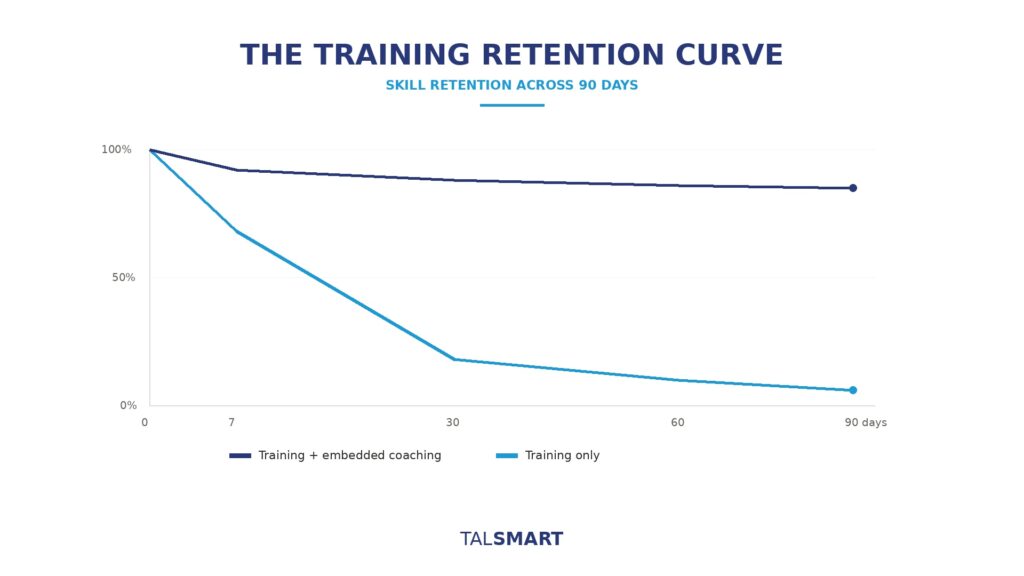
Research consistently shows that 87 percent of training is forgotten within 30 days without reinforcement. That number does not change based on how good the content is. It changes based on what happens after the training ends, and whether a system was built around it.
Start Here: Know What You Are Actually Solving For
A successful B2B tech sales strategy starts with understanding where revenue performance is breaking down across the sales cycle. By identifying specific gaps in discovery, qualification, proposal development, or closing, sales leaders can make more informed decisions about training, coaching, and execution priorities.
Most sales leaders shortlist training vendors before they have answered the most important question: where exactly is the team breaking down?
A skill gap analysis is not optional. It is the foundation. Without it, you are spending a budget on a solution to a problem you have not fully defined. Enterprise sales has five distinct stages, and underperformance in one stage requires a different fix than underperformance in another. Discovery gaps are not closed by negotiation training. Pipeline stagnation is not fixed by prospecting content.
| Sales Stage | Goal | Common Failure Mode | What Fixes It |
|---|---|---|---|
| Prospecting | Determine lead quality via need analysis | Reps target the wrong accounts | Prospect Research Tool |
| Qualification | Separate interest from intent | Deals advance that should not | BANT-PR qualification framework – go reverse, start with Timing |
| Discovery | Uncover how pains impact key business requirements | Surface level questions, no pain uncovered | Lead Quality Analysis Model |
| Solution Presentation | Prioritize challenges from discovery and handle objections | Value case is generic, not buyer specific | P2Q0C (Pause, Paraphrase, Question, Offer, Confirm) |
| Negotiation – Close | Turn buyer emotions (Fear, Anxiety, Anger) into a close | Reps default to discounting | CLEPT (Compromise, Logic, Emotion, Power, Trade) |
Each stage fails differently. The right training program treats them differently too.
If you cannot say which of these five stages is costing you the most deals right now, that is the gap a training program alone will not close.
Not sure which stage your team is losing at?
The Revenue-Gap Diagnostic benchmarks your reps across five B2B tech sales stages against the top 4% of performers globally. Free. 20 minutes. Get Instant Report.
Get Your Free Revenue-Gap Diagnostic →
The Decision-Maker’s Checklist: Seven Questions Before You Shortlist
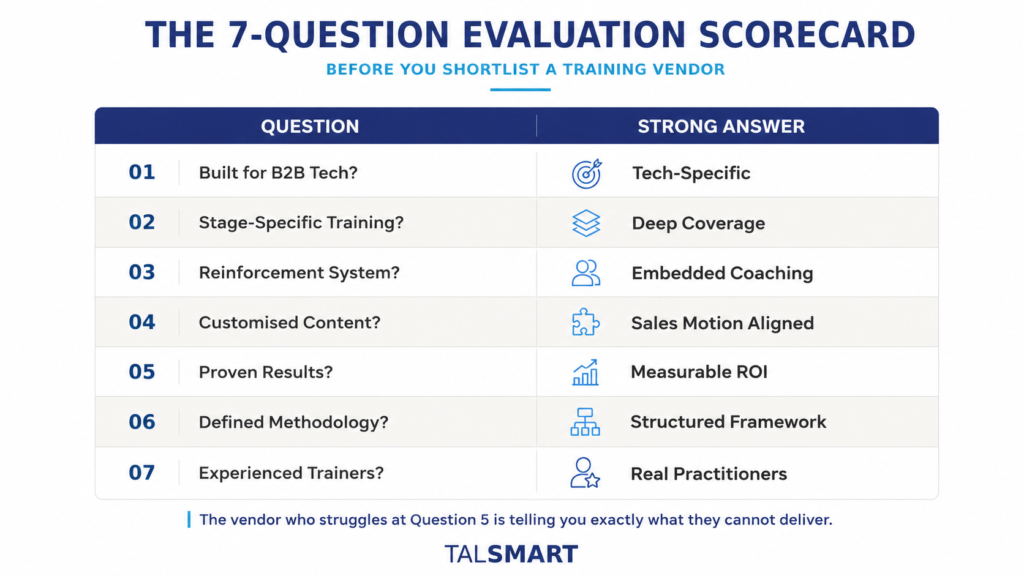
These seven questions apply to any sales training program you are evaluating, regardless of vendor size or price point. Ask them in order. Most vendors will answer the first few comfortably and struggle by the fifth.
1. Is it built specifically for B2B tech sales, or adapted from generic methodology?
Generic sales training programs teach principles that apply across industries. B2B tech deals involve multi-stakeholder decision making, long enterprise sales cycles, technical buyer committees, and consultative selling complexity that generic frameworks do not address.
The right enterprise sales training program is built from the ground up for complex technology sales, not repurposed from a retail or FMCG methodology with a tech coat of paint on top. The best sales training for tech companies treats consultative selling as the default mode of engagement, not an advanced technique reserved for senior reps.
If your shortlist could just as easily be selling insurance or industrial equipment, your system is missing the layer that actually matters for B2B tech.
Worth knowing
TALSMART’s Tech Sales Mastery Program is built exclusively for B2B tech sales. Stage by stage. Cinematic, neuroscience-based. Top-rated on Udemy. From $20.
Start the Free Diagnostic →
2. Does it address your specific stage breakdown, or cover everything at surface level?
Depth matters more than breadth. A program that covers every stage shallowly is less useful than one that goes deep on where your team actually struggles. Review the curriculum against your pipeline data. If your deals stall between discovery and proposal, you need depth at that stage, not a broad overview of the entire sales process.
If every stage gets equal airtime in the curriculum, your system is treating a specific problem like a general one.
3. What is the reinforcement mechanism?
This is the question most buyers forget to ask, and it is the one that determines whether you see any return at all.
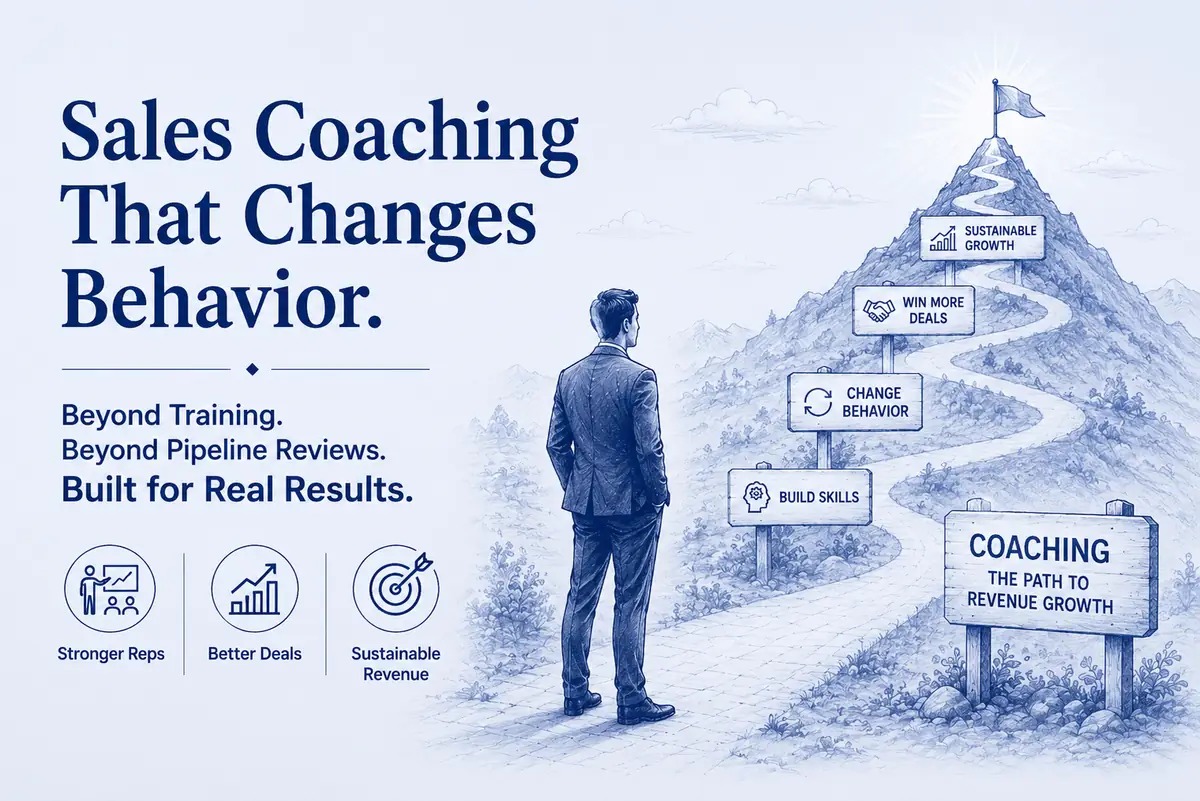
Training without sales coaching embedded into real deals produces awareness, not behavior change. The best B2B sales training programs include a coaching infrastructure. Embedded coaches inside live pipeline reviews. Deal coaching on active opportunities. A feedback loop between training content and field execution.
Sales enablement is not a one time event. It is a system. A sales enablement function that hands reps a learning management login and calls it done has not built reinforcement. It has built a library. Ask any vendor what happens after the final session. If the answer is a follow up webinar and an online portal, you have your answer.
If the program ends with a certificate and a portal login, your system is missing the layer that turns training into behavior.
4. Is the training customized to your sales motion, or delivered as a standard package?
Training customization is the difference between content your reps recognize as relevant to their actual deals and content they sit through politely and forget. High quality enterprise sales training programs build from your deal structure, your buyer profiles, your common objections, and your product context.
Ask vendors specifically what they adapt and what stays fixed. The more fixed the program, the more you are paying for their shelf product rather than your team’s development.
If the deck looks the same as the one shown to a competitor in a different industry, your system is built on someone else’s playbook, not yours.
5. Can they show quota attainment data from clients similar to you?
Sales training ROI for B2B teams is measurable. It shows up in quota attainment, deal cycle length, pipeline conversion rates, and time to ramp for new reps during sales onboarding. Ask for evidence, not testimonials. Any vendor worth shortlisting should be able to show you client outcomes that are specific and verifiable.
Goldman Sachs achieved a 34 percent reduction in deal cycle length and doubled quota attainment within six months of implementing a structured system. Globant reduced pipeline stagnation by 28 percent in 90 days. They are the natural result of structured execution replacing assumption driven selling.
If a vendor cannot point to a specific client outcome with real numbers, your system is being built on a pitch deck, not on proof.
6. Does it use a defined sales methodology, or a collection of tips?
An effective B2B sales process provides a structured framework for managing opportunities from prospecting through closing. When sales teams follow a clearly defined process, organizations benefit from improved consistency, stronger forecasting accuracy, and greater visibility into pipeline performance.
A sales methodology is an architecture. At the qualification stage, for instance, BANT-PR adds buyer process and risk analysis on top of the standard budget, authority, need, and timeline questions. The outcome is specific: it exposes which opportunities are real and removes the rest from the pipeline early, before they consume a quarter of a rep’s time. A collection of tips does not do this. It is helpful in the moment and useless under pressure.
Enterprise sales training programs built around a coherent sales methodology give reps a shared language, give managers a coaching framework, and give the organization a foundation for learning management and continuous improvement. A training program that ignores the underlying B2B sales process produces reps who improve individually but never converge on a shared way of working. Every rep improves at a different rate and in a different direction.
If two of your reps would qualify the same deal differently, your system has no shared architecture, only individual habits.
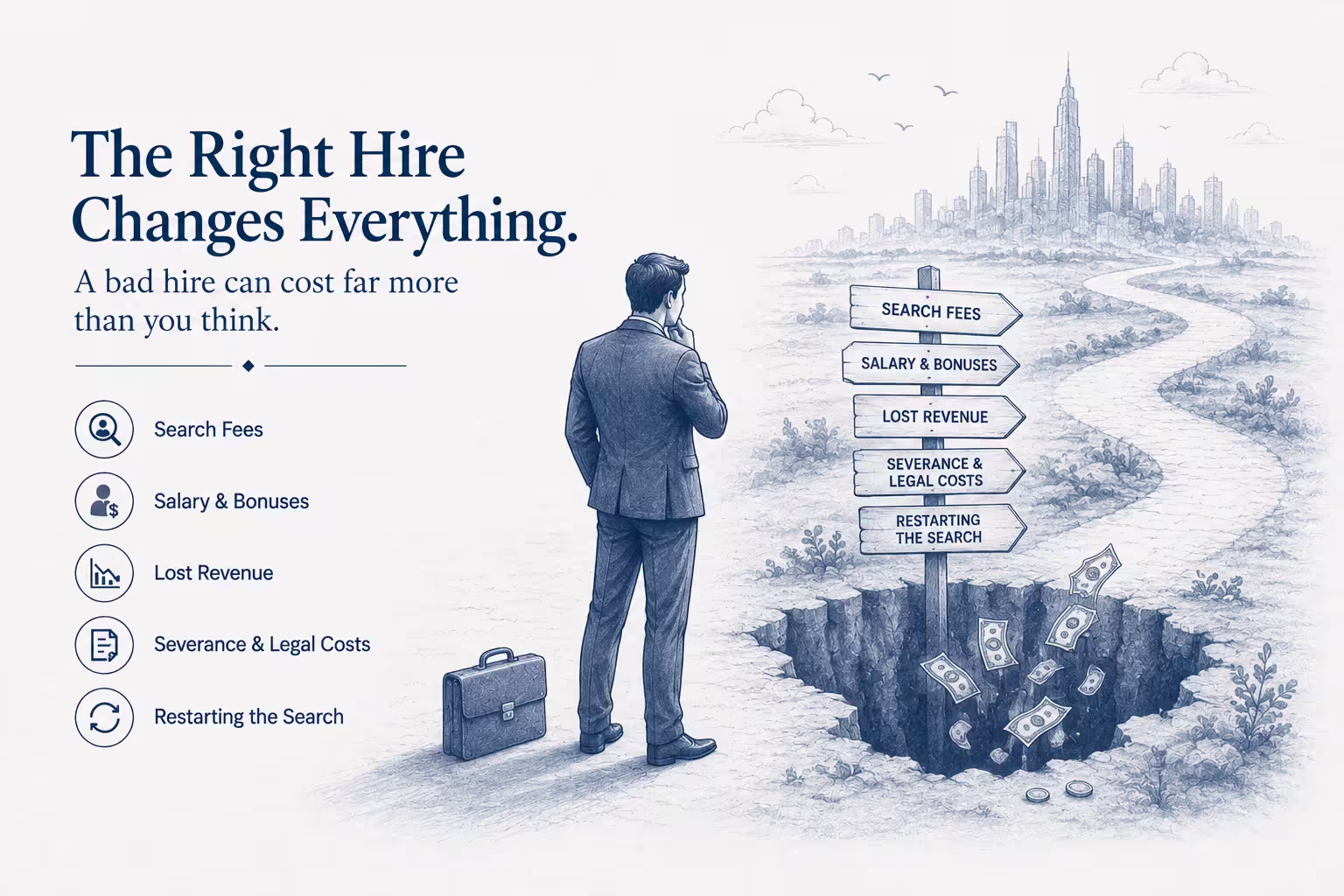
7. Who delivers the training, and what have they actually closed?
It is worth asking who is in the room. Not every trainer has carried a quota in enterprise tech. The ones who have teach differently.
The coaches and facilitators behind a program matter as much as the curriculum. Sales leaders and reps do not learn from theory. They learn from practitioners who have sat across the table from the same kind of buyers, handled the same objections, and built the same kind of pipeline. Credentials matter. Experience in enterprise sales matters more.
If the facilitator has never carried an enterprise tech quota, your system is being taught by theory, not practice.
Start Building Stage-Specific Sales Skills
TALSMART’s Tech Sales Mastery Program covers all five B2B tech sales stages with cinematic real-world stories, proprietary frameworks, and neuroscience-based learning. From $20.
What the Right Decision Actually Looks Like
The right B2B tech sales training program is not a course. It is a system. It diagnoses precisely where performance is breaking down, builds capability at those specific points, embeds coaching into live deal execution, and gives sales leadership the visibility to know whether any of it is working.
Generic sales training programs don’t help. They teach the same content to every rep, regardless of where that specific rep is weakest, and they assume awareness alone will change behavior on the next call. A sales training program built around diagnosis at each stage of the tech sales cycle instead of assumption does the opposite. It treats every rep’s gap as specific, measurable, and worth solving on its own terms. This is also the point where training stops being a line item and becomes part of a broader B2B tech sales strategy, one that ties skill development directly to pipeline outcomes rather than treating the two as separate conversations.
The teams that improve quota attainment quarter over quarter are not the ones that ran the most training sessions. They are the ones that built a structure where training compounds. Each rep gets better not just after the workshop, but in the field, on the next deal, and the one after that.
None of this means the earlier attempt failed because of anything you did wrong. Recognizing the gap now, before another quarter passes, is the fix beginning, not a failure being admitted.
The difference between a sales training investment that returns and one that disappears into the quarter is almost always the same thing. Whether coaching was embedded into the work, not bolted on afterward.
How Top 4% Performers Compare: The Benchmarks That Matter
| Metric | Average B2B Tech Team | Top 4% (TALSMART Benchmark) |
|---|---|---|
| Quota attainment | 42% | 72% to 78% |
| Deal cycle length reduction | Baseline | 34% faster |
| Training retention at 90 days | Below 20% | Above 70% with coaching |
| Pipeline stagnation | High in qualification stage | Reduced by 28% in 90 days |
| Revenue gap per underperforming rep | $240,000 per year | Closed within 6 months |
Source: TALSMART Revenue-Gap Diagnostic benchmarks across 4,200+ leaders in 100 + countries.
Build on Data, Not a Best Guess
Before you choose a training program, know exactly where your team’s performance gaps sit. Free. 20 minutes. Get Instant Report. No sales call required.
Frequently Asked Questions
How do you choose the best sales training program for a B2B tech company?
Start with a skill gap analysis to find exactly where your team is breaking down across the sales cycle. Then shortlist programs built specifically for B2B tech, not adapted from generic methodology. Check for stage specific depth, a reinforcement mechanism such as embedded coaching, training customization to your sales motion, and verifiable quota attainment data from similar clients before you commit.
What features should a B2B sales training program include?
Look for content built specifically for enterprise tech deals, depth at the sales stages where your team actually struggles, and a defined sales methodology rather than a collection of disconnected tips. Equally important are training customization to your buyer profiles and objections, a coaching infrastructure that reinforces skills after the session ends, and facilitators with real quota carrying experience in enterprise sales.
How can sales leaders measure the ROI of sales training?
Sales training ROI for B2B teams is measurable through quota attainment, deal cycle length, pipeline conversion rates, and ramp time for new reps during sales onboarding. Ask vendors for specific, verifiable client outcomes rather than testimonials. Globant reduced deal cycle length by 34 percent and doubled quota attainment in six months. Ugam cut pipeline stagnation by 28 percent in 90 days.
Why do most B2B sales training programs fail?
Most programs fail because they end at the workshop. Training without sales coaching embedded into real, live deals produces awareness, not behavior change. 87 percent of training is forgotten within 30 days without reinforcement. The content itself is rarely the problem. What happens after the training ends is what determines whether performance actually improves.
What role does sales coaching play in training effectiveness?
Sales coaching is the mechanism that makes training stick. It embeds what reps learned into live pipeline reviews and active deals, closing the gap between knowing a skill and using it under pressure. Programs that include embedded coaching hold skill retention above 70 percent at 90 days, compared to programs without it, which drop below 20 percent in the same period.
What makes enterprise sales training different from generic sales training?
Enterprise sales training is built for multi-stakeholder decision making, long enterprise sales cycles, technical buyer committees, and consultative selling complexity. Generic sales training teaches principles that apply across industries but does not account for this complexity. An enterprise sales training program built specifically for B2B tech goes deeper at the stages where complex deals actually stall.
TALSMART is a global revenue execution partner helping B2B technology companies accelerate growth across 100 + countries and 23 languages. Our Revenue Execution System, Diagnose, Build, Execute, Lead, is designed specifically to address the complexities of enterprise technology sales.