
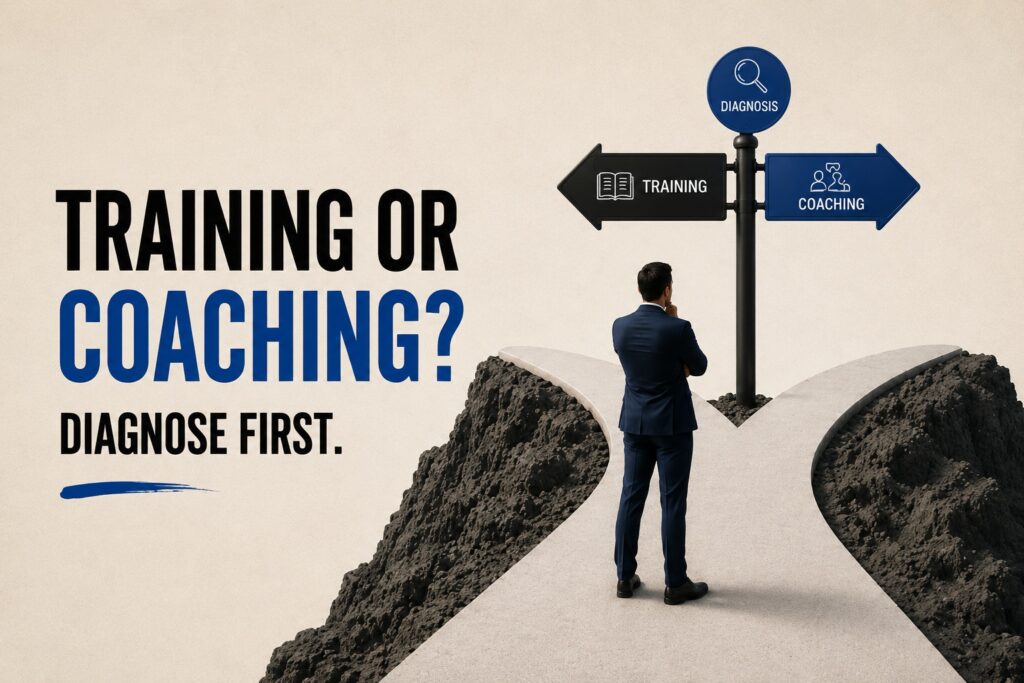
Most tech sales leaders facing a performance problem reach for one of two solutions. They either send the team to training or bring in a coach. Both feel like action. Both feel responsible. And in most B2B tech organizations, neither produces the sustained improvement that justified the investment.
If you have done both and still ended the quarter short, this is not a reflection of your judgment. The majority of sales coaching vs sales training decisions are made before the real problem has been identified. The intervention is chosen before the diagnosis has been done.
The belief that sales performance improves through better training or more coaching is understandable. Both matter. The problem is that neither works when applied to the wrong stage of the deal cycle, to the wrong rep, at the wrong moment. The question every B2B tech sales leader should be asking is not whether to train or coach. It is which stage is actually broken, and what precise intervention that stage requires.
Every B2B Tech Sales Leader Is Asking the Wrong Question
The sales coaching vs sales training debate dominates every revenue leader conversation about underperformance. Which matters more? Which should come first? Should we train first and then coach, or coach first and then train? These are real questions, but they are secondary to the one that should come before all of them.
The right question is not which intervention to choose. It is which stage of your B2B tech sales process is producing the performance gap. Because the answer to that question determines everything else. A rep whose deals stall in discovery does not have a training problem. They have a specific skill gap in uncovering business pain across multiple stakeholders. A rep who is prospecting brilliantly but qualifying poorly does not benefit from more coaching on discovery or negotiation. They need targeted capability building at the qualification stage.
The same logic applies at the organizational level. A B2B tech sales strategy built on generic training events and periodic coaching sessions will produce periodic improvements. A sales strategy built on diagnosing which stage is broken, for which reps, and then applying the right intervention there, produces compound improvement. The difference is sequence, not effort.
Sales reps who receive dedicated sales coaching see 16.7 percent higher revenue growth than teams who do not receive coaching. (Seismic Sales Enablement Research) That gap is not explained by coaching quality. It is explained by whether the coaching addresses the stage where each rep actually breaks down.
Why Sales Teams Miss Quota Even After Investing in Training and Coaching
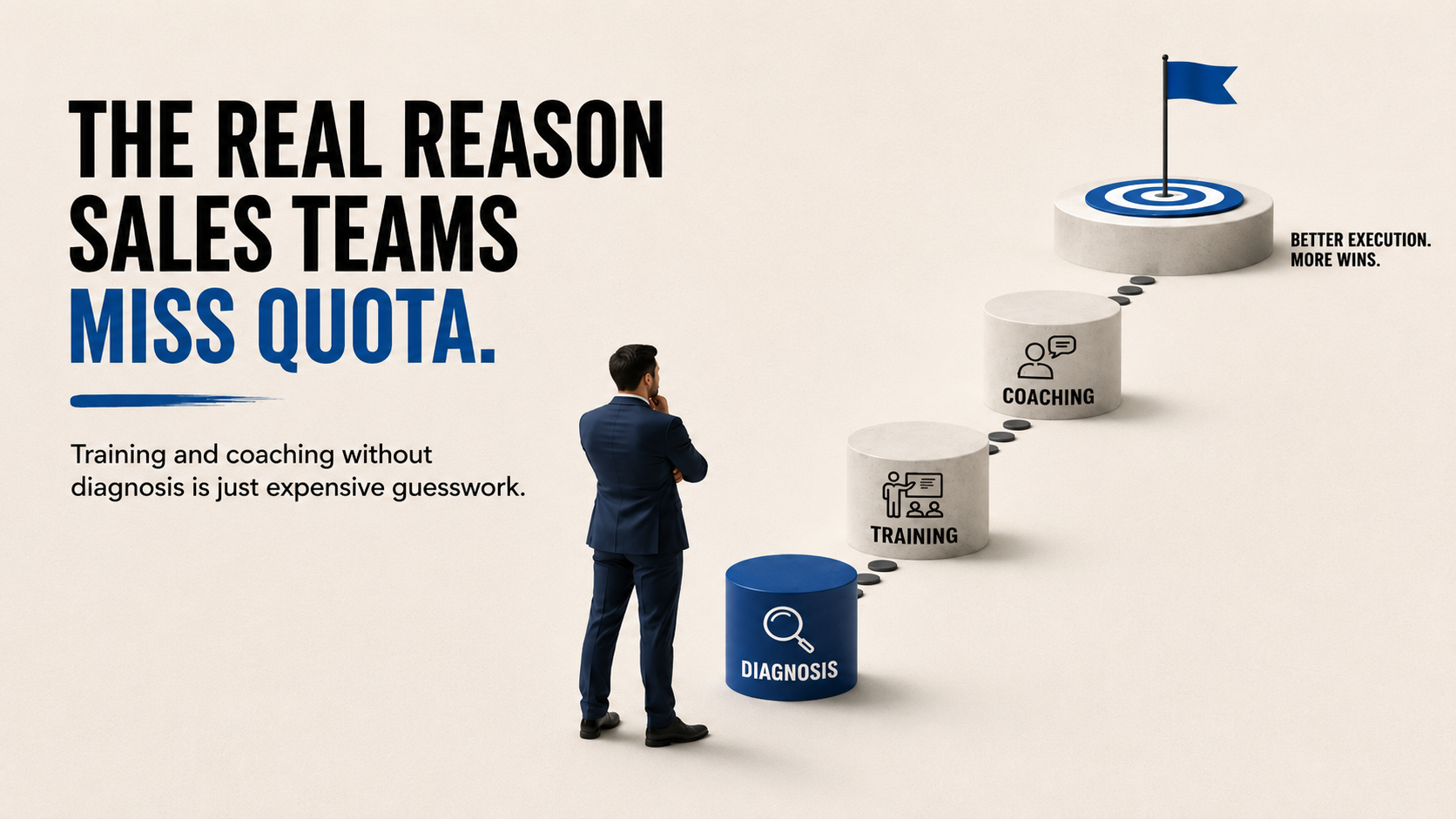
Eighty-seven percent of training content is forgotten within thirty days without reinforcement. (CSO Insights) Yet most B2B tech sales organizations continue to run team-wide training events and expect the improvement to sustain itself in the field. It does not, and the reason is structural.
Training transfers knowledge to a group. Coaching changes behavior in an individual. When they are applied in the wrong sequence, or to the wrong problem, neither produces its potential return. Sales training ROI evaporates when the training is applied to a skill the rep already has, or when it addresses a stage that is not where the rep’s performance is actually breaking down. Sales coaching fails to compound when the coach does not know which specific stage the rep needs to improve, because no assessment has been done to identify it.
The most expensive pattern in B2B sales development is running training when coaching is needed, and coaching when neither can work without a prior diagnosis. It is not waste that comes from poor intent. It is waste that comes from skipping the step that makes every other step effective.
Think about what happens when someone joins a gym without doing a fitness assessment first. They show up every day, work hard, spend time on the machines they feel comfortable with, and after three months wonder why the results are not matching the effort. The problem is not commitment. It is that they were training the muscles they already had, avoiding the weak ones, and nobody helped them see the difference. A personal trainer who steps in at week ten, without knowing which specific areas were neglected in weeks one through nine, has to start the diagnosis from scratch.
Sales development follows the same pattern. Reps attend training on the skills the program covers. Managers coach on what they observe in pipeline reviews. But if no one has mapped which specific stage each rep is breaking down at, the training and coaching land on the wrong problem. The rep improves in areas that were already adequate, while the stage that is actually losing deals goes unaddressed.
Which Stage of Your Sales Process Is Limiting Revenue?
The Revenue Gap Diagnostic identifies exactly where each rep is breaking down across all five B2B tech sales stages. Free. 20 minutes. Get Instant Report. No sales call required.
Effective sales enablement is not a series of training events followed by coaching sessions. It is a system that begins with identifying exactly where execution breaks down, then applies the right capability building and reinforcement at that precise stage. The order matters. And the diagnosis that determines the order is what most B2B tech sales organizations skip entirely.
Sales Methodologies Don’t Improve Performance by Themselves
MEDDIC. SPIN. Sandler. Challenger. Every year, B2B tech sales organizations invest in one of these frameworks, train the team on it, and measure the results ninety days later. In most cases, win rates do not improve meaningfully. Pipeline accuracy does not improve meaningfully. And the conclusion drawn is usually that the methodology was not the right one. The same pattern repeats with B2B sales coaching: organizations invest in coaching programs, see short-term improvement, and watch it fade within a quarter because the coaching was not connected to a stage-level diagnosis.
That conclusion is wrong. The methodology is rarely the problem. The problem is that every sales methodology assumes the rep already has the underlying stage-specific skill to execute it. MEDDIC assumes the rep knows how to qualify a buying committee. SPIN assumes the rep can run discovery across multiple stakeholders with diverging priorities. Sandler assumes the rep can manage buyer psychology while simultaneously navigating structural procurement friction.
A methodology organises the sales conversation. It does not create the capability to execute it. When that capability is missing at a specific stage, the methodology becomes a label attached to a broken process rather than a system that improves it. The sales training methods that produce lasting change are the ones aligned to the stage where the gap exists, not the ones that introduce a new framework on top of an undiagnosed problem.
A strong B2B tech sales strategy accounts for this distinction. It uses methodology as the framework and stage-specific capability as the foundation. When the foundation is weak at a specific stage, it targets that stage. When it is strong, it reinforces it through coaching on live deals. The methodology stays constant. The intervention changes based on where each rep needs it most.
Sales Performance Isn’t One Skill: It’s Five Different Skills
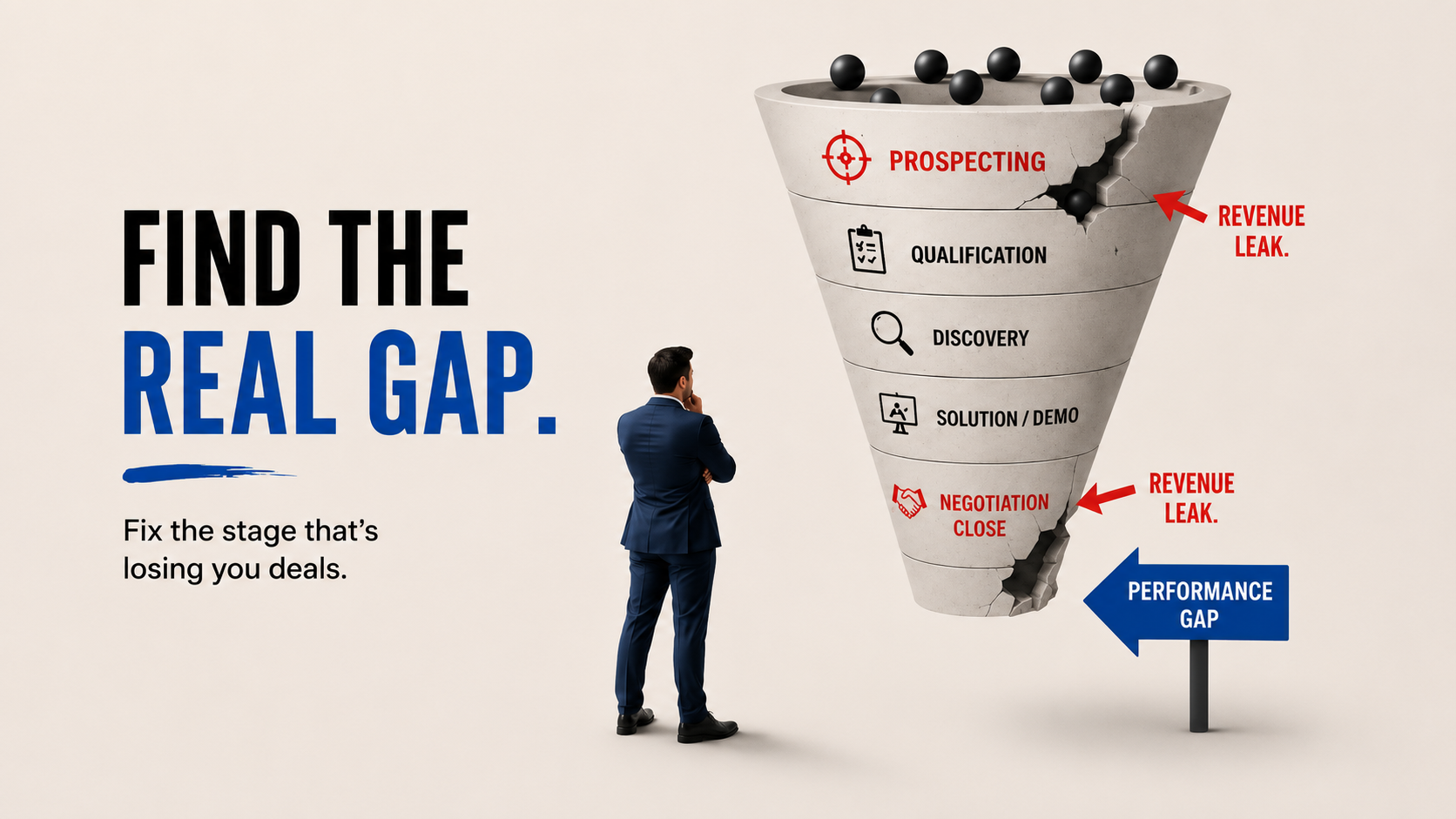
The most important insight in sales performance improvement is one that almost every training program ignores. Sales performance is not a single skill. It has five distinct capabilities, one per deal stage, each requiring a different competency, each producing a different failure mode when it is weak.
The five stages of the B2B tech sales process are Prospecting, Qualification, Discovery, Solution and Demo, and Negotiation and Close. Each stage has a core competency that determines whether the deal advances or stalls. Each stage can be strong in one rep and weak in another. And each stage requires a different intervention when the competency is missing.
| Sales Stage | Core Competency Required | What Breaks Without It |
|---|---|---|
| Prospecting | Intent Signal Intelligence – Differentiate active buying intent from static ICP fit using change matrix and trigger-event signals. | Reps fill the pipeline with accounts that will never convert, wasting qualification capacity downstream. |
| Qualification | Multi-Threaded Opportunity Qualification – Validate decision authority, stakeholder influence, procurement pathways, budget governance, and buying consensus. | Deals advance on champion enthusiasm alone and die at procurement, wasting months of team effort. |
| Discovery | Value Gap Quantification – Diagnose measurable business pain, quantify the cost of inaction, and align success criteria across stakeholders. | Proposals built for the champion get rejected by the buying committee, delaying cycles and reducing confidence. |
| Solution & Demo | Stakeholder-Centric Value Orchestration – Personalize the solution narrative to stakeholder priorities while demonstrating differentiated business outcomes. | Generic demos create interest but not urgency, causing deals to stall between proposal and decision. |
| Negotiation & Close | Commercial Value Defense – Protect pricing integrity by reinforcing business value, managing procurement tactics, and navigating commercial risk. | Margins erode while procurement extends timelines using playbooks reps were never prepared to handle. |
Every stage fails differently. Improving the wrong stage wastes budget and delays fixing the one that matters.
Every Salesperson Has a Different Bottleneck
This is the insight that makes the sales coaching vs training debate almost irrelevant until it is answered. Three reps sitting in the same training session have three different bottlenecks. Training all three on the same content develops the one rep for whom it is relevant and fails the other two.
| Rep | Strength | Bottleneck & Revenue Impact |
|---|---|---|
| Rep A | Prospects brilliantly, generating a strong pipeline volume. | Discovery fails to uncover business pain, so meetings lead nowhere. Revenue Impact: High volume, low conversion, with training investment delivering little return. |
| Rep B | Excels at Discovery, consistently surfacing genuine buyer problems. | Negotiation defaults to discounting under pressure. Revenue Impact: Revenue per deal continues to shrink quarter after quarter. |
| Rep C | Builds trust and consistently wins the Discovery stage. | Qualification advances unqualified opportunities that later fail at procurement. Revenue Impact: Pipeline appears healthy, but forecasts become unreliable. |
Training all three reps together on discovery techniques develops Rep B and produces almost no return for Rep A or Rep C. Each rep needs targeted intervention at their specific bottleneck stage.
Diagnostic Before Prescription
Consider how medicine works. A doctor does not prescribe medication before running a diagnosis. They examine the patient, identify the specific condition, and then prescribe the intervention appropriate to that condition. Prescribing the same medication to every patient regardless of the diagnosis would be considered negligent.
Sales leadership operates the inverse of this principle every day. A team misses a quota. The leader prescribes training. Or coaching. Or both. Before identifying which stage is broken, for which reps, and at what level of severity. The intervention is chosen before the diagnosis is done.
The result is the same as prescribing penicillin to a patient with a fracture. It is not harmful in the way a wrong medication might be. But it delays the treatment that would actually work, while creating the impression that something effective has been done. Revenue growth planning built on this model produces unpredictable results because the interventions are not connected to the specific causes of the performance gap.
The Missing Piece: Stage-Specific Sales Assessments
A skill gap assessment at the stage level is what makes the rest of the system work. Without it, training and coaching are both guesswork delivered with confidence. With it, every development investment is targeted to the stage that is producing the most deal loss, for the specific reps who need it most.
Stage-specific assessment maps each rep’s execution capability across all five deal stages. It identifies not just where a rep is underperforming, but why, and at what stage the chain of events that leads to a lost deal begins. A rep losing deals at negotiation is often revealing a problem that started at discovery. A rep with a weak pipeline is often revealing a prospecting competency gap that a qualification training program will never fix.
Know exactly where to coach before investing in more training
Stop Guessing Where Sales Performance Breaks Down
A stage-specific sales assessment pinpoints exactly where each rep begins losing deals across your sales process. Uncover the root cause of performance gaps, prioritise coaching with confidence, and invest in training where it will have the greatest impact.
What a Stage-Specific Assessment Actually Reveals
Most sales assessments tell you whether a rep is performing well overall. They don’t explain where performance starts to break down or which competency is limiting revenue.
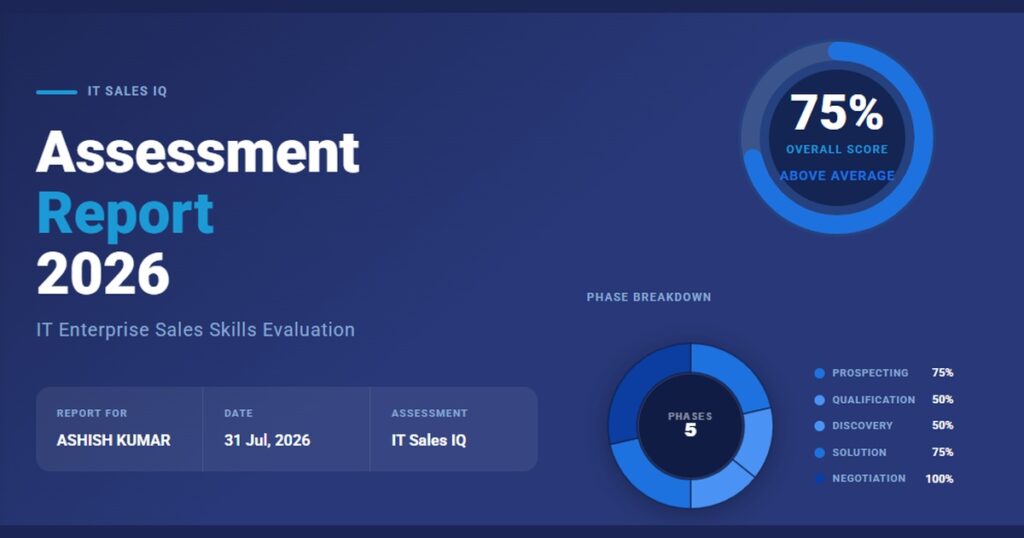
The Tech Sales Assessment evaluates every salesperson across the five critical stages of the B2B tech sales process: Prospecting, Qualification, Discovery, Solution & Demo, and Negotiation & Close. Instead of providing a single score, it benchmarks each stage independently, helping revenue leaders identify the exact competency gap affecting pipeline quality, win rates, and forecast accuracy.
The assessment doesn’t just highlight weaknesses. It recommends where managers should focus coaching, which capability requires targeted training, and which tool can help strengthen that stage before it impacts revenue.
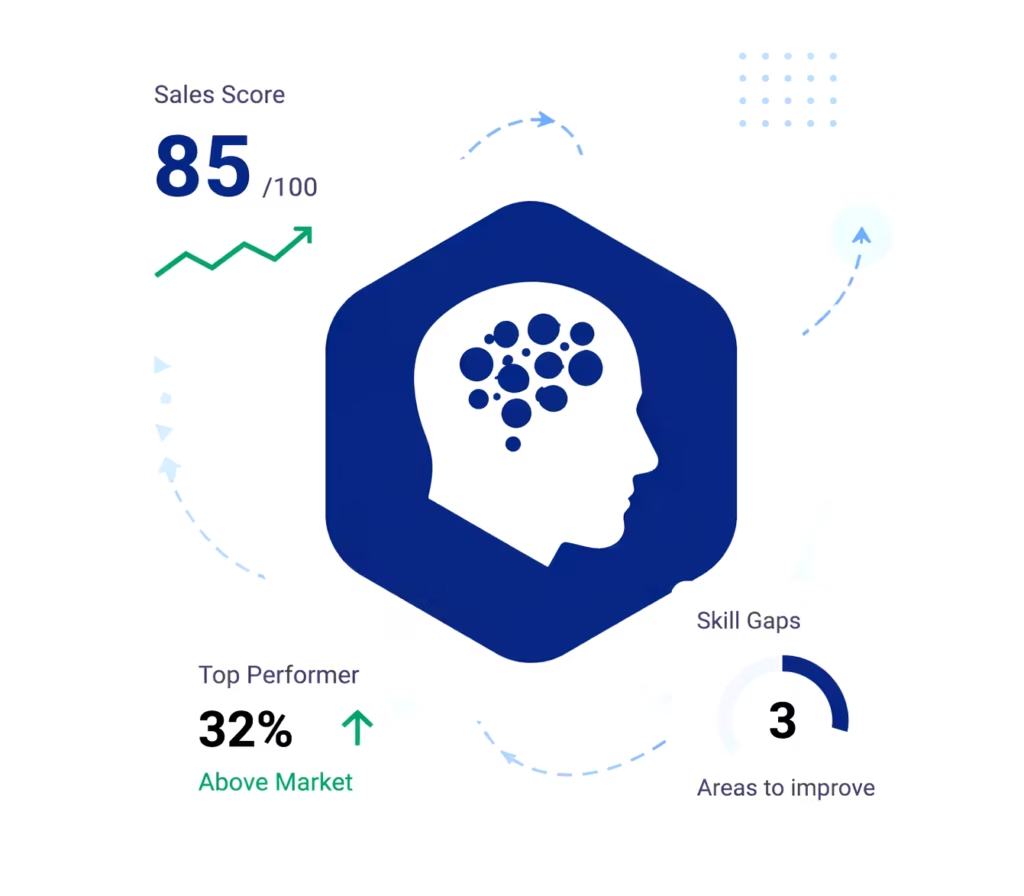
Below is an example of what a stage-specific assessment report looks like.
Example 1: Discovery and Negotiation Gaps Identified
| Sales Stage | Score |
|---|---|
| Prospecting | 92% |
| Qualification | 81% |
| Discovery | 38% |
| Solution & Demo | 74% |
| Negotiation & Close | 29% |
Diagnosis
The assessment shows that the biggest performance gaps are in Discovery and Negotiation & Close, limiting the rep’s ability to convert qualified opportunities into closed revenue.
Next Step
Strengthen negotiation capability with the Objection Intelligence System, designed to help reps prepare for common objections, defend value, and improve commercial conversations before they happen.
Example 2: Prospecting Gap Identified
| Sales Stage | Score |
|---|---|
| Prospecting | 34% |
| Qualification | 79% |
| Discovery | 84% |
| Solution & Demo | 81% |
| Negotiation & Close | 76% |
Diagnosis
The assessment shows that Prospecting is the primary bottleneck. Although the rep performs well in later stages, insufficient pipeline creation limits overall sales performance.
Next Step
Improve prospect targeting with the Prospect Research Tool, which helps reps identify genuine buying intent, prioritise high-potential accounts, and build a stronger pipeline.
From Diagnosis to Revenue Execution
A sales assessment identifies where each rep is struggling. But diagnosis alone doesn’t change behavior.
Performance improves only when every identified gap is reinforced through targeted practice, coaching, and measurement.
The three free tools below address the specific competencies that most frequently drive performance gaps in B2B tech. They are free, stage-specific, and built to give reps and managers an accurate picture of where to focus capability building before any training or coaching investment is made.
Prospect Research Tool
Prospecting in B2B tech is not a volume problem. It is a targeting problem. Most reps prospect into accounts that match an ICP profile on paper but show no active buying intent. The result is a high volume of outreach that produces a low volume of qualified conversations, which creates a pipeline that looks healthy and converts poorly.
Before a rep makes a single call, the Prospect Research Tool is built to solve this. A rep starts by entering the accounts they are considering targeting. The tool maps buying intent signals, recent company triggers such as leadership changes, funding rounds, and expansion announcements, alongside competitive context for each account. What comes back is not a ranked list of companies. It is a view of which accounts are showing genuine readiness signals right now versus which ones simply fit the firmographic profile. Reps use this before they build their outreach sequence, so the sequencing effort goes toward the accounts most likely to respond. Managers use it to review targeting quality before pipeline entries are created, preventing low-intent accounts from entering and consuming qualification capacity downstream.
The practical outcome is that reps spend their outreach time where real urgency exists. Pipeline entry quality improves. And the downstream stages, qualification, discovery, and proposal, are protected from being filled with deals that were never likely to close.
Free Tool: Prospect Research Tool
Identify accounts with genuine buying intent before investing outreach capacity. Maps intent signals, company triggers, and competitive context at account level so reps target readiness, not just ICP fit.
Lead Quality Analysis Tool
The qualification stage is where the largest performance gaps accumulate invisibly. When deals advance because a champion is enthusiastic rather than because a buying committee is aligned, reps spend three to four months on opportunities that were never going to close. By the time that becomes clear, the quarter is committed and the pipeline review looks worse than anyone expected.
The Lead Quality Analysis Tool is designed to surface this before it costs a quarter. A rep inputs the details of an active opportunity: the stakeholders they have spoken to, the decision process the buyer has described, and the risk signals they have observed. The tool assesses each deal against the criteria that predict whether it can actually close, specifically buying committee coverage, documented decision process, procurement risk exposure, and timeline credibility. What the rep receives is a clear assessment of which deals are genuinely qualified and which are being advanced on assumption. What the manager receives is a view across the full pipeline, showing where deal quality is strong and where coaching effort should be directed before the pipeline review meeting, not during it.
Reps who use this tool before their weekly pipeline review arrive with a clearer picture of which deals deserve their attention in the coming week and which should either be disqualified or moved to a nurture track. Managers who build this into their review cadence stop spending coaching time on deals that were never real, and direct that time toward the opportunities where it changes the outcome.
Free Tool: Lead Quality Analysis Tool
Assess each active opportunity against the criteria that predict whether it can actually close: buying committee mapping, decision process documentation, and procurement risk profile. Gives reps and managers a clear view of which deals are real before pipeline review.
Objection Intelligence System
Objections in B2B tech negotiation are rarely surprising if you know the buyer profile. Price pressure from procurement, security concerns from IT, legal markup from in-house counsel, and urgency challenges from finance follow predictable patterns by deal type and buyer segment. The rep who encounters one of these for the first time inside a live deal is unprepared. The rep who has mapped these objections in advance and built evidence-based responses to each of them walks into the same conversation with a different kind of confidence.
The Lead Quality Analysis Tool is designed to surface this before it costs a quarter. A rep inputs the details of an active opportunity: the stakeholders they have spoken to, the decision process the buyer has described, and the risk signals they have observed. The tool assesses each deal against the criteria that predict whether it can actually close, specifically buying committee coverage, documented decision process, procurement risk exposure, and timeline credibility. What the rep receives is a clear assessment of which deals are genuinely qualified and which are being advanced on assumption. What the manager receives is a view across the full pipeline, showing where deal quality is strong and where coaching effort should be directed before the pipeline review meeting, not during it.
Reps who use this tool before their weekly pipeline review arrive with a clearer picture of which deals deserve their attention in the coming week and which should either be disqualified or moved to a nurture track. Managers who build this into their review cadence stop spending coaching time on deals that were never real, and direct that time toward the opportunities where it changes the outcome.
The shift this creates is from reactive objection handling to proactive objection preparation. A rep who has already thought through the procurement team’s likely security concerns, and has the evidence ready to address them, handles that conversation differently than one who is working through it for the first time under deal pressure. That difference shows up in close rates and in margin protection.
Free Tool: Objection Intelligence System
Map the specific objections that arise at solution presentation and negotiation for your deal type and buyer profile. Builds structured, evidence-based responses so objection handling becomes preparation rather than improvisation under deal pressure.
Find Out Which Stage Is Costing Your Team the Most Deals
The Revenue Gap Diagnostic benchmarks your reps across all five B2B tech sales stages against the top 4% of performers globally. It identifies exactly where the gap sits before you invest in training or coaching. Free. 20 minutes. Get Instant Report.
The New Growth Model for B2B Tech Sales Teams
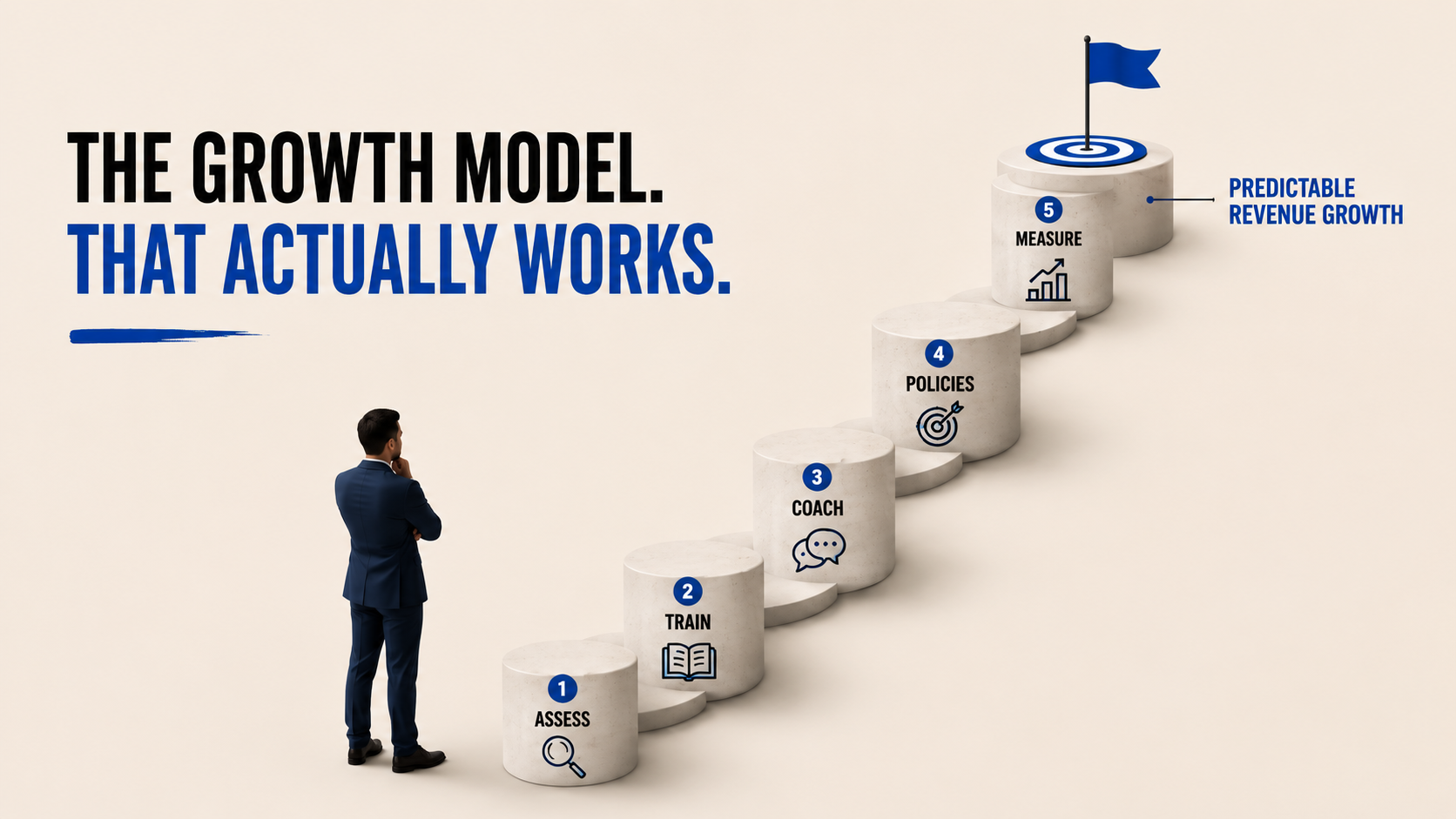
The five-stage growth model below is not a replacement for training and coaching. It is the sequence that makes both effective. The reason sales coaching techniques fail to compound and sales training ROI evaporates is almost always that either or both are applied without the diagnostic step that determines where they are needed.
| Stage | What Happens | Output |
|---|---|---|
| 1. Assessment | A stage-level skill gap assessment identifies exactly where each rep breaks down across the sales process. | An individual performance profile for every rep at every sales stage. |
| 2. Targeted Training | Deliver tech sales training aligned to the specific competency gap revealed by the assessment. | Reps develop the exact competency they need instead of a generic skill set. |
| 3. Stage-Specific Coaching | Apply sales coaching to live opportunities at the stage where each rep has the identified gap. | Skills become real-world execution rather than classroom knowledge. |
| 4. Practice | Practice account research, buyer conversations, and difficult sales scenarios until mastery. | Personalised reinforcement that improves confidence and increases close rates. |
| 5. Measurement | Track stage-level performance metrics instead of measuring overall quota alone. | Predictable revenue growth driven by measurable leading indicators. |
The sequence matters more than the investment size. A well-resourced training program applied without a prior assessment produces knowledge without application. A skilled coach working with a rep whose bottleneck stage has not been identified produces insight without direction. The growth model above produces compounding returns precisely because each stage of the model depends on the output of the previous one.
This is also where the sales coaching framework becomes meaningful rather than generic. B2B sales coaching that operates at the stage level, using real deal data, changes what a rep does in the next conversation. It maps directly to the buyer journey at the specific stage where that rep is losing deals. Sales coaching strategies that operate at the team level, without that stage-level precision, produce general awareness and temporary improvement.
Sales leadership coaching that operates this way produces a measurable change in team floor rather than a temporary lift in individual ceiling. The reps who were underperforming at specific stages move toward the team benchmark. The team benchmark moves toward the top performer standard. And the top performer standard becomes a system rather than an individual.
How High-Performing B2B Tech Companies Build Winning Sales Teams
The companies that combine Assessment + Training + Coaching + Practice Win
Goldman Sachs’s sales leadership ran a stage-specific assessment across their team before committing to any training or coaching investment. The assessment identified precisely which reps had gaps at which stages, which enabled the team to build targeted training plans rather than running a team-wide program. The same assessment framework was then used to benchmark new sales team hires during a period of rapid growth, ensuring that incoming reps met the competency standard at the stages where the existing team was already strong. (Revenue Gap Diagnostic)
Vertex used the same assessment approach as a hiring benchmark. Rather than relying on interview performance alone to evaluate sales candidates, they used stage-level competency scoring to identify which candidates had the specific capabilities their deals required. The result was a shorter ramp time for new hires and a measurable reduction in early-stage attrition among new sales team members. ( Revenue Gap Diagnostic)
Across more than 4,200 sales professionals in 100 + countries, a global benchmark of 4,200 plus professionals across 100 + countries has shown consistently that the teams with the highest performance consistency are not the ones with the best average rep. They are the ones with the clearest picture of where each rep’s bottleneck sits and a system that addresses each bottleneck with the right intervention at the right stage.
Before waiting for a full training program to be built, your sales team can start strengthening specific stage gaps today. The Prospect Research Tool, the Lead Quality Analysis Tool, and the Objection Intelligence System are three free diagnostic tools , each designed to give reps and managers an immediate action at the exact stage where performance is breaking down. Sales teams across 100 + countries have used these tools to create momentum in their pipeline while a more comprehensive assessment and coaching program is being built through TALSMART’s Revenue Execution System.
The teams that improve performance consistently are not the ones who invest most in training or most in coaching. They are the ones who invest first in knowing exactly where the problem is, and then align every subsequent investment to that answer. That sequence is available to any sales leader willing to prioritize diagnosis before prescription.
Tech Sales Mastery Program
The Tech Sales Mastery Program builds stage-specific capability across all five B2B tech sales stages. Neuroscience based. Stage by stage. Built to address the gaps that generic sales training programs leave open.
Top rated on Udemy. From $20
TALSMART is a global revenue execution partner for B2B technology companies, operating across 100 + countries and 23 languages. The Revenue Execution System is built exclusively for the complexity of enterprise technology sales.
Frequently Asked Questions
Is training vs coaching even the right question for a B2B tech team?
No. The right question is which stage of your sales process is producing the most deal loss, and which reps have the specific gap that stage requires. Sales coaching vs sales training is a secondary decision that can only be made effectively once a stage-level diagnosis has been completed. Applying training or coaching before that diagnosis produces investment without direction and results without predictability.
What is the real difference between sales coaching and sales training?
Sales training transfers knowledge to a group: frameworks, methodology, product understanding. Sales coaching changes behavior in an individual by applying what they know to a specific live deal situation. Training answers ‘do they know what to do?’ Coaching answers ‘why aren’t they doing it in this deal right now?’ Both are necessary. Neither is sufficient without the other, and neither works without a prior assessment that identifies which stage needs the intervention.
How do you know if your team has a training gap or a coaching gap?
Run a stage-specific skill gap assessment before making any development investment. If reps do not know the competencies required at a specific stage, that is a training gap. If they know them but are not applying them consistently in live deals, that is a coaching gap. The most common pattern in B2B tech is a qualification competency gap that gets treated as a coaching problem, and a discovery coaching gap that gets treated as a methodology training problem. A stage-level assessment removes the guesswork.
Why do sales teams still miss quota after MEDDIC or SPIN training?
Because every sales methodology assumes the rep already has the underlying stage-specific skill to execute it. MEDDIC assumes the rep can qualify a full buying committee, not just identify an economic buyer. SPIN assumes the rep can run parallel discovery conversations across multiple stakeholder groups. When those underlying competencies are missing, the methodology becomes a label attached to a broken process rather than a system that improves performance. The framework is not the problem. The missing capability is.
What should come first: sales training or sales coaching?
Assessment comes first. Without a stage-level diagnosis, both training and coaching are applied on assumption. With it, training addresses the specific competency gap identified at the specific stage where the rep breaks down, and coaching reinforces the application of that competency on a live deal. In that sequence, training delivers knowledge and coaching converts it into behavior. Dynamic coaching in live deals correlates with a twenty-one percent improvement in quota attainment and a nineteen percent improvement in win rates. (Ebsta x Pavilion, 2025) Those numbers are achieved when coaching follows targeted training, not when it replaces assessment.
Can sales coaching work without sales training?
Yes, and it often does, particularly when the rep has the underlying knowledge but is not applying it consistently under deal pressure. Coaching that surfaces blind spots and behavioral patterns in the context of a live deal produces real improvement even without prior formal training. But the combination is significantly more powerful. Training builds the knowledge base. Coaching converts it into repeatable field behavior. When both are aligned to the same stage, based on an assessment of where that rep actually breaks down, the improvement compounds across quarters rather than producing a temporary lift.